
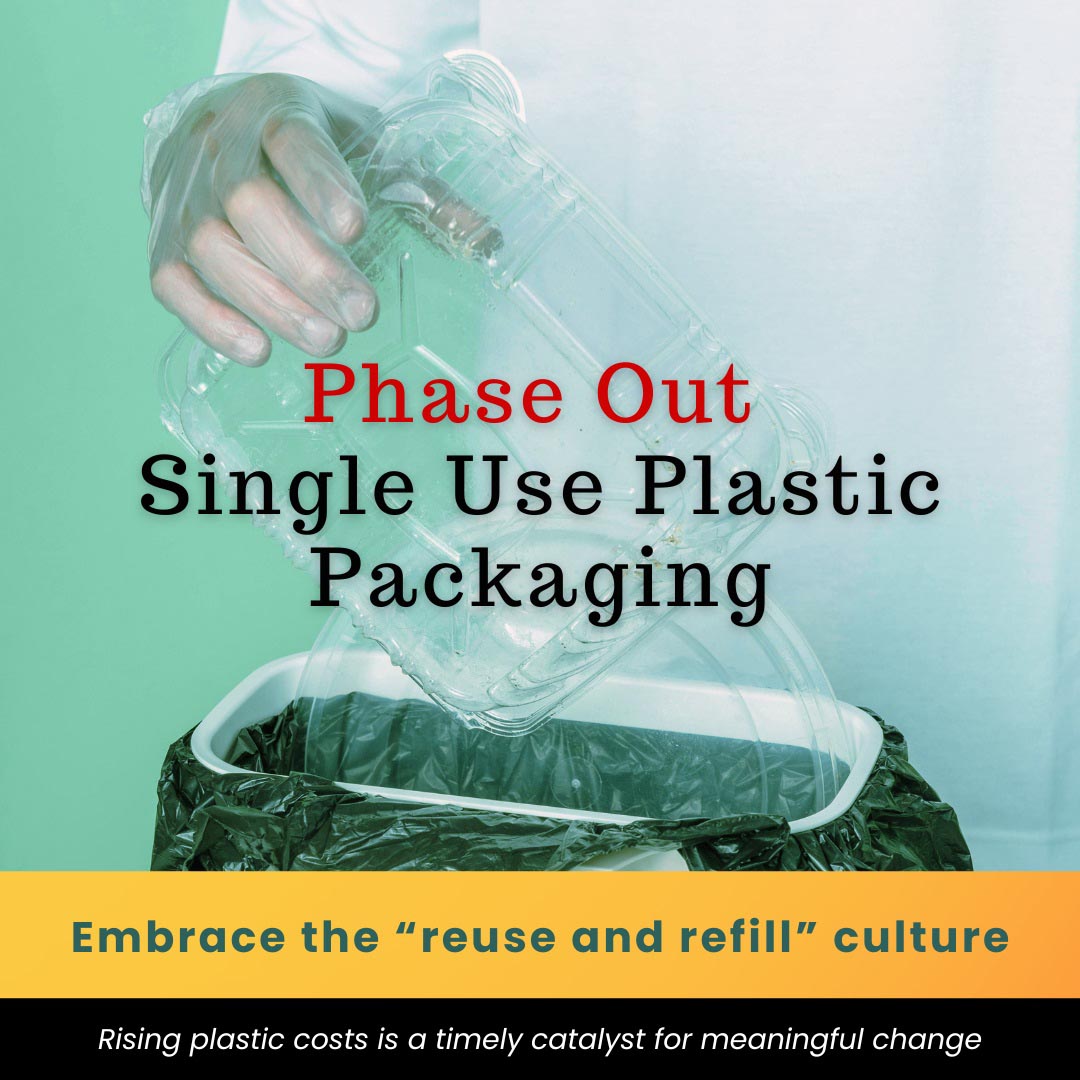
Rising Plastic Costs Demand an Urgent Shift Away from Single-Use Products and Plastic Packaging
The recent escalation in global oil prices, driven in part by ongoing geopolitical tensions in the West Asia, has contributed to an increase in the cost of plastic production. As most conventional plastics are derived from petroleum-based feedstocks, fluctuations in oil prices can significantly influence the cost of plastic packaging materials, which are widely used across the retail and food sectors.
The Consumers’ Association of Penang (CAP) views this development as both a challenge and an opportunity. The rising cost of plastics should serve as a timely catalyst for corporations to transition away from plastics, and traders, retailers and consumers to rethink entrenched habits, particularly the continued reliance on single-use plastic packaging. For too long, convenience has come at the expense of the environment and economic prudence.
Traders and businesses must now take the lead by phasing out the provision of single-use plastic packaging. This includes plastic bags, plastic takeaway containers, cutlery and excessive wrapping. Viable alternatives are increasingly available, ranging from reuse systems, refilling and reusable packaging systems. While some businesses may be concerned about losing customers who purchase takeaway food without bringing their own containers, the current rise in plastic costs emphasises that maintaining the status quo is no longer economically viable.
Equally important is the role of consumers. Behavioural change at the consumer level is critical to ensuring the success of any transition. Members of the public should be actively encouraged to bring their own containers, reusable bags and utensils when purchasing food or goods. This simple yet effective practice not only reduces dependence on single-use plastics but also helps consumers save money over time. Consumers should also recognise that the cost of packaging is ultimately borne by them as part of the purchase price.
Public awareness campaigns, incentives and clear policy direction can further accelerate this shift. Authorities should ban unnecessary, avoidable and harmful single-use plastics, provide incentives for businesses adopting sustainable packaging, and undertake educational initiatives to promote responsible consumption. The current increase in plastic prices can serve as a catalyst for meaningful behavioural change. A coordinated approach involving policymakers, industry players and consumers is essential.
The promotion of biodegradable plastics should be approached with caution, as their degradation is highly dependent on environmental conditions such as temperature, oxygen levels, moisture, and the presence of microorganisms. It is therefore difficult to make simple or generalised assessments as to which types are environmentally beneficial or otherwise. In some cases, these materials may merely fragment into microplastics, which persist in the environment and can enter the food chain, an issue that is already of growing concern.
Furthermore, biodegradable plastics are typically more expensive than conventional plastics, yet they may fall short of achieving the intended objective of reducing single-use plastic consumption.
Ultimately, the current situation highlights a broader truth: our overreliance on single-use plastics is both environmentally unsustainable and economically vulnerable to external shocks such as oil price volatility. By embracing more sustainable practices now, we can build resilience, reduce waste, and move towards a more circular and responsible economy.
The time has come to seize this opportunity to make lasting changes that benefit not only our economy but also the environment for future generations. Consumers should also be aware that many plastics take decades to hundreds of years to break down, during which time they fragment into microplastics that have been detected in the food chain and humans.
These realities demonstrate the urgent need for Malaysians to transition away from plastics. We should embrace the “reuse and refill” culture, and we urge consumers to use durable, non-toxic, and reusable products.
Mohideen Abdul Kader
President
Consumers’ Association of Penang
Letter to the Editor, 17 April 2026