
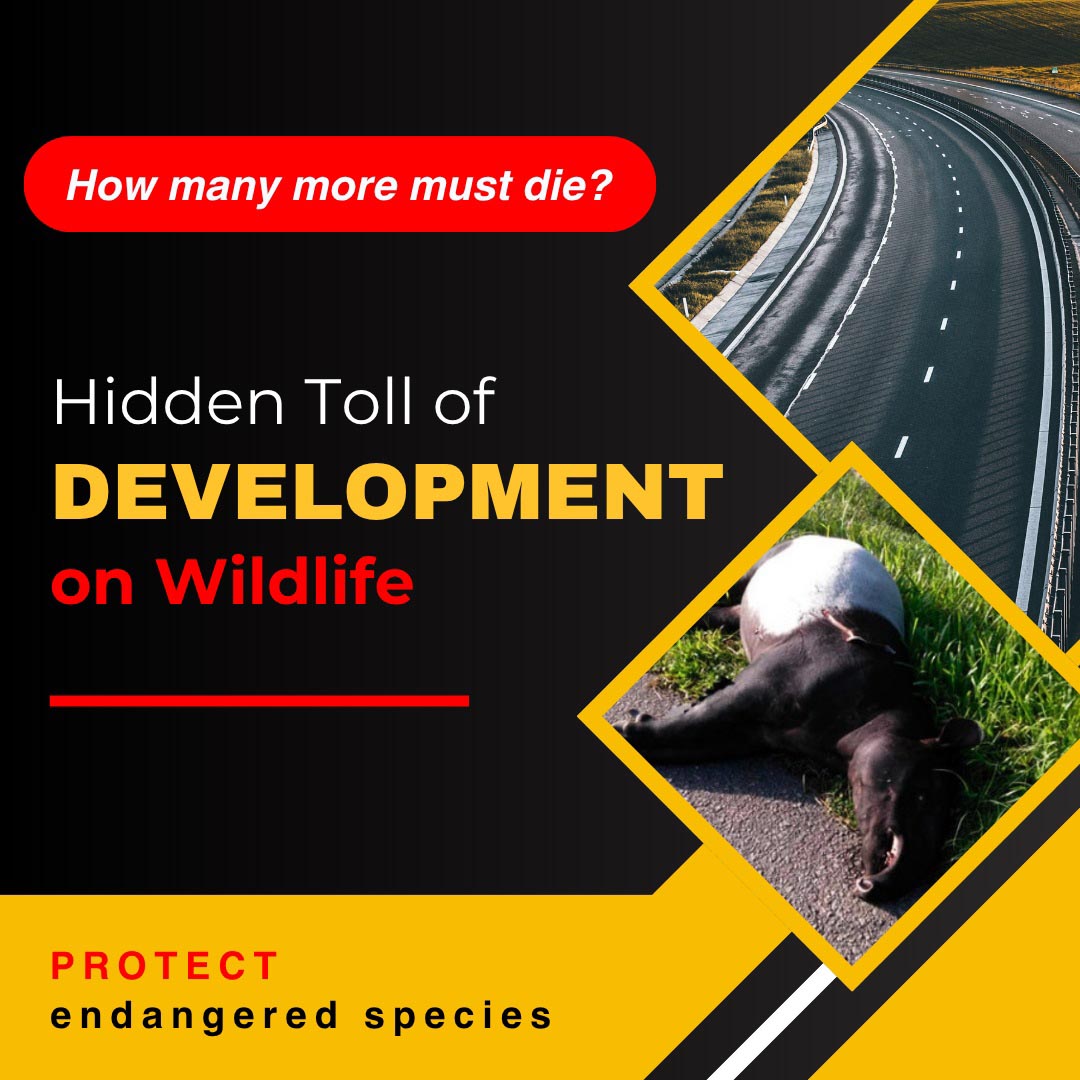
How Many More Must Die? The Hidden Toll of Development on Wildlife
The deaths of two more Malayan tapirs in Johor, found lifeless along a road connected to the Sedili–Desaru corridor, are not isolated tragedies. They are the predictable outcome of a development model that continues to treat wildlife as collateral damage.
That these incidents only came to public attention after footage circulated on TikTok on 20 March raises another uncomfortable question; how many such deaths go unnoticed, unrecorded, and unaddressed?
The Consumers’ Association of Penang (CAP) describes this as a glaring failure of conservation policy. For all the talk of “sustainable development,” the reality on the ground tells a very different story.
Wildlife crossings viaducts and underpasses are frequently showcased as evidence that environmental concerns are being taken seriously. But the continued deaths of endangered species expose a hard truth; these measures are being overstated and underperformed. They are not solutions in themselves, and when used as justification for clearing forests and pushing highways through critical habitats, they become part of the problem.
The issue is not simply whether such structures exist, but whether they work. And increasingly, the answer appears to be no.
Tapirs, which are already classified as endangered, rely on large, continuous tracts of forest to survive. Their natural behaviour involves moving across wide areas in search of food, mates, and shelter. When highways and development projects cut through these habitats, they disrupt long-established movement patterns. Expecting them to adapt neatly to man-made crossings which are often poorly sited, inadequately designed, or surrounded by noise and human activity, is not just unrealistic; it is irresponsible. As a result, wildlife is often forced onto roads, leading to fatal encounters with vehicles.
This recent incident underscores a deeper systemic issue: the failure of existing laws and policies to adequately regulate development in forested areas. While environmental impact assessments and mitigation measures are often required on paper, in practice they frequently fall short of ensuring meaningful protection for wildlife.
Current legal frameworks tend to focus on minimizing damage rather than preventing it altogether. This allows projects to proceed even when they pose significant risks to biodiversity, as long as some form of mitigation such as the construction of wildlife crossings is included. And yet, accountability remains elusive. After construction ends, who is responsible for ensuring that mitigation measures actually deliver results? Where is the data showing reduced wildlife mortality? Where is the transparency? Too often, it is absent.
As long as laws allow critical habitats to be fragmented in the first place, no number of underpasses will be enough. Once ecosystems are broken, their functions cannot simply be restored with concrete structures, and the ecological integrity of the landscape is fundamentally altered, pushing animals into increasingly smaller and more isolated patches of habitat. Over time, this leads to population decline and a higher risk of local extinction. The death of tapirs is not just the loss of a single animal, it is a symptom of a broader pattern of habitat loss and ecological imbalance.
The tapirs’ deaths should force a reckoning. Not another round of statements, not another promise of better planning — but a fundamental shift in how development is approached.
If Malaysia is serious about conservation, then certain lines must be drawn. Forests that serve as critical habitats cannot continue to be treated as land banks for future development. Avoidance, not mitigation, must become the first principle. Where risks to endangered species are high, projects should not proceed. Full stop.
At the same time, existing wildlife crossings must be reassessed with scientific rigour. Are they located along actual animal movement routes? Are they connected to intact forest on both sides? Are disturbances being minimised? Without evidence-based design and continuous monitoring, these structures will remain ineffective.
Ultimately, this is not just about tapirs. It is about the kind of environmental legacy we are choosing to leave behind.
Do we accept a future where iconic species survive only in fragmented pockets, constantly at risk, steadily declining? Or do we take seriously the responsibility of safeguarding the ecosystems that sustain them? The answer cannot remain rhetorical.
If current trends continue, the loss will not be gradual or abstract. It will be visible, measurable, and irreversible. And by the time we fully grasp the cost, it will already be too late.
Mohideen Abdul Kader
President
Consumers’ Association of Penang
Press Statement, 22 April 2026