
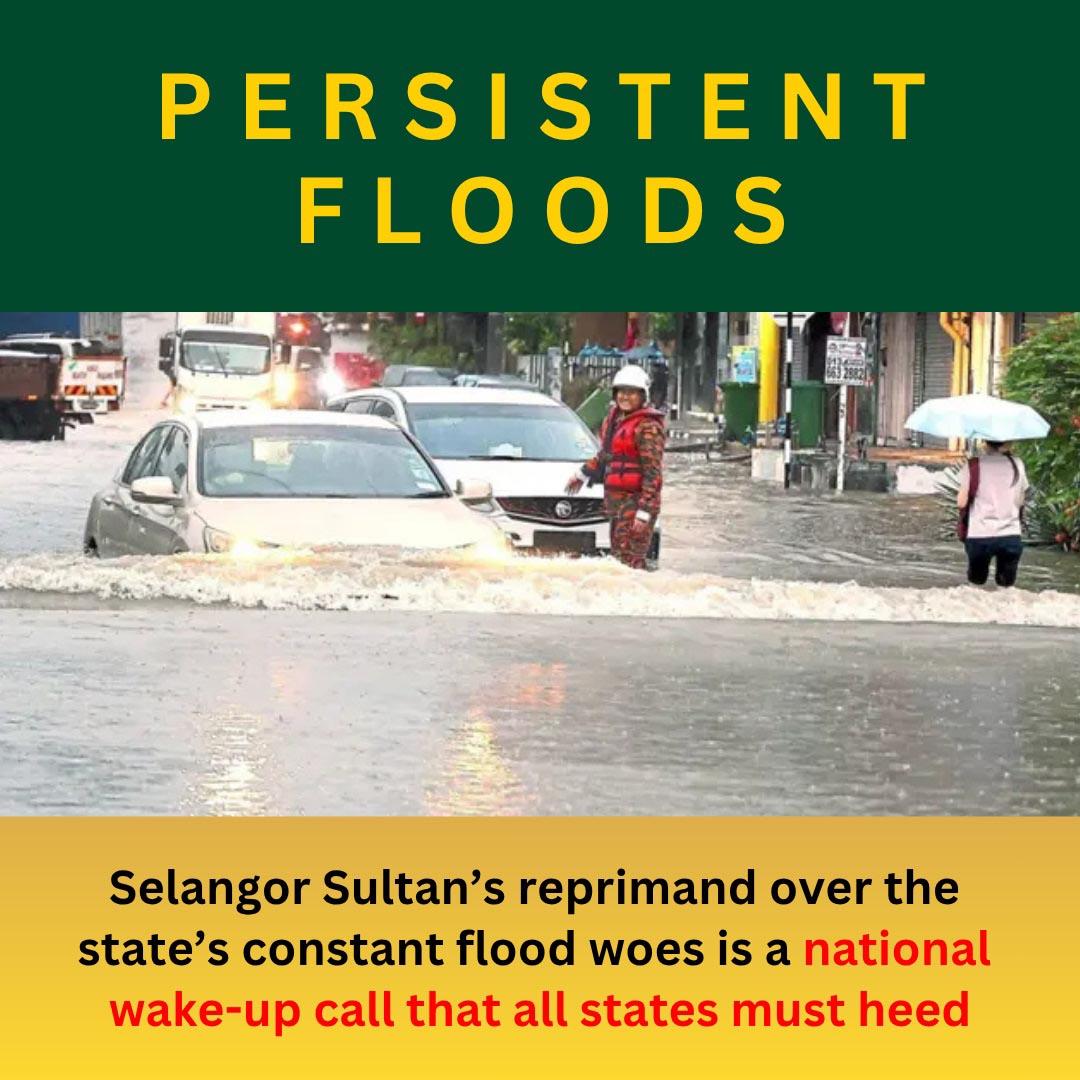
PERSISTENT FLOODS — A Reprimand that All States Must Heed
The reprimand by Sultan Sharafuddin Idris Shah over the persistent flood situation in Selangor should not be viewed as an isolated concern, but as a national wake up call for all state governments across Malaysia.
Flooding has become an increasingly frequent and severe challenge in many parts of the country, from urban centres to rural communities. Despite repeated assurances, budget allocations, and policy announcements, the reality on the ground suggests that flood mitigation efforts have often fallen short of expectations. The consequences are borne heavily by ordinary Malaysians through damaged homes, disrupted livelihoods, rising living costs, and growing public frustration.
The Sultan’s firm stance highlights a critical point: flood management cannot remain a reactive, seasonal exercise. It demands sustained political will, competent governance, and long-term, science-based planning. His earlier suggestion to seek expertise from countries such as the Netherlands, renowned for its advanced water management systems, points to the need for Malaysia to be open to global best practices rather than relying solely on fragmented domestic approaches.
All state governments must now take collective responsibility to:
- Prioritise integrated flood management strategies that combine infrastructure upgrades, river basin management, and land use planning;
- Restore flood plains, as removing or encroaching on them tends to worsen flooding, and ensure that river reserves serve as a protective margin between human activity and the river;
- Ensure transparency and accountability in the utilisation of funds allocated for flood mitigation;
- Strengthen coordination between federal, state, and local authorities to avoid duplication and inefficiencies;
- Accelerate the adoption of modern technologies, data systems, and climate resilient solutions;
- Engage communities meaningfully in preparedness and response efforts.
Equally important is the urgent need to address environmental degradation, such as deforestation, hill cutting, and unregulated development, which continues to exacerbate flood risks nationwide.
The directive to clean the Klang River further reflects the interconnected nature of flood mitigation and water resource management. Clean, well-maintained rivers are not only essential for water supply but also play a crucial role in reducing overflow and improving drainage capacity.
In essence, this call must resonate beyond Selangor. Every state in Malaysia should treat it as a reminder that the cost of inaction is far greater than the investment required to implement effective solutions. The time has come for decisive, coordinated, and results oriented action to safeguard the well-being of the rakyat and the resilience of the nation.
Mohideen Abdul Kader
President
Consumers’ Association of Penang
Letter to the Editor, 27 April 2026