
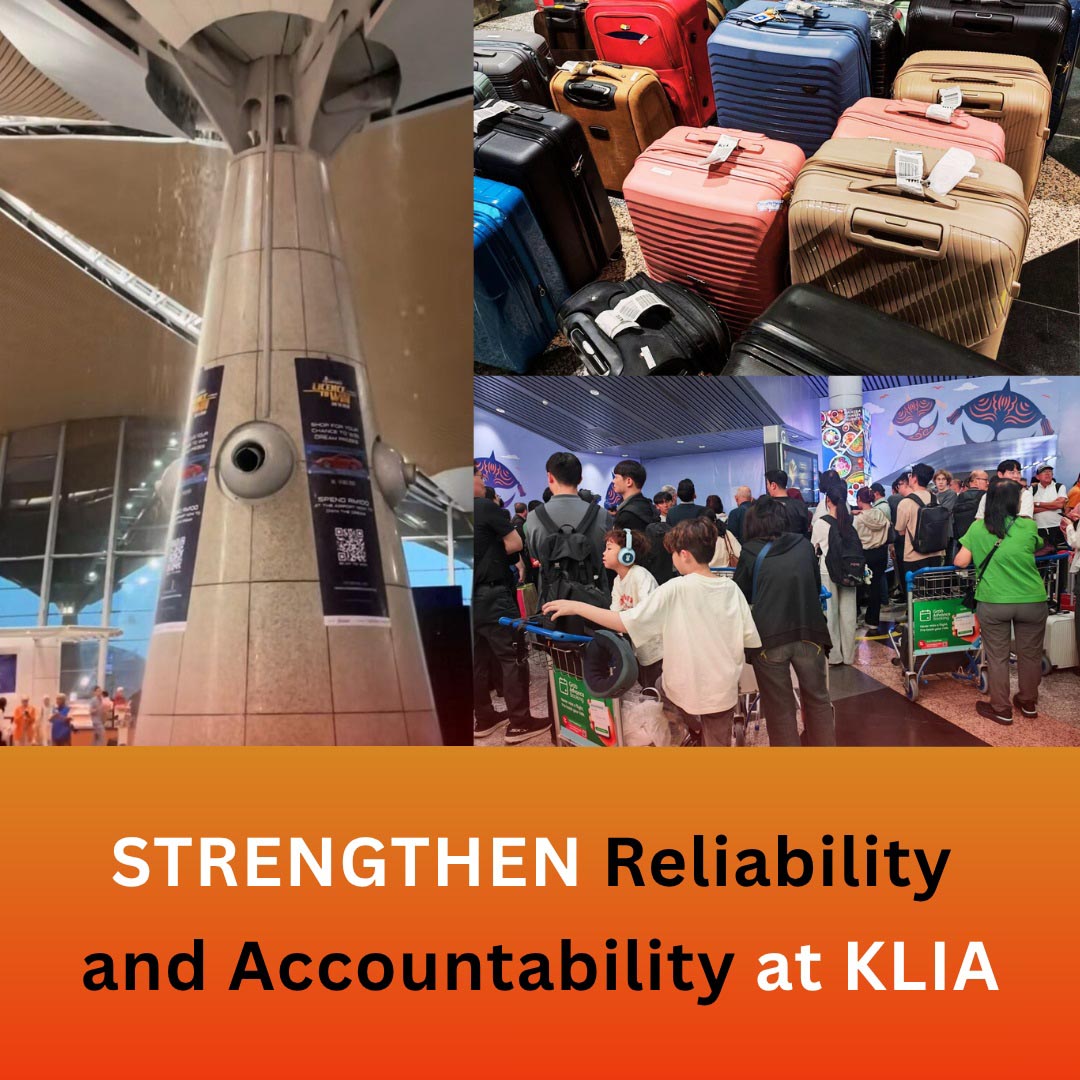
Strengthen Reliability and Accountability at KLIA
The Consumers’ Association of Penang (CAP) calls on the government to investigate recurring disruptions at Kuala Lumpur International Airport (KLIA), particularly those affecting the aerotrain and baggage handling systems. These incidents raise legitimate concerns about the effectiveness of maintenance and asset management practices. While such failures may indicate shortcomings in preventive maintenance, it would be overly simplistic to attribute them solely to this factor.
KLIA, which commenced operations in 1998, is now approaching three decades in service and remains the busiest airport in Malaysia. With annual passenger volumes recovering to around pre-pandemic levels, estimated at approximately 60 to 65 million passengers, it is operating under sustained and growing demand. Given its age and heavy utilisation, KLIA requires a more systematic, forward-looking maintenance regime rather than reliance on corrective or emergency repairs.
As the operator, Malaysia Airports Holdings Berhad (MAHB) bears responsibility not only for routine maintenance but also for long-term asset planning, timely system upgrades, and effective oversight of contractors. Many of the airport’s systems are ageing, and even well-maintained infrastructure requires periodic replacement or major refurbishment. Delays in these areas can increase the risk of operational disruptions.
At the same time, the performance of external vendors, procurement decisions, and budgetary priorities also play critical roles. Preventive maintenance is only one component of a broader ecosystem that includes lifecycle management, funding allocation, and operational strategy.
Taken together, the pattern of recurring issues suggests gaps not only in maintenance, but also in overall planning, coordination, and execution. Addressing these challenges will require a comprehensive approach that goes beyond routine servicing, encompassing stronger governance, clearer accountability, and forward-looking investment in critical airport systems.
There have been numerous reported incidents in recent years that warrant urgent attention:
- In April 2026, a reported power disruption at a regional substation affected the baggage handling system at KLIA Terminal 1, resulting in significant delays and requiring manual sorting by ground personnel.
- Reports of basic facility issues, including roof leaks, intermittent power outages, and deteriorating amenities, suggest that some assets may be operating beyond their intended design lifespan.
- With Malaysia’s total passenger traffic projected to continue rising sharply, airports such as those in Penang and Kota Kinabalu are experiencing increasing congestion. While expansion projects are underway, they appear to be catching up with demand rather than anticipating it.
- In April 2026, a reported system outage disrupted immigration clearance systems nationwide, including the National Integrated Immigration System (NIISe) and MyBorderPass QR facilities. This led to manual processing at key entry points, including KLIA and Johor land checkpoints, and caused prolonged delays.
- In November 2025, water leakage at KLIA Terminal 1 near the departure hall check-in counters highlighted possible shortcomings in contractor procedures. Maintenance and construction works in critical areas should incorporate proper weather risk assessment and safety protocols.
The Government should closely examine the systemic issues affecting Kuala Lumpur International Airport (KLIA), which is managed and operated by MAHB. In Malaysia alone, MAHB manages 39 airports. Given the critical importance of airport operations, where timing, safety, and reliability are paramount, these recurring disruptions may point to deficiencies in preventive maintenance, asset renewal planning, and operational oversight.
CAP urges the Ministry of Transport Malaysia to hold MAHB accountable and to accelerate both preventive and corrective measures. Without timely and decisive action, recurring failures will continue to undermine passenger confidence and may ultimately affect the efficiency and reliability of flight operations.
Mohideen Abdul Kader
President
Consumers’ Association of Penang
Letter to the Editor, 4 May 2026