
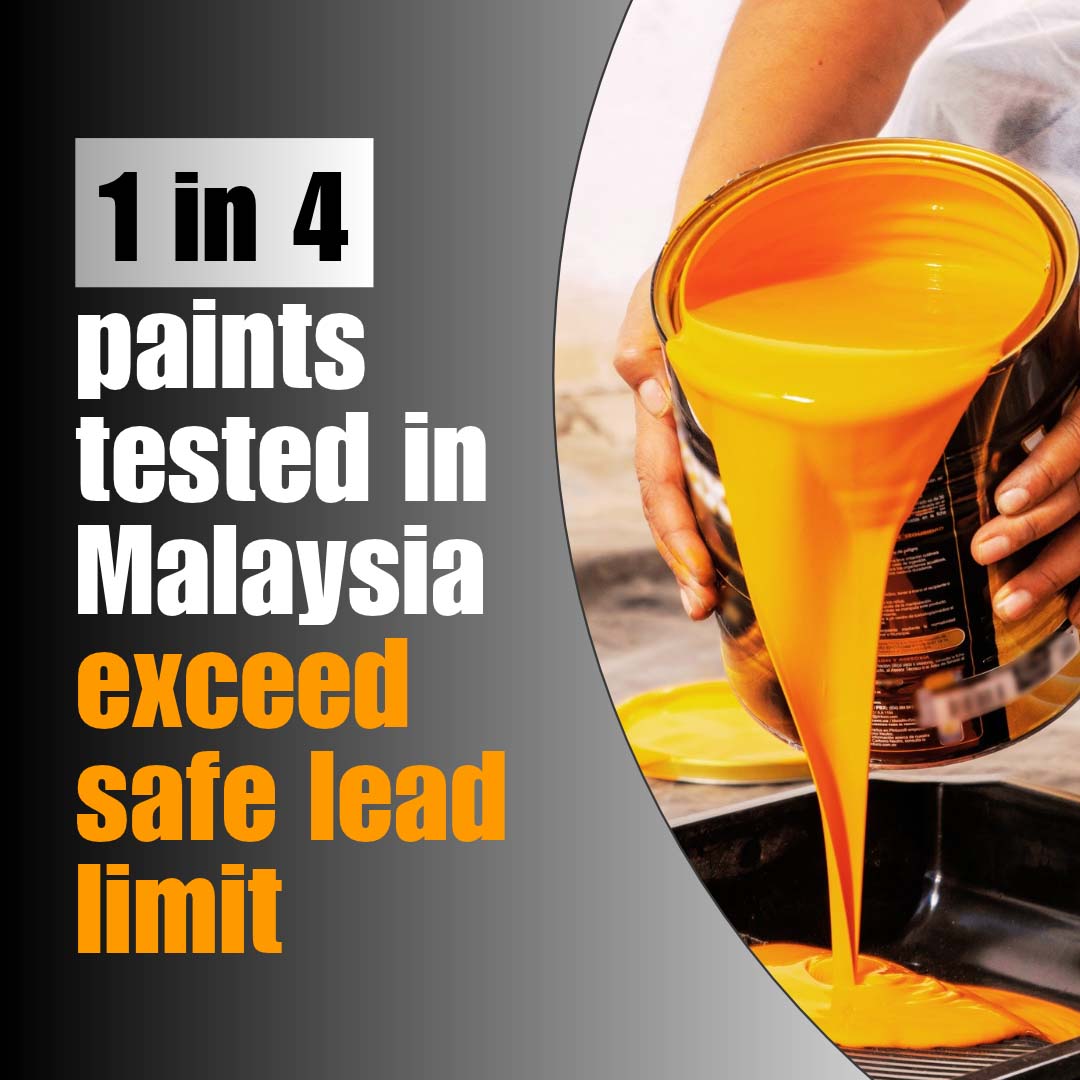
One in Four Paints Tested in Malaysia Exceed Safe Lead Limit as Industry and Consumer Groups Back Mandatory Standard
New study finds lead up to about 1,100 times the safe limit; coalition calls for Malaysia’s voluntary standard to be made mandatory
KUALA LUMPUR, 27 October 2026 — One in four household paints tested in Malaysia contain lead above the internationally recognised safe limit of 90 parts per million (ppm), according to a new market study released today by the Lead Exposure Elimination Project (LEEP), the Consumers’ Association of Penang (CAP) and the Malaysian Paint and Coating Manufacturers’ Association (MPCMA).
The study tested 122 decorative paint samples from 31 manufacturers, bought from retailers, hardware stores and online platforms across Peninsular and East Malaysia. Thirty-one samples (25.4%) exceeded 90 ppm, and 15 of the 31 manufacturers sold at least one paint above the limit. The highest reading, in a yellow paint, reached about 99,000 ppm, roughly 1,100 times the safe limit. Lead levels were highest in oil-based and aerosol paints, particularly in yellow and red shades.
More than 70% of the paints that exceeded the limit carried no lead information on the can.
Malaysia introduced a voluntary standard, MS 2762, in 2022, setting a 90-ppm limit on lead in decorative paint. Compliance is not legally required. The share of high-lead paints has fallen since CAP’s earlier studies in 2016 and 2022, and several manufacturers have reformulated successfully. But the new findings show that voluntary action alone has not removed lead paint from Malaysian shelves.
The coalition is calling for MS 2762 to be made mandatory.
Because lead-free alternatives are already commercially available, the cost of a mandatory standard is small. An independent Regulatory Impact Assessment (RIA) commissioned by LEEP puts the estimated total cost to industry and government at around US$11 million over 20 years in today’s money, less than a single year of the harm lead paint causes, however that harm is counted. Even under the assessment’s conservative scenario, the health and productivity benefits outweigh these costs by 4,059 to one.
These are preliminary, modelled estimates. No Malaysian study has yet measured how much lead exposure comes from paint, so the assessment uses a central estimate of 15%, triangulated from UNEP, WHO and IHME evidence, and a conservative scenario of 10% attribution to lead paint. Benefits would accrue gradually as compliant paint replaces older stock.
Lead exposure causes permanent damage to children’s developing brains, lowering educational attainment and lifetime earnings. In adults, it is linked to high blood pressure and heart disease. Symptoms are often mild or absent, so exposure frequently goes undetected. Lead paint becomes a hazard as it ages, breaking down into dust and flakes that children can swallow or inhale.
Mageswari Sangaralingam, Chief Executive of the Consumers’ Association of Penang, said, “Lead exposure, even at low levels, is a serious risk to human health, especially for children, whose developing brains are particularly vulnerable. Lead paint breaks down into dust and flakes that are easily ingested or inhaled, often unknowingly, causing lifelong cognitive and physical harm. We have tested and found lead in Malaysian paint for decades. It is time for the voluntary standard to be made mandatory.”
Prescilla Ngan, Honorary Secretary, MPCMA, said, “Many Malaysian manufacturers have already moved to lead-free production, proving that safe, high-quality and affordable paint can be made locally. MPCMA supports making the 90-ppm limit mandatory, with a reasonable transition period, so that every manufacturer competes on the same terms and every consumer is protected. Responsible manufacturers should not be undercut by those who continue to use lead.”
Ivan Mahardika, Program Manager at LEEP, said, ““The evidence is clear, and so is the solution. Malaysia already has the right direction in MS 2762. Making it mandatory is the step that will protect the next generation of Malaysian children. LEEP will continue to support the Government in this work, and we are offering free technical assistance to any manufacturer that wants to reformulate.”
The study is released as part of LEEP’s campaign for International Lead Poisoning Prevention Week. Full findings are available at leadelimination.org/Malaysia-Paint-Study-2026.
About the study: LEEP purchased 122 decorative paint samples, including oil-based, water-based and spray paints, from retailers, hardware stores and e-commerce platforms across Peninsular and East Malaysia. Where available, white, yellow and red shades were selected from each brand. The sample covers at least 85% of Malaysia’s decorative paint market. Dried paint samples were analysed by the Wisconsin Occupational Health Laboratory (WOHL), which is accredited under ISO/IEC 17025 and ISO/IEC 17043 and by the American Industrial Hygiene Association under the US EPA Environmental Lead Laboratory Accreditation Program. WOHL digested the samples in acid and measured total lead content by inductively coupled plasma optical emission spectrometry (ICP-OES), following NIOSH Method 7303. Results are reported in ppm dry weight.
About the RIA: LEEP’s independent Regulatory Impact Assessment estimates the costs and benefits of making MS 2762 mandatory over a 20-year horizon. It identifies the Trade Descriptions Act 2011 as the most direct route, with the Consumer Protection Act 1999 and the Environmental Quality Act 1974 as complementary measures. The assessment presents LEEP’s analysis and does not represent the position of any Government ministry or agency.
About LEEP: LEEP’s mission is to end childhood lead poisoning. We work globally to eliminate lead exposure at its source, by first identifying lead prevalence through market studies, supporting governments to introduce and enforce lead regulations, and assisting industries to transition to lead-free alternatives.
About CAP: Consumers’ Association of Penang (CAP) is a Malaysian consumer advocacy and public interest organisation focused on consumer rights, public health, environmental protection, and sustainable development.
About MPCMA: Malaysian Paint and Coating Manufacturers’ Association (MPCMA) is the principal industry association representing paint and coating manufacturers in Malaysia, supporting industry standards, technical collaboration, and regulatory engagement.
Click here for the PDF version:
https://consumer.org.my/wp-content/uploads/2026/10/261027-Press-Release.pdf
Press Release, 27 October 2026