No products in the cart.

Author: admin

alt

Immediately stop the sale of QBB ghee

The Consumers Association of Penang (CAP) calls on the Ministry of Domestic Trade, Cooperative  and Consumerism to immediately call for the withdrawal of sale of QBB ghee being sold in Malaysia. This is in view of the fact that the halal status of the ghee has been withdrawn by the Jabatan Kebangsaan Islam Malaysia (JAKIM) on the grounds that it contains doubtful elements. CAP has been...
Read More

Make halal certification for hotels mandatory

Consumers Association of Penang (CAP) views with concern recent media reports that a majority of hotels in Malaysia still do not have halal certificates from the Department of Islamic Development, Malaysia or JAKIM. A news report in a Malay daily yesterday (Aug 18, 2010) said the Ramadan buffet food served at 70% of the hotels in the Klang Valley are not halal, and in some instances, even...
Read More
rhodamine

After 37 years, cancer-causing agent still in food

The Ministry of Health is making a mockery of the Food Regulations as the use of Rhodamine B in food is still rampant in spite of it being banned. CAP first detected the presence of Rhodamine B in belacan in 1973 and since then tests conducted in 1983, 1993, 1995, 1999, 2000, 2001, 2002, 2007 and 2008 have still found this dye to be present in belacan and other foods.   On each occasion...
Read More
codex

Corporations rule our food rules: WHO/FAO Compromises International Food Standards

Who decides on what can be added to our food or what food is considered safe for consumption? Whether in Malaysia, China or Australia, Governments have to follow the Codex Alimentarius, rules set up by the WHO and FAO which are policed by the WTO (World Trade Organisation). This is supposed to facilitate free trade. But the Codex Alimentarius which is supposed to protect consumers with safe food...
Read More
alt

CAP welcomes Polystyrene ban In Penang

The Consumers’ Association of Penang (CAP) welcomes the Penang State Government’s decision to enforce a ban on polystyrene starting 1st January, 2011.  The ban is expected to cover all food premises and temporary hawking sites owned by local councils in the State. The ruling is indeed laudable because the biggest environmental health concern associated with polystyrene is the...
Read More
bloody-rubbish

Horrors in our markets

The Consumer’s Association of Penang (CAP) urges the Majlis Perbandaran Pulau Pinang (MPPP) to immediately clean up and beautify all wet markets in Penang which are in deplorable conditions of filth and poor hygiene. In a survey of wet markets carried out by CAP in Chowrasta, Central, Bayan Baru, Ayer Itam, Pulau Tikus, Jelutong, Riffle Range, Taman Tun Sardon, Padang Tembak and the old...
Read More
rice

Is our rice safe from banned endosulfan?

The Consumers Association of Penang is appalled by the Pesticide Board not taking action to eradicate the pesticide endosulfan. Endosulfan, a highly acute toxin and a suspected endocrine disruptor, was banned in 2005 under the Pesticides Act 1974. In a letter to CAP dated 17th October 2008, the Pesticide Board informed us that the registration for endosulfan was terminated in 15th August 2005....
Read More
boric-acid1

25 years of inaction: Boric acid still in food

The Consumers Association of Penang (CAP) is shocked that banned boric acid is still found in food, in spite of our numerous calls to the Ministry of Health for the last 25 years to take action on the issue. CAP’s latest test on various types of food such as Bak chang (Chinese dumpling), yellow noodles and Nyonya kuih found boric acid to be present in all the samples tested. Bak chang...
Read More
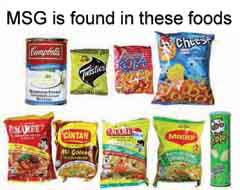
msg-food1

Is MSG safe?

Monosodium Glutamate (MSG), a popular flavouring substance commonly used in home-cooked and restaurant foods — as well as in most processed, packaged and frozen foods — is a long-trusted food seasoning in Malaysia. The food industry tells us it’s “natural” and “safe”. But eater, beware: A growing mountain of evidence indicates that MSG may be more toxic...
Read More

Don’t milk the school milk scheme

Recently, repeated cases of food poisoning among schoolchildren after consuming milk under the school milk scheme forced authorities to put a temporary halt to this scheme. However, the scheme resumed in June - following checks and assurances that the milk scheme was up to standard. Unfortunately, food poisoning incidents are surfacing again in spite of the additional precautions taken by the...
Read More