
Call for Transparency in Malaysia’s Highway Concession Agreements
It has been almost forty years since Malaysia first introduced tolled roads as part of its national privatisation drive, and the Consumers’ Association of Penang (CAP) is now calling on the government to declassify highway concession agreements as a step towards greater transparency in decision making.
The shift towards tolled highways was driven primarily by practical and fiscal considerations. At the time, the government faced significant financial constraints and lacked the resources to build the extensive highway network required to support economic growth. By introducing toll concessions, highway development could be accelerated without placing additional strain on the federal budget. Equally important was the desire to tap into private sector capital, technical expertise and operational efficiency.
The concession agreements governing tolled highways are typically long term in nature. They often span between thirty and fifty years, or continue until the concessionaire has recovered its investment together with an agreed rate of return. A central feature of these contracts is the toll rate mechanism, which sets out when and how tolls may be reviewed. Adjustments are often linked to factors such as inflation or traffic volumes, although any increase may still be subject to government consent.
Some agreements also include provisions relating to traffic volume guarantees. These are intended to protect investors by providing compensation if actual traffic falls below agreed thresholds, thereby reducing the financial risk associated with uncertain usage levels. In addition, the contracts commonly provide for government support or compensation in specific circumstances. Where government policy decisions, such as freezing toll rates for political or social reasons, reduce the concessionaire’s expected revenue, the agreement may require the government to compensate for those losses.
The agreements also spell out the conditions under which a concession may be terminated early. These clauses define events of default, the rights of both parties and the method for calculating compensation or buy out amounts should the government choose to end the concession before its natural expiry.
Despite their clear public impact, some concession agreements remain classified under the Official Secrets Act (OSA). As a result, no part of such an agreement may be disclosed to the public without the consent of both the government and the concessionaire. Even where classification has been lifted, most agreements still contain strict non disclosure clauses based on commercial confidentiality, which continue to prevent their wide publication without the consent of the concessionaires. In addition, concession agreements themselves usually include confidentiality provisions, meaning that even if the government is inclined towards disclosure, it may still require the consent of the private party to avoid breaching contractual obligations.
In practical terms, classification under the OSA does not necessarily mean that the public can never see these contracts. Rather, it means that without explicit approval from the government and the concessionaire, or a formal decision to reclassify the document, the full text cannot be freely published or widely distributed. There have been repeated attempts to push for greater transparency. Around 2008, efforts were made to reclassify toll concession agreements so that they could be inspected by the public, albeit under controlled conditions.
More recently, lawmakers, including Members of Parliament, have called for full declassification of agreements such as the PJD Link concession so that their terms and value for money can be examined by Parliament and the public. These calls have so far been resisted on the grounds of the OSA and contractual confidentiality, even as transparency advocates continue to argue that toll concessions are major public contracts that deserve full and open disclosure beyond limited physical inspection.
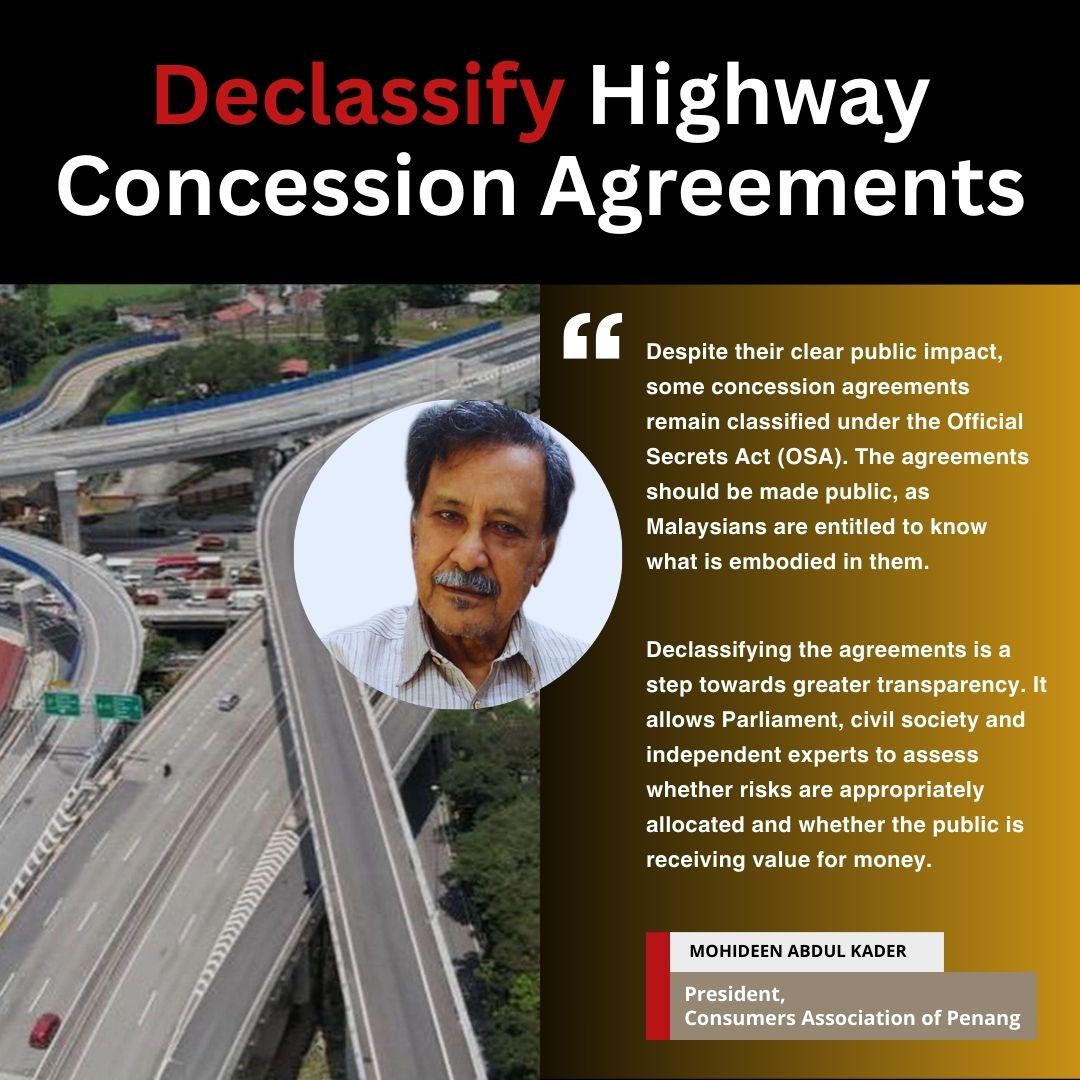
CAP maintains that such concession agreements should be made public, as Malaysians are entitled to know what is embodied in them. It also questions the logic of compensating concessionaires when actual traffic falls below agreed thresholds, noting that risk is an inherent element of any business venture, particularly when the contractual basis for such compensation is withheld from public scrutiny.
Beyond calling for the declassification of highway concession agreements, CAP also urges the government to take over control of highway once a concession agreement comes to an end. In many jurisdictions, public private partnership contracts are published, with only narrowly defined commercially sensitive sections redacted. Such transparency allows Parliament, civil society and independent experts to assess whether risks are appropriately allocated and whether the public is receiving value for money. If Malaysians are expected to bear the fiscal consequences of these agreements, it is reasonable that they should be able to see the terms that created those obligations.
Mohideen Abdul Kader
President
Consumers’ Association of Penang (CAP)
Letter to the Editor, 13 January 2025