
CAP’s Deep Concern Over Escalating Corruption
The Consumers’ Association of Penang (CAP) expresses grave concern over the increasing number of individuals charged in court for corruption related offences from 2025 through to early 2026. The sums involved run into billions of Ringgit, funds that could have benefited Malaysians through the maintenance or upgrading of infrastructure, rather than being uncovered by Malaysian Anti-Corruption Commission (MACC) officers in the form of unaccounted cash, valuables, assets and bank accounts.
In 2025 alone, MACC recorded more than RM8.4 billion in asset recovery actions, over 1,100 arrests and nearly 200 convictions as it intensified its crackdown on corruption, abuse of power and financial crimes. During the same year, the MACC opened 6,114 investigation papers, carried out 966 arrests, filed 1,128 charges, secured 445 prosecutions and obtained 189 convictions. Of those arrested, 423 were public servants, 163 were from the private sector, 504 were members of the public, 34 were linked to government linked companies and four were politicians.
More recent cases include former senior military leaders, with an ex-Army Chief charged for money laundering and former Armed Forces Chief charged for abuse of power, criminal breach of trust and accepting bribes. Through such alleged activities, those who are meant to benefit from public projects are instead deprived of them. This marks the first time in Malaysian history that individuals holding the nation’s highest military leadership positions have been formally charged with corruption and related offences.
Corruption is often associated with individuals in positions of power who are able to fulfil the demands of those offering bribes. As such, corruption can permeate any position or rank, as seen in the recent case involving the Director-General and Deputy Director-General of the Department of Environment, together with an assistant environmental control officer, who were remanded over alleged abuse of power and corruption linked to electrical and electronic waste (e-waste) management.
The illegal importation of e-waste endangers the country’s environment and public health through toxic pollution, while further intensifying the need for proper and safe disposal.
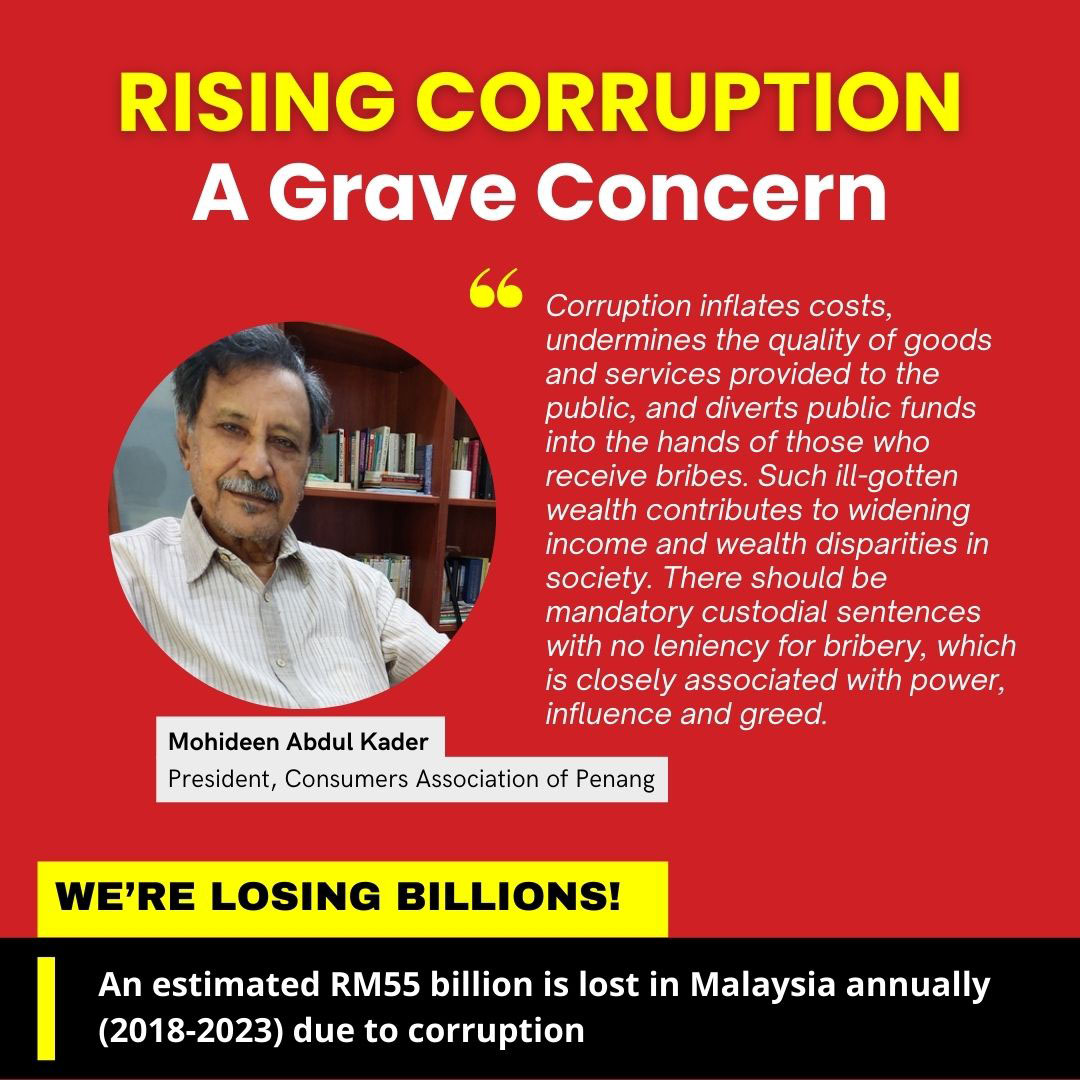
We welcome the increasing number of high-profile corruption cases being uncovered, particularly as Malaysia is estimated to have lost about RM55 billion annually between 2018 and 2023 due to corruption. Such ill-gotten wealth also contributes to widening income and wealth disparities in society. When corruption is widespread, foreign investors are deterred from operating in the country, fearing higher operating costs and reduced profits.
Malaysia must do more to encourage whistleblowers to come forward. In this regard, CAP suggests revisiting the book Questioning Arms Spending in Malaysia by Dr Kua Kia Soong, which raises critical issues on transparency and accountability in defence expenditure.
As the military is a nation’s key asset and serves as the frontline in protecting national sovereignty, any weakness or instability signals vulnerability to external threats. Corruption among those entrusted with safeguarding the country represents a betrayal of trust of the highest order, as it directly undermines national security.
CAP abhors all forms of corruption, as it inflates costs, undermines the quality of goods and services provided to the public, and diverts public funds into the hands of those who receive bribes. We call for mandatory custodial sentences with no leniency, as bribery is closely associated with power, influence and greed. This must be clearly distinguished from minor offences such as shoplifting, which are often committed out of poverty, desperation and basic need rather than malice or abuse of power.
Mohideen Abdul Kader
President
Consumers’ Association of Penang
Letter to the Editor, 11 February 2026