
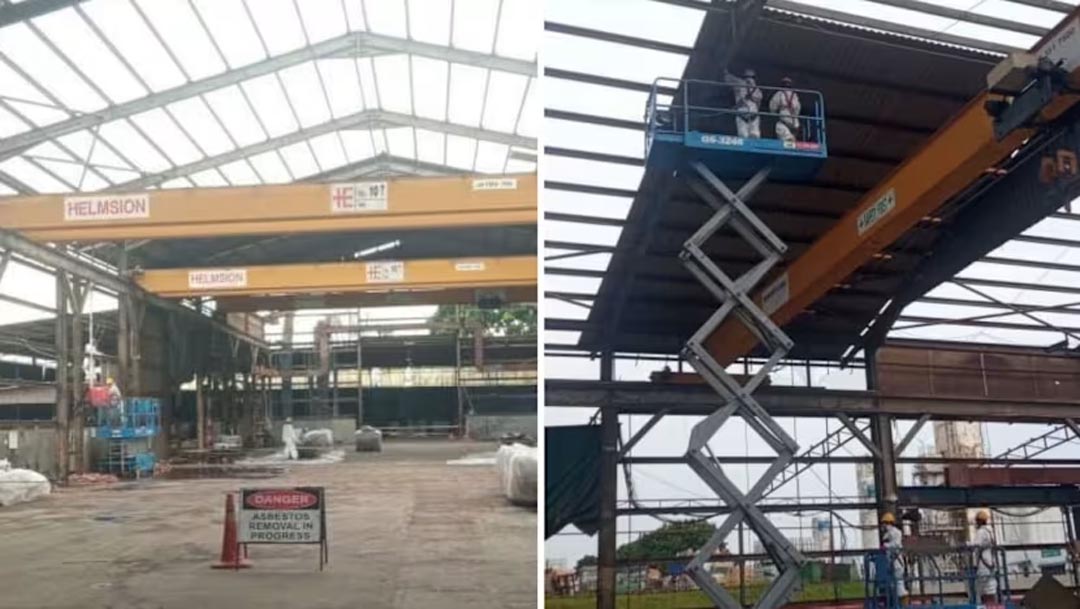
‘Not rocket science’: Why Malaysia groups are again pushing to ban asbestos in construction work
Asbestos is a group of naturally occurring minerals resistant to fire and water, and is commonly found in older buildings and homes including in Malaysia. But it is also known to cause cancer.
Several groups in Malaysia, including a workers’ union and a consumer watchdog, are again pushing for a full ban on asbestos, a material used in construction known to cause cancer.
But industry players and activists say the road ahead won’t be easy, given how similar past efforts went nowhere due to a powerful industry lobby and changes in governments in recent years, as well as the complexity of follow-up measures to fully ban the use of asbestos.
On Jan 6, four organisations renewed calls for the newly appointed Natural Resources and Environmental Sustainability Minister Arthur Joseph Kurup to prioritise and finalise a complete ban of asbestos by 2027.
Asbestos is a group of naturally occurring minerals made up of fine, durable fibres that is resistant to heat, fire and water. Because of these properties, it was widely used in construction, manufacturing and many industrial applications from the late 1800s to the 1980s across the world.
Proponents of a complete ban said it is necessary to protect public health and workers who might improperly handle the material. Global health institutes have said that inhalation of asbestos leads to increased lung cancer risk.
The Consumers’ Association of Penang (CAP), Building and Wood Workers’ International, Health and Safety Advisory Centre (HASAC), and environmental group Sahabat Alam Malaysia insisted there is “no safe level” of asbestos exposure, citing the World Health Organization (WHO) and International Labour Organization.
They pointed to international attempts in the past to play down the dangers of chrysotile asbestos, aimed at supporting the ongoing mining of chrysotile and the manufacture of asbestos-containing products.
Physician T Jayabalan, who leads HASAC, which focuses on public health education and policy advocacy, said governments have a “duty of care” to protect both local and migrant workers.
“It’s not rocket science for you to ban it,” he told CNA.
“It’s about the administration being aware, and they should be sensitive to it because of the fact that this is not only an environmental but also a public health issue.”
Comprehensive Plan Needed
If Malaysia does impose a full ban, the next step would be to implement a comprehensive plan to manage and eventually remove the existing asbestos in the country. But some experts say this process could be time-consuming and expensive.
Malaysia’s former environment minister Nik Nazmi Nik Ahmad told CNA there remains “broad agreement” within the government on a phased approach towards a full ban, but that more details should come from the ministry.
CNA has approached the Ministry of Natural Resources and Environmental Sustainability for comment.
There is no mining or milling of asbestos in Malaysia. Of the six types of commercial asbestos, the country only allows the import of one – chrysotile, also known as white asbestos – although it cannot be used in government-built schools, clinics and hospitals since 1999 and all government buildings since 2005.
This means government buildings, schools, hospitals, factories and low-cost flats built between the 1950s and 1980s in Malaysia are likely to contain asbestos. They are commonly seen in roofing shingles and cement walls as well as ceiling and floor tiles.
There are no acts or regulations prohibiting the use of asbestos in private buildings.

Medical experts say breathing in the ultra-thin asbestos fibres – which are released into the air when the material cracks – can lead to an increased risk of lung cancer.
Asbestos-related diseases include mesothelioma – a cancer of the chest lining and abdominal cavity – and asbestosis, in which the lungs become scarred with fibrous tissue.
According to the Global Cancer Observatory, 27 mesothelioma cases were reported in Malaysia in 2022, a figure projected to increase to 51 in 2045.
The WHO has stated that the most efficient way to eliminate asbestos-related diseases is to stop using all types of asbestos.
The CAP said it has raised awareness on the negative effects of asbestos since the 1980s. In 2001, and more recently in July 2024, it submitted memorandums to the government calling for a total ban on the material.
As of September 2025, 72 countries and territories – including Japan, South Korea and Taiwan – have imposed national bans on chrysotile asbestos mining, importation, production and use, according to the International Ban Asbestos Secretariat.
In Southeast Asia, Singapore has banned the use of asbestos in buildings since 1989, but many old buildings in the city-state still contain asbestos. Other countries in the region either have no or partial asbestos bans.
Industry Lobby Still Exerting Pressure
Lobbying by the chrysotile industry in Malaysia has led to its continued use and “false belief” that chrysotile can be used safely, said Mageswari Sangaralingam, chief executive of CAP.
“We believe that the chrysotile industry group derailed the proposal for a ban in Malaysia by diminishing the dangers of chrysotile,” she told CNA.
“However, it is evident that all forms of asbestos, including chrysotile, are hazardous to human health.”
The International Chrysotile Association maintains that chrysotile is much safer than the other five types of commercial asbestos called amphiboles, and that many countries have allowed “controlled use” of chrysotile instead of banning it.
While the association admitted there is no consensus about what the safety threshold is for exposure to chrysotile asbestos, it claimed the “scientific community” recognises that this threshold “does exist”.
“The confusion purposely maintained by opponents to safe chrysotile use is due to confusing two families of fibres, without distinction, despite the fact that the type, geological source, use and effects on health are radically different,” said a brochure by the Asbestos Institute available on the association’s website.
Jayabalan from HASAC said Malaysia should have been able to “easily defang” the chrysotile industry lobby in the name of environmental and health safety. He claimed that the “powerful” lobby knows where it can apply pressure in terms of administrative sections that deal with occupational safety regulations.
CNA has reached out to the International Chrysotile Association for comment.

Beyond the lobbying, CAP’s Mageswari said subsequent attempts for an asbestos ban were “quashed by an unstable government with frequent changes of leadership and ministers”.
But the four groups calling for the ban acknowledged that Nik Nazmi, the former environment minister who held the portfolio from 2022 to 2025, had “laid the groundwork” for a safer Malaysia.
Nik Nazmi announced in January last year that Malaysia was considering a full ban on asbestos, and a month later confirmed in parliament that the government was looking at a “phase-down approach” of stopping the use of chrysotile.
The Hazardous Chemicals Management task force was studying a gradual cessation of asbestos use, he said, with several laws being mulled to implement the ban.
Nik Nazmi told CNA he believes that since he left the ministry, a technical committee on implementing the ban had met and recommended a timeline.
“There was some industry pushback and while we took that into account, priority was given on health and safety considerations as pushed for by health and consumer advocates,” he said.
“There was a push (from the industry lobby) for a longer phase-down, but we came up with a shorter one.”
The asbestos lobby asserted that all construction materials contain elements “likely to be harmful” to workers’ health if used incorrectly.
“Workers must make sure they are using the appropriate equipment and recommended work methods, regardless of the materials they use. This is true for chrysotile, as well as for many other substances that are sometimes more harmful,” said the Asbestos Institute brochure.
Real Risk of Asbestos Exposure
The reality in Malaysia, however, is that renovation contractors are asking their foreign workers to handle asbestos without the proper skills and protective equipment, Jayabalan said.
“(The worker) finishes his renovation, he is exposed to this dust, he doesn’t even know that he is exposed to it,” he said.
“When he goes back to his country of origin, he develops this deadly disease, which is either mesothelioma, lung cancer, asbestosis or whatever it is.
“Treatment is very disappointing in the sense that it’s like giving a person a death sentence; you have about so much time to live.”
While Malaysia’s Department of Occupational Safety and Health (DOSH) has established procedures for the handling and disposal of asbestos, Jayabalan said many contractors ignore them due to the administrative hassle and costs involved.
“It’s also the constraints of the system … The easy thing to do is ban it. Then you are cleared of this deadly material,” he said.
Jayabalan also shared pictures of asbestos being improperly disposed of in Malaysia, calling this a “double jeopardy”.
“Why? Number one is exposure to the worker. Then, there is the environmental exposure, meaning in the immediate vicinity, the (asbestos) dust is now made available,” he added.
Hisham Yahaya, general manager of Safe Asbestos Solutions, told CNA that DOSH can legally stop such improper work, but this is often hard to detect as it occurs in areas not visible from main public roads.
And if part of an asbestos roof shingle is damaged, for instance, it is cheaper to replace that part with new asbestos instead of swapping out the entire roofing with an asbestos substitute like cement cladding, Hisham said.

Hisham said his company handles at least two to three projects a month mainly for corporate clients, involving the detection, management and removal of asbestos, in places like factories, embassies and on board ships in Malaysia and the region.
While bigger multinational and local companies are cognisant of the dangers posed by asbestos, smaller businesses and homeowners might not have the same funds or awareness, he said.
“A lot of the older low-cost housing built by the government has asbestos, and should the government highlight the dangers of asbestos, people might go into a panic stage,” Hisham said.
These residents could then demand that authorities cover the cost of removing the asbestos, or threaten to vote out the government of the day.
“That’s the tricky part; it’s more on political will,” he said.
A Ban — Then What Next?
When Hisham was asked why he thinks the government has not fully banned asbestos until now, he said a ban must be followed up with a multi-decade plan on how to handle the existing asbestos in the country.
This includes tracking the age of buildings that contain asbestos and deciding whether their asbestos components can still be mitigated or should be replaced.
“The phasing-out will actually take years,” said Hisham, referring to the Netherlands as an example.
In the late 1970s, the Netherlands banned the amphibole asbestos crocidolite. “Non-glued” asbestoses were forbidden a few years later and from the early 1990s onwards a total ban on asbestos was issued.
With that said, Hisham said he feels the current government should take the first step of banning the import of all types of asbestos, before educating people on how to manage the risks of existing asbestos, like painting over damaged asbestos parts.
“You cannot do it overnight because of the costs associated with it,” he added.
In terms of follow-up measures, CAP’s Mageswari said the government should identify consumer products containing asbestos, and ban imports of these products as well.
“The government should also ensure asbestos waste transportation, management and disposal strictly comply with the law, and provide guidance on asbestos removal procedures,” she said.
Jayabalan from HASAC said the government should develop a nationwide registry of all asbestos-containing material, and take the opportunity to replace them when there are major renovation works on affected buildings.
Homeowners who wish to renovate their homes can check this registry, and if asbestos is present, inform DOSH for it to be removed safely at no cost, he said.
“A ban doesn’t even mean immediately you’re going to solve the problem. It takes some time, but it’s a start of your attempts at mitigating the problem,” he added.
Source: CNA/hz(ao), 20 January 2026