
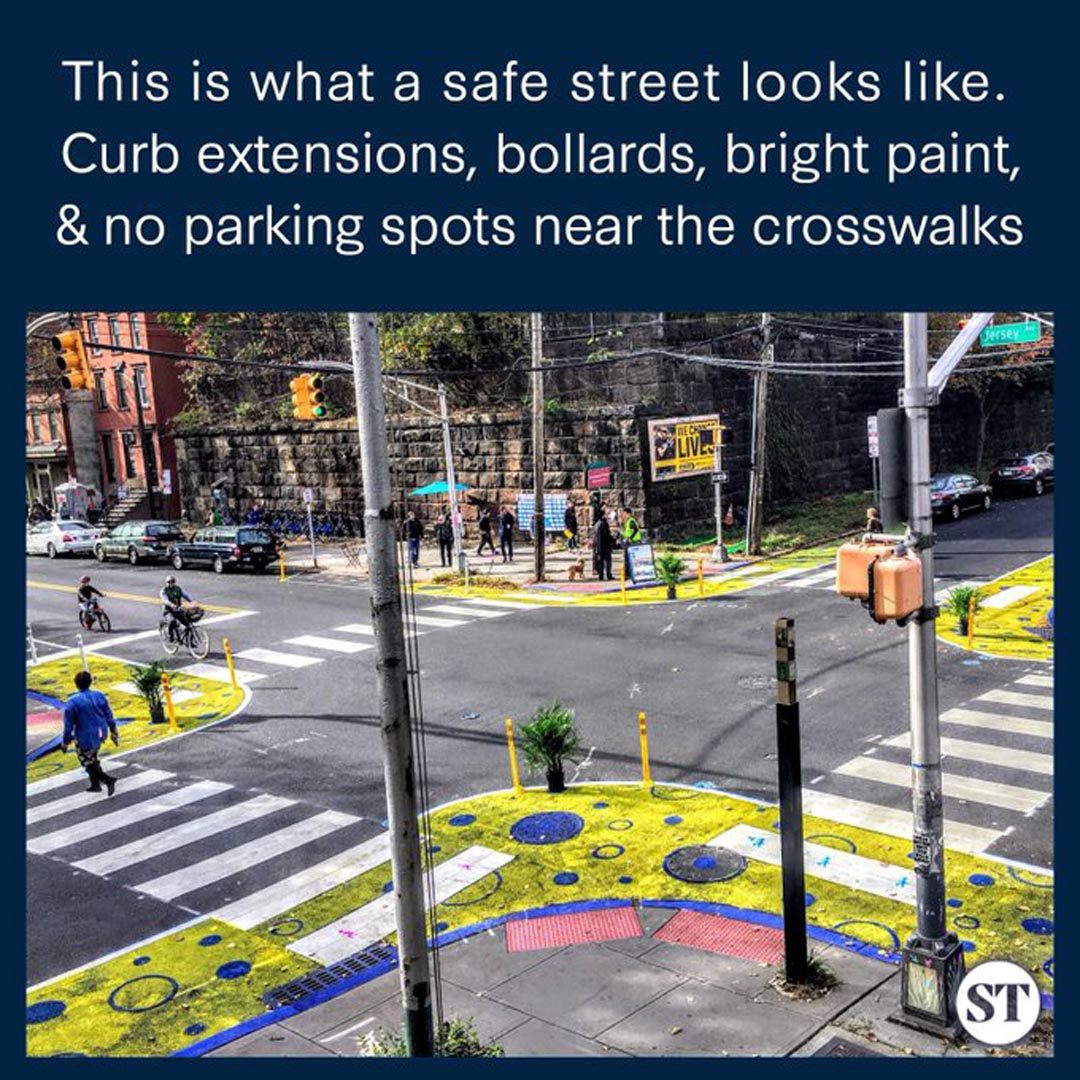
SAFE STREETS SAVE LIVES
More than 1.2 million people die on roads around the world every year. That is equivalent to roughly one person dying every 30 seconds, or over 3,400 people dying every single day of the year. Many of these deaths occur on urban roads and are preventable crashes caused by behaviour induced by street design.
According to the World Health Organization, tens of millions of people are also injured or disabled on the world’s roads every year. Children, pedestrians, cyclists, and older people are among the most vulnerable of road users.
Many traffic injuries are directly related to design. Common causes for traffic fatalities include:
- lack of sidewalks and accessible crossings
- wide, multi-lane streets without refuge spaces for the elderly or those who move at a slower pace
- lack of signals and countdown clocks
- lack of cycle facilities
- poor intersection design (large intersections are often designed for dangerous, high-speed turning)
- surface hazards (obstacles and surface degradation, potholes)
Conditions become more dangerous with the addition of speed. In fact, speed is the single most important factor in the safety of a street, and is directly proportional to the risk of pedestrian fatality in cases of conflict.
Highway-like street designs that prioritise automobiles over vulnerable users and encourage high speeds fail to provide safe environments.
The human body is fragile and can only survive certain forces. Reducing speed is essential for safety. When vehicles move at or below 40 km/h, potential conflicts take place at lower speeds, dramatically increasing the chances of survival in the case of a crash.
The Vision Zero (initiated in Sweden) and Sustainable Safety (initiated in the Netherlands) programmes are proactive safety programmes being adopted by an increasing number of cities around the world. The premise of such programmes is that loss of life is unacceptable, and their goal is preventing all serious road crashes.
These initiatives place the burden of safety on the system design, not the road user. Innovative street designs that reduce speed, strict enforcement against traffic violations, legislative ordinances that lower speed limits, and public awareness campaigns have proven to be impactful strategies adopted by these programmes.
– edited extracts from “Safe Streets Save Lives”, Global Designing Cities Initiative
Read more here:
https://globaldesigningcities.org/…/safe-streets-save…/