
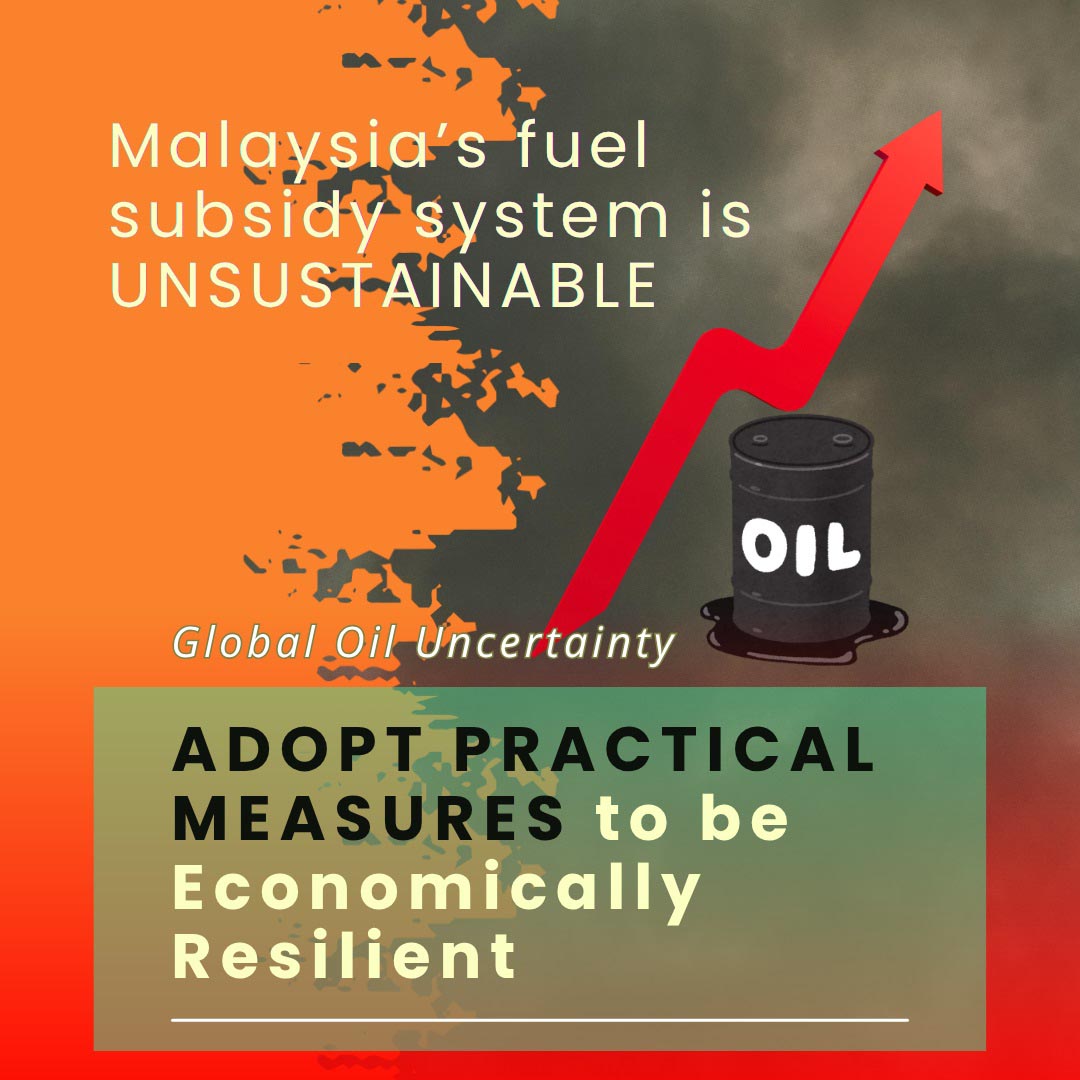
A Pragmatic Approach to Fuel Subsidies and Economic Resilience Amid Global Oil Uncertainty
In view of the current geopolitical situation in the Gulf region, the Consumers’ Association of Penang (CAP) is urging the government and the public to take a pragmatic approach as it is difficult to determine how long the conflict is going to last and the consequences of it.
Malaysia’s broad fuel subsidies are expensive and inefficient as they potentially benefit higher-income groups and leak to smugglers who capitalise on the global oil shortage and the huge price difference from Malaysia’s neighbours.
Although the government has maintained the subsidised price of RON95 petrol at RM1.99 per litre since the introduction of the BUDI MADANI petrol subsidy programme on 30 September 2025, Malaysians should be aware that the unsubsidised price of petrol continues to fluctuate with global market conditions and the global oil prices.
The retail price of RON95 was RM3.27 per litre with the government subsidising RM1.28 for every litre of RON95 when it was sold at the subsidised rate of RM1.99. Thus, the government has to subsidise the car owner RM23.04 each time a car owner fills half of a 36-litre tank! This doesn’t include cars of bigger tank capacities.
Obviously this approach is not sustainable in times of great uncertainties and whatever savings the government make can be channelled to combat inflation that is imminent if the war in Iran continues. The reason is that if the war of attrition continues and the passage of oil tankers through the narrow Straits of Hormuz continues to be disrupted, it will cause a greater impact on the global economy.
Much of the global economy is running on oil, thereby affecting logistic sector, private and public transport, manufacturing industries, agriculture (such as production of fertilisers), Liquified Natural Gas (LNG) used as fuel for cooking and the generation of electricity.
We would propose that Malaysia should fix the subsidy of RON95 and diesel rather than fixing the subsidised price irrespective of the retail price. According to reports, the monthly subsidies of RON95 and diesel has risen from RM700 million to RM3.2 billion in the period within a week of the start of the conflict. Subsidies, even with the best intention, cannot be sustained this way.
Therefore, Malaysians should help themselves by reporting any smuggling activities and consider deferring non-essential travel. Taking public transport is most advisable and if driving cannot be avoided, carpooling and careful trip planning can help reduce fuel consumption by allowing several errands to be completed in a single journey.
The impact of a global oil supply disruption may remain manageable if the conflict lasts only a few months. However, if it continues for a longer period, the consequences could be more severe and may trigger wider economic difficulties, including:
- Rising inflation caused by higher fuel and food prices, as well as increased shipping and insurance costs for transport through conflict-prone regions.
- Disruptions to food supply chains when harvests cannot be exported promptly or when shipments are delayed, leading to spoilage and shortages. The production of chemical fertilisers such as urea and ammonium nitrate that farms are so dependent on are manufactured from petroleum.
- Fuel shortages, including liquefied natural gas (LNG), affecting transportation and electricity generation where gas-fired power plants are used. When there is LNG shortage, it may cause a price increase in electricity bills and food prices if they depend on LNG in their preparation. The cost of electricity may spike because of the hike in oil prices and the conflict is contributing to global warming and environmental pollution that the world is trying to avoid.
- Industrial slowdowns or shutdowns in sectors that rely heavily on oil or gas, potentially leading to layoffs and job losses. Industrial boilers that run on fuel oil or diesel will be impacted and the increased cost of production and subsequently the logistics cost will be borne by consumers.
- Malaysians opting for public transportation helps to reduce traffic volume on the roads, hence using less fuel, as well as to help in reducing greenhouse gases that contribute to global warming which are more frequently felt as heatwave as what is being experienced now. Companies can assist by adopting ‘work-from-home’ for less critical employees to cut down on fuel consumption.
- The government can assist by engaging markets and food outlets to channel food waste for bulk composting, which can then be sold to farmers at minimal cost as fertiliser thereby reducing food waste ending up in landfill, and encouraging organic farming.
In light of these risks, Malaysians should adopt a spirit of moderation and resilience. Households can strengthen their financial position by reducing unnecessary expenditure, conserving energy and supporting efforts to improve national food security. While global events are beyond our control, responsible consumption and prudent planning can help cushion the country against the economic shocks that may arise from prolonged geopolitical instability.
Mohideen Abdul Kader
President
Consumers’ Association of Penang
Letter to the Editor, 26 March 2026