
Groups Warn Malaysia of Likely Illegal Exports from Batam, Indonesia, Arriving on Sept 3
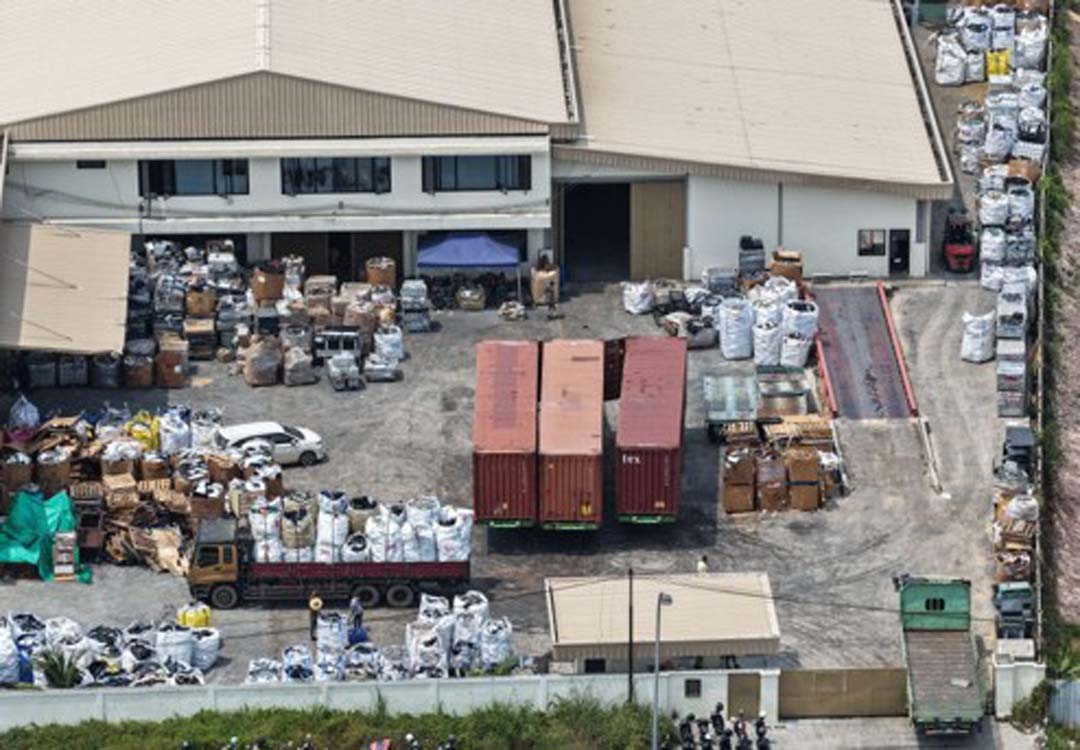
Kuala Lumpur. Jakarta September 3, 2026. Following a visit to Batam, the Basel Action Network (BAN), together with Nexus3 Foundation and Ecological Observation and Wetlands Conservation (Ecoton) in Indonesia, have identified three containers suspected of carrying electronic waste (e-waste) from a premise linked to e-waste recycling company PT Esun International Utama Indonesia (PT Esun). Publicly available trade data indicates that the containers are due to arrive at Port Klang, Malaysia, on September 3, despite Malaysia having banned the importation of e-waste. BAN and Sahabat Alam Malaysia have warned Malaysian authorities of this development.
Additionally, BAN has received new data indicating that in March and April 2026 alone, three companies which reportedly had their import licenses revoked in January,[1] continued to import thousands of containers suspected of carrying electronic waste from the United States (US) into Batam.
E-waste imports crisis in Batam
Batam, one of over 2,000 islands in the Riau Islands near Singapore, came into the limelight in September 2025 when it was revealed that PT Esun was illegally importing e-waste from the US to Indonesia, facing the same fate as Malaysia, Thailand, and the Philippines. The then Minister of Environment attempted to visit the facility, but his visit to the factory was famously thwarted.[2]
By April 2026, the number of seized suspect containers at Batu Ampar Port had ballooned to 914, and two other importing facilities (PT Logam Internasional Jaya (PT Logam) and PT Batam Battery Recycle Industries (PT Batam Battery)) had also been implicated in the likely illegal imports. The government reportedly promised to hold the companies accountable and to repatriate the containers, in line with provisions for illegally trafficked waste controlled under the Basel Convention on the Control of Transboundary Movements of Hazardous Wastes and Their Disposal (Basel Convention). However, the Indonesian government dramatically changed their plans soon after, claiming they would destroy the e-waste on the island itself.[3]
The Jakarta Post reported that the Batam Free Trade Zone Authority (BP Batam) made the decision based on an inspection of one container, which found less than 5 per cent of hazardous wastes. Wastes not categorised as hazardous were to be returned to the importer.[4]
BP Batam’s decision to return the wastes to the importer is highly suspicious, as the Basel Convention’s E-Waste Amendments[5] are not concerned with whether the e-wastes are hazardous.[6] Under the Basel Convention’s E-Waste Amendments, effective 1 January 2025, all e-waste exports, including whole equipment, components, and waste residues, can only be transported with notification to and consent by importing countries. No such e-waste, hazardous or not, can be imported from the US because the US is not a Party to the Convention.
Trade Data Shows Likely Illegal e-Waste Importation from the United States
Trade data reported by the Indonesian government itself show hundreds of shipments each month in 2025, until April of this year, arriving at PT Esun, PT Logam and PT Batam Battery, with most coming from the US. On occasion, these importing companies, which presumably had their import licenses revoked, used proper HS codes for e-wastes. These should have indicated to the government that the containers held e-wastes and are illegal. Nevertheless, the imports were allowed to continue.
“Why were these companies allowed to continue importing e-waste after their permits were revoked in January?” asked Wong Si Peng, research and communications officer with the Center to Combat Corruption and Cronyism. “Who will then be responsible when these e-wastes of US origin are further transported to other countries in Southeast Asia?”
Is Batam exporting e-waste?
As noted above, recent field investigations by the groups revealed three containers located within the premises of PT Esun due to arrive in Malaysia on September 3, 2026. PT Esun is the local partner of the Chinese-owned e-waste trading giant known as Wai Mei Dat, and known in the US as Corporate e-Waste Solutions (CEWs). The company was called out in the BAN report “Brokers of Shame” last year.[7]
If Indonesia is indeed allowing a notorious e-waste trading company, found to illegally import e-waste, to further export e-waste to Malaysia, this would be a serious dereliction of Indonesia’s duties and obligations as a Party to the Basel Convention.
“Malaysia had announced a ban on all importation of e-waste into the country in February this year.[8] The government reiterated its stand at the Basel Convention Open-Ended Working Group meeting held in Geneva in June,[9]” explained Mageswari Sangaralingam, honorary secretary of Sahabat Alam Malaysia.
“Thus, all exports of e-wastes from Indonesia to Malaysia are definitely illegal. Even if the three identified containers were claimed to carry plastic wastes, it is likely that they are electronic plastic scrap, which would also be controlled by Basel’s Plastic Waste Amendments.[10] These exports would still require notification to, and consent from, the Malaysian government,” she added.
Regarding possible next steps, founder and strategic director of BAN, Jim Puckett, said, “It is imperative that the Malaysian authorities seize these three containers upon arrival to Port Klang and search them for contraband e-waste. If they are e-waste or e-waste-derived-plastic waste, entering the country without notification and consent, they are illegal. The Indonesian government must take them back and prosecute PT Esun for any illegal export.”
The groups affirm that Malaysia, Thailand and the Philippines are taking stern action against illegal e-waste trafficking. Malaysia and Thailand have banned most e-waste imports, while the Philippines is beginning to turn away suspected containers of illegal e-waste.[11] Meanwhile, Indonesia appears to be allowing blatant violations of its international obligations.
Puckett further emphasised, “The Indonesian government must undertake a multi-agency inquiry as to why the Basel Convention is allowed to be ignored by international waste traders operating in Batam.”
For more information:
Jim Puckett, Basel Action Network
jpuckett@ban.org
Mageswari Sangaralingam, Sahabat Alam Malaysia
foemalaysia@gmail.com
Wong Si Peng, Center to Combat Corruption and Cronyism
sipeng@c4center.org
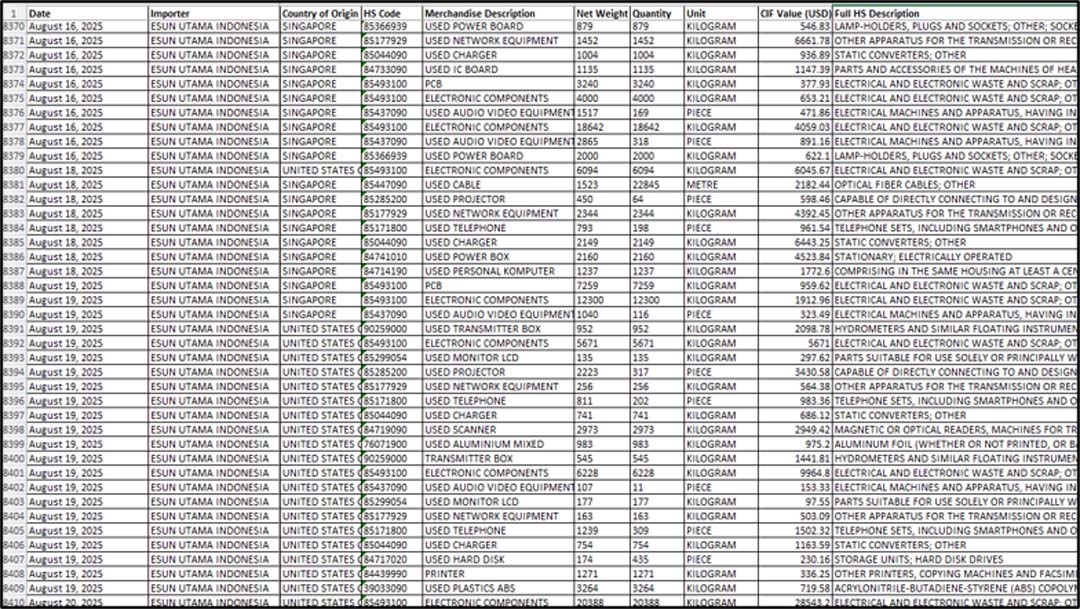
A screenshot of e-waste and other suspect imports by PT Esun in August 2025, according to trade data reported by the Indonesian government. Credit: Basel Action Network
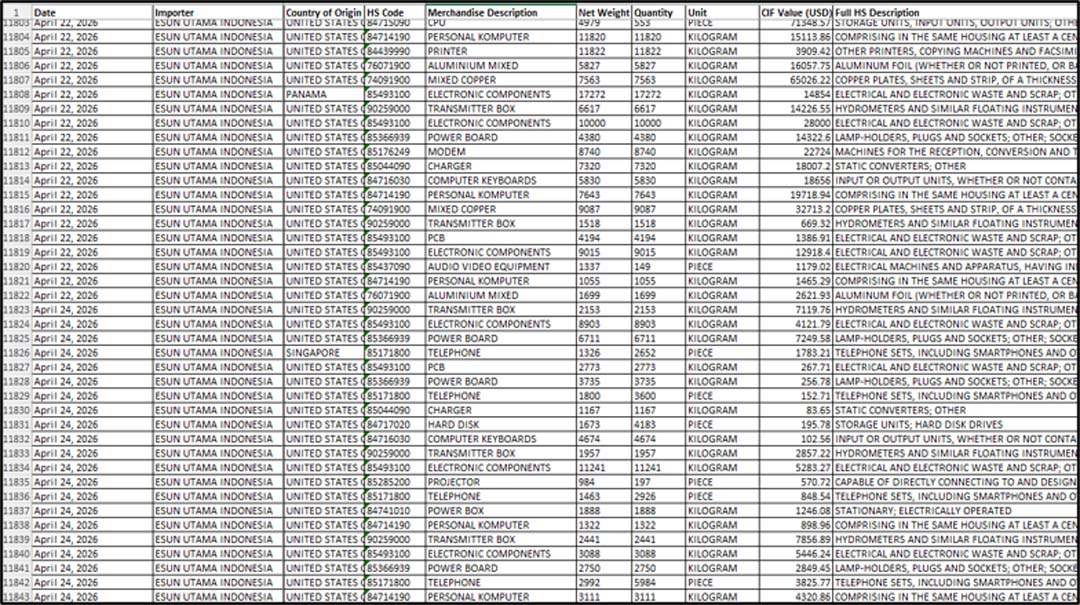
A screenshot of e-waste and other suspect imports by PT Esun in April 2026, according to trade data reported by the Indonesian government. Credit: Basel Action Network
Containers located within the premises of PT Esun, due to arrive in Malaysia on September 3. Credit: Basel Action Network
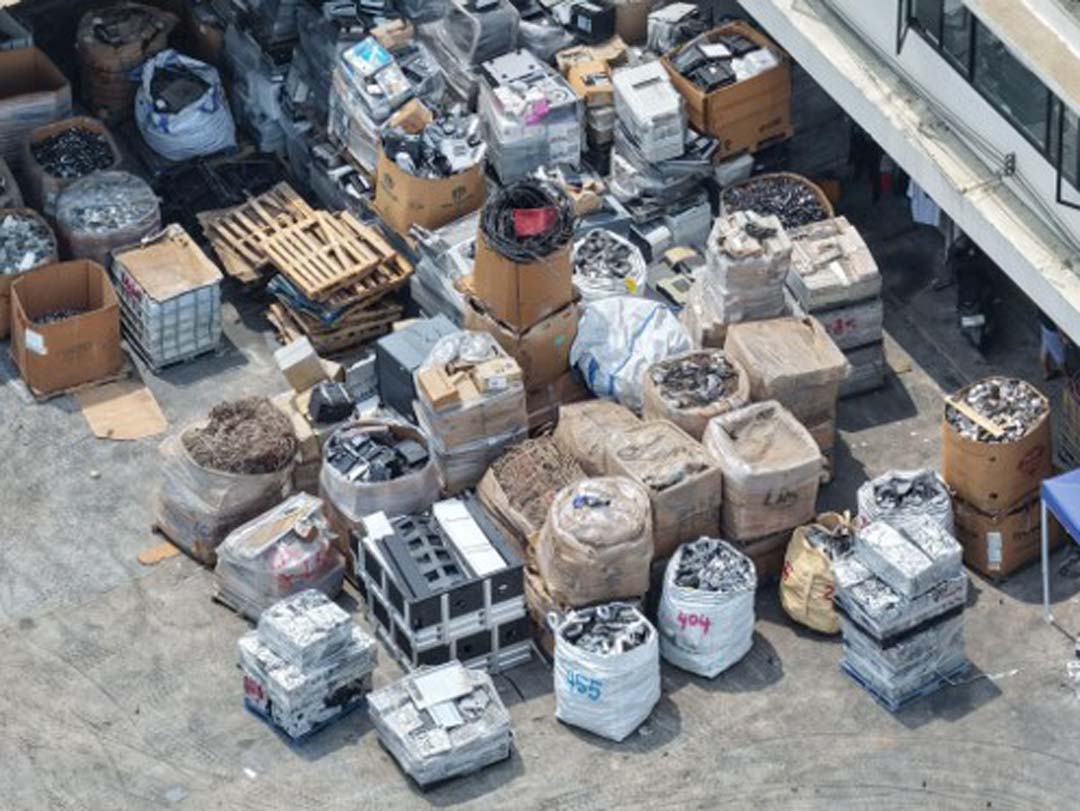
Electronic components within the premises of PT Esun. Credit: Basel Action Network
[1] https://www.thejakartapost.com/indonesia/2026/01/17/batam-sidelines-speed-for-compliance-in-e-waste-reexport-case
[2] https://mongabay.co.id/2025/09/27/menteri-lingkungan-gagal-segel-importir-limbah-elektronik/
[3] https://www.straitstimes.com/asia/se-asia/batam-to-destroy-illicit-us-e-waste-abandons-re-export-plan
[4] https://www.thejakartapost.com/indonesia/2026/05/18/bp-batam-reveals-reason-for-canceled-reexport-of-us-origin-waste
[5] https://www.basel.int/Implementation/Ewaste/EwasteAmendments/Overview/tabid/9266/Default.aspx
[6] Thus, under the Amendments, all other countries seeking to export e-waste to Indonesia can only do so if the exporting country notifies Indonesia about the shipments prior to sending them, and the Indonesian government gives consent officially, on a shipment-by-shipment basis. Similarly, exports of e-waste from Indonesia can only move with such notification and consent, and cannot move to non-Parties such as the US, nor to countries that have banned the import of e-waste according to national laws.
[7] https://www.ban.org/reports/brokers-of-shame
[8] https://apnews.com/article/malaysia-bans-ewaste-dumping-607917a17a968ddfd0bb9e7a6861f6e3
[9] https://enb.iisd.org/basel-convention-oewg-15-briefing-note
[10] https://www.basel.int/Implementation/Plasticwaste/Amendments/Overview/tabid/8426/Default.aspx
[11] https://globalnation.inquirer.net/335532/another-us-e-waste-shipment-intercepted-in-subic?