
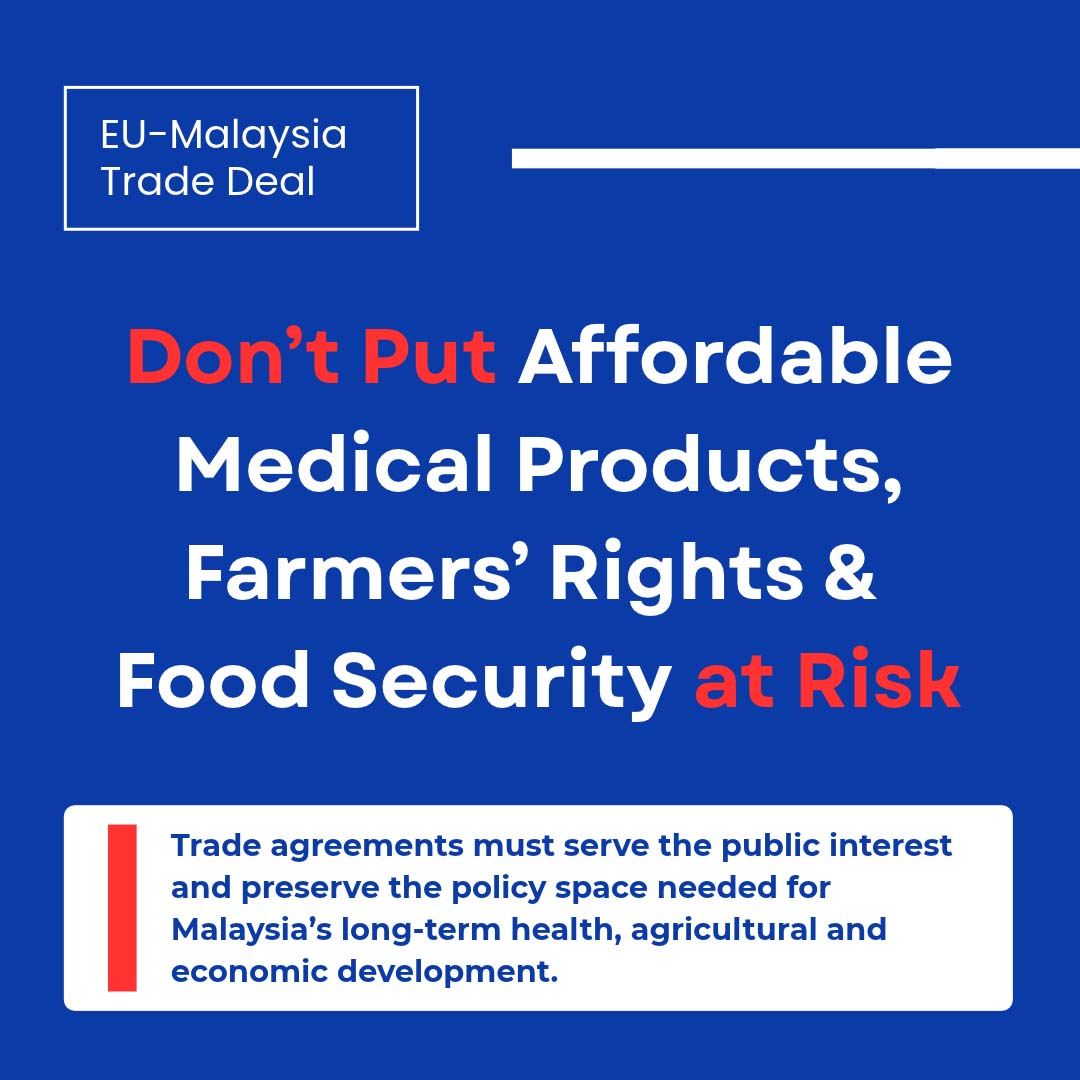
EU-Malaysia Trade Deal Must Not Put Affordable Medical Products, Farmers’ Rights and Food Security at Risk
The Consumers’ Association of Penang (CAP) and 40 other Malaysian civil society organisations call on the Malaysian Government to reject intellectual property demands by the European Union (EU) that go beyond Malaysia’s obligations under the WTO Agreement on Trade-Related Aspects of Intellectual Property Rights (TRIPS).
Together with these organizations, CAP has sent a letter to Prime Minister Dato’ Seri Anwar Ibrahim, warning that these TRIPS-plus demands of the EU could undermine access to affordable medicines, weaken Malaysia’s domestic generic pharmaceutical industry, restrict farmers’ rights and threaten food security.
With the latest round of Malaysia–EU Free Trade Agreement negotiations taking place from 21–25 September 2026, the Government must ensure that trade commitments do not restrict Malaysia’s ability to protect public health, and safeguard the interests of farmers and consumers.
CAP is particularly concerned about the EU’s proposals on data and marketing exclusivity, patent-term extension, trade secrets, intellectual-property enforcement, industrial designs and plant variety protection. These TRIPS-plus measures could extend monopoly protection, delay generic competition and increase costs for consumers and the public healthcare system.
Higher medicine prices and delayed generic competition
The EU’s proposals for patent-term extensions of up to five years would extend pharmaceutical monopolies beyond the 20-year patent term required under TRIPS. Combined with expanded data and marketing exclusivity, such provisions could delay the entry of affordable generic medicines.
A 2022 review of 91 studies found that stronger pharmaceutical monopolies created through TRIPS-plus provisions are generally associated with higher drug prices, delayed availability and increased costs for consumers and governments. The same review estimated that the combined impact of patent-term extensions and data exclusivity under the Colombia–EU FTA could increase Colombia’s pharmaceutical spending by US$756 million in 2025.
The EU’s TRIPS-plus proposals can also undermine the domestic generic pharmaceutical industry which has been identified as strategically important under the New Industrial Master Plan 2030 for improving affordability, accessibility and domestic production.
Malaysia is also a net importer of intellectual property, with approximately US$2.7 billion in net IP royalty outflows in 2024, compared with around US$348 million in receipts. Stronger and longer IP protection would increase royalty outflows and impose additional costs on Malaysian consumers, public health programmes and domestic manufacturers.
“At a time when Malaysia’s health budget has already been cut, it would be deeply irresponsible for the Malaysian government to agree to EU proposals that could further drive up the prices of medical products and place additional financial burdens on the Malaysian people and on an already stretched public health system”, said Mohideen Abdul Kader, President of the Consumers’ Association of Penang.
Reject UPOV 1991 and protect farmers’ rights
CAP and the other 40 civil society organisations are also deeply concerned about the EU’s proposal requiring Malaysia to protect plant varieties in accordance with the 1991 Act of the International Convention for the Protection of New Varieties of Plants (UPOV 1991).
Malaysia already has its own plant variety protection system under the Protection of New Plant Varieties Act 2004 (Act 634). This framework protects commercial plant breeders while preserving farmers’ rights to save, use, exchange and sell farm-saved seeds of protected varieties. It also contains safeguards such as measures to prevent biopiracy of local plant genetic resources, and ensure the availability of seeds at reasonable prices for Malaysian farmers.
Aligning Malaysia’s system with UPOV 1991 will only contribute to greater corporate concentration in the seed sector, and consequently increase the costs of seeds with wider implications for consumers as food prices increase, food security, agrobiodiversity and the resilience of Malaysian agriculture. The EU’s interest is to increase market access for European seed companies in Malaysia.
‘Malaysia does not need to accept TRIPS-plus commitments to conclude an ambitious EU trade agreement. Recent EU agreement with India demonstrates that it is possible to negotiate a trade agreement without having to align with UPOV 1991 and agree to TRIPS-plus provisions such as patent-term extension, data and marketing exclusivity, and other TRIPS-plus obligations’, said Chee Yoke Ling, Executive Director of Third World Network, another signatory to the letter to the Prime Minister .
The letter calls on the Government to:
- Reject all TRIPS-plus IP provisions that go beyond Malaysia’s WTO obligations, including data and marketing exclusivity, patent-term extensions, excessive trade-secret and industrial-design protection, expanded IP border measures and UPOV 1991 commitments;
- Protect Malaysia’s policy space to use compulsory licensing, government use and other public-health safeguards;
- Maintain the Protection of New Plant Varieties Act 2004 (Act 634) and reject any commitment to align with or accede to UPOV 1991;
- Ensure that the FTA does not undermine access to affordable medicines, generic and biosimilar competition, Malaysia’s domestic generic pharmaceutical industry, farmers’ rights or the resilience of the agricultural system; and
- Ensure transparency and meaningful consultation with civil society, consumer organisations, patient groups and smallholder farmers throughout the negotiations.
CAP further notes that detailed concerns have already been raised with the relevant Ministries, including through letters sent by Third World Network on 4 June and by the Malaysian Food Sovereignty Forum (FKMM) on 19 June 2026. The civil society organisations state that, to date, they have not received a response from any Ministry concerning the status of the negotiations.
CAP urges the Government to ensure that the Malaysia–EU FTA does not trade away Malaysians’ access to affordable medicines, farmers’ rights, food security or Malaysia’s ability to pursue public-interest policies. Trade agreements must serve the public interest and preserve the policy space needed for Malaysia’s long-term health, agricultural and economic development.
Signatories to the letter include Malaysian Agroecology Society – SRI-Mas, Malaysian AIDS Council, Malaysian AIDS Foundation, Malaysian Food Sovereignty Forum (FKMM), Malaysian Rare Disorders Society; Médecins Sans Frontières (MSF)-Malaysian chapter; Persatuan Pengguna Islam Malaysia; Sahabat Alam Malaysia (Friends of the Earth) – SAM; and Together Against Cancer Association.
Mohideen Abdul Kader
President
Consumers’ Association of Penang
Press Statement, 25 September 2026