
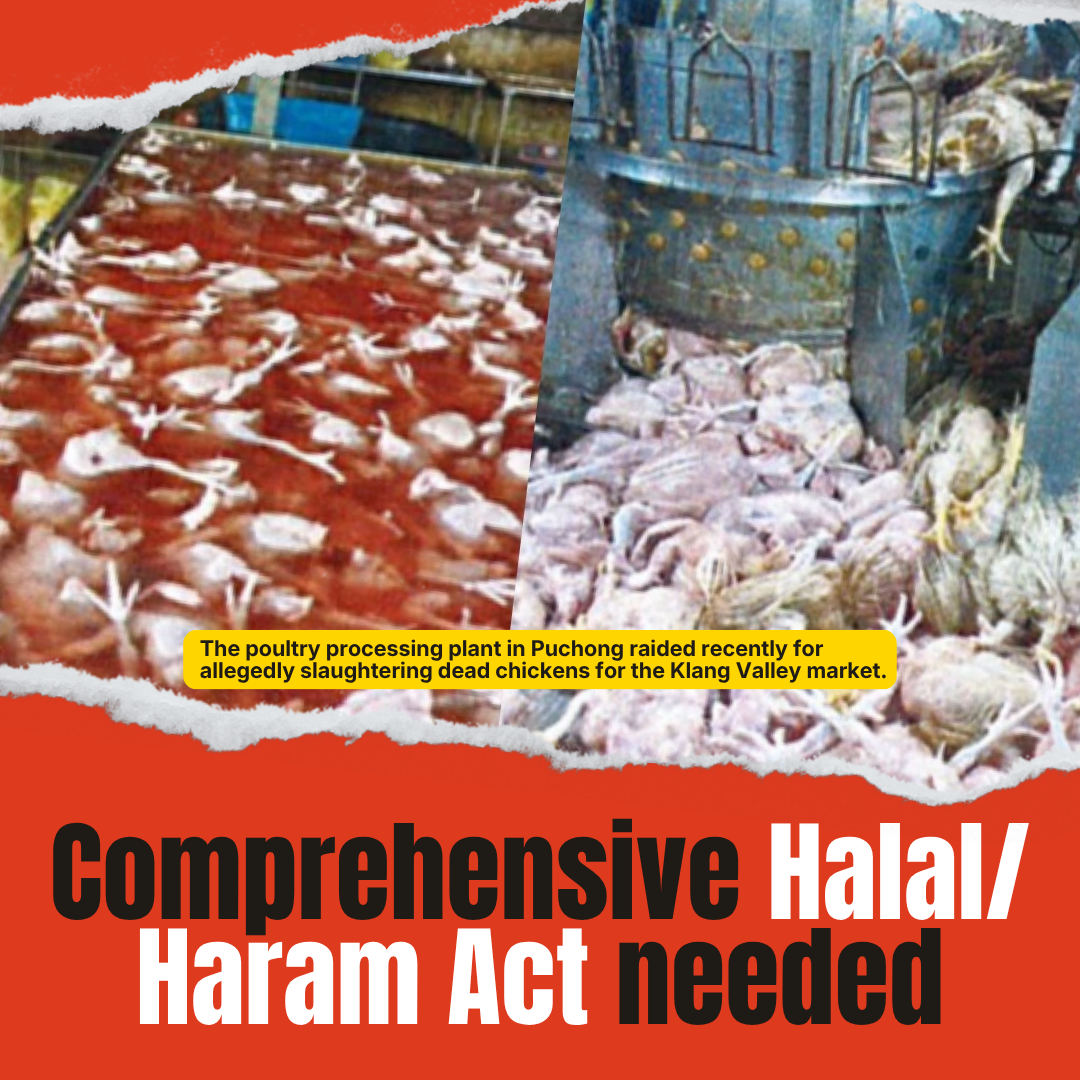
CAP: Comprehensive Halal/Haram Act Needed
The Consumers’ Association of Penang (CAP) calls on the government to introduce a comprehensive Halal/Haram Act to regulate all aspects of the halal industry.
Such legislation would help ensure that producers act responsibly and are held accountable for the halal status and labeling of their food products. Presently the burden of verifying whether a product is genuinely halal often falls on the consumers.
Currently, halal matters in the country are governed by piecemeal legislation. This fragmented framework is unable to give an assurance of the halal status of the products and services due to the lack of enforcement and unscrupulous business practices.
Last Friday, police raided a poultry processing plant in Puchong for allegedly slaughtering dead chickens for the Klang Valley market. Investigations found that the plant used electric water baths to stun chickens prior to slaughter, but the electrical voltage applied was too high. This instantly killed the birds when they were dunked into the water before being slaughtered in accordance with Islamic law.
The plant is believed to have the capacity to process about 40,000 chickens a day. The processed chickens were believed to have been supplied to restaurants, grocery shops and supermarkets across the Klang Valley. According to media report the company has been operating for more than 20 years.
The stunning of animals before slaughtering is unacceptable in Islam. Numerous medical studies have shown that stunning leads to the retention of a significant amount of blood in the meat and it is the cause of death in some animals before slaughtering. The consumption of blood and the meat of animals which have died before slaughter are prohibited in Islam as it is harmful.
However, the Muzakarah Khas Fatwa Majlis Kebangsaan Bagi Hal Ehwal Ugama Islam Malaysia on the 29 September 2005 allowed the use of electrical and water bath stunning as well as the use of drugs and carbon dioxide, prior to slaughter.
Stunning of animals before slaughtering should not be allowed. Evidence has shown that the Islamic method of slaughtering is the least painful.
For more than 30 years CAP has called for the enactment of a Halal/Haram Act. Although CAP had participated in several discussions and meetings on the issue, little progress has been made. The drafting of the necessary legislation and policy-making have been sidelined by the authorities for years.
The Halal/Haram Act will help to ensure that producers act more responsibly in labelling food and products as Halal, rather than burden consumers to determine the Halal status of the product. The Act should also mandate the clear use of the term “Non–Halal” as a guide and warning for Muslim consumers. This term encompasses not only pork meat and pork-derived products but also all other products, ingredients and substances that are prohibited in Islam.
Given the above situation, it is the right time for the government to introduce the Halal/Haram Act, while simultaneously reviewing and amending existing legislation related to halal and haram matters.
Meanwhile existing laws should be strengthened to provide clarity on the use of the word Haram whether in food or products. For example, the food-labelling provisions under the Food Act should be amended to ensure that Haram ingredients are declared on the label. If a substance or ingredient is derived from several sources, then, the producer or manufacturer should be required to disclose its origin. This will help Muslim consumers to avoid any food and products that contain doubtful or Haram substance.
The Act will give more bite to the authorities in implementing more stringent supervision and enforcement on the Halal supply chain.
- Given the above scenario, the Consumers’ Association of Penang calls on the authorities to:
- Introduce a comprehensive Halal/Haram Act to regulate all aspects of the halal industry, strengthen enforcement, enhance transparency, and protect consumers from false or misleading halal claims.
- Conduct public awareness campaigns to educate consumers and create proper channels for reporting Halal violations or fraudulent claims to the relevant authorities.
- Set up an independent committee to monitor and evaluate the effectiveness of the agencies entrusted to deal with Halal Haram matters in Malaysia.
These measures are essential to safeguard the integrity of the halal ecosystem, strengthen consumer confidence, and ensure that responsibility for halal compliance rests with producers, manufacturers, and regulators.
Mohideen Abdul Kader
President
Consumers’ Association of Penang
Letter to the Editor, 4 November 2026