
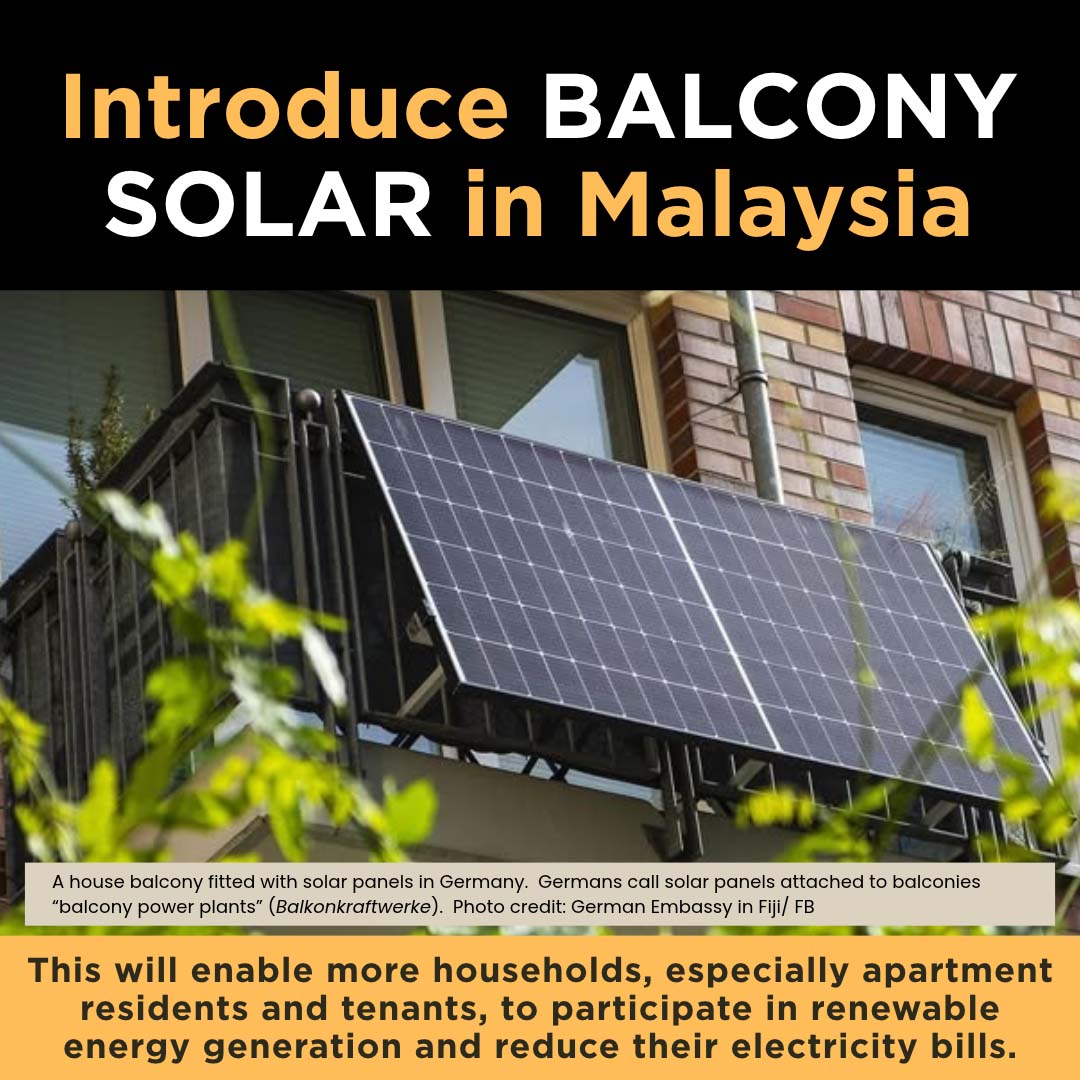
CAP Calls for Consumer Empowerment in the Clean Energy Transition
The Consumers’ Association of Penang (CAP) calls on the Government to consider introducing a regulated balcony solar programme in Malaysia to enable more households, particularly apartment residents and tenants, to participate in renewable energy generation and reduce their electricity bills.
While rooftop solar has expanded in Malaysia, many consumers are unable to benefit because they live in high rise buildings, rent their homes, or do not have access to suitable roof space. Moreover, rooftop solar system are considered unaffordable to many households that do not use much electricity to justify the investment.
Balcony solar systems, which consist of small solar panels connected to a microinverter and plugged into a household electrical socket, provide an affordable and practical alternative.
Germany’s experience demonstrates the potential of this approach. Known as Balkonkraftwerke or plug-in solar systems, these small solar installations have become increasingly popular among ordinary households. Germany recorded approximately one million balcony solar systems by mid-2025, with the number doubling within about one year as more consumers adopted the technology. The country’s Bundesnetzagentur (Federal Network Agency) registered about 435,000 new plug-in balcony solar installations in 2024 alone, contributing around 0.4 gigawatts of additional solar capacity.
The rapid growth of balcony solar in Germany shows that renewable energy adoption does not have to be limited to homeowners with large rooftops. Apartment dwellers, tenants and ordinary consumers can also become participants in the energy transition when barriers such as high upfront costs, complicated approvals and lack of roof access are reduced.
Malaysia is particularly well suited for such a programme because of its abundant sunlight throughout the year. A properly regulated balcony solar system could help households generate electricity during daylight hours, reducing their dependence on grid supplied electricity and lowering monthly electricity expenses.
The primary purpose of balcony solar should be consumer self-generation rather than commercial electricity production. Electricity generated should first be used within the household to offset consumption. Any excess electricity that flows into the grid should be managed through appropriate regulatory arrangements that protect both consumers and the stability of the electricity system.
CAP recognises concerns that widespread adoption of small solar systems could affect the electricity distribution network. However, Germany’s experience shows that small scale solar can be integrated successfully when supported by proper technical standards, registration procedures and grid management. The impact of individual systems is small, and the electricity generated is largely consumed close to where it is produced.
At the same time, CAP emphasises that consumer safety must remain the highest priority. Only certified solar panels, inverters and installation systems should be permitted. Systems must include essential safety features such as anti-islanding protection which automatically disconnects solar generation during power failures to protect electricity workers and the public.
Malaysia should also utilise the ongoing deployment of smart meters to prepare for a future where electricity flows in both directions. Smart and bidirectional metering can help ensure accurate monitoring of electricity consumption and any surplus electricity supplied back to the grid.
CAP therefore urges the Government, the Energy Commission, the Ministry of Energy Transition and Water Transformation, the Sustainable Energy Development Authority (SEDA) Malaysia and electricity provider companies to conduct a feasibility study on introducing balcony solar systems. The study should address:
● safety standards and product certification;
● installation requirements for high rise buildings;
● consumer protection measures;
● landlord and strata management considerations;
● grid integration requirements; and
● fair arrangements for any surplus electricity exported to the grid.
The success of balcony solar in Germany demonstrates that the energy transition can be made more inclusive by putting renewable energy generation within the reach of ordinary consumers. Malaysia should explore this opportunity so that apartment residents, tenants and households without rooftop access are not left behind in the move towards a cleaner and more affordable energy future.
High rise buildings with flat roofs can benefit from such systems by reducing electricity costs for common areas. Solar panels also provide shade that protects roofs from weather exposure, reduces heat transfer to top floors, and helps extend roof lifespan. These benefits can lower maintenance costs and reduce the financial burden on residents.
Mohideen Abdul Kader
President
Consumers’ Association of Penang
Letter to the Editor, 19 August 2026