
CAP Calls to Stop Wildlife Crime
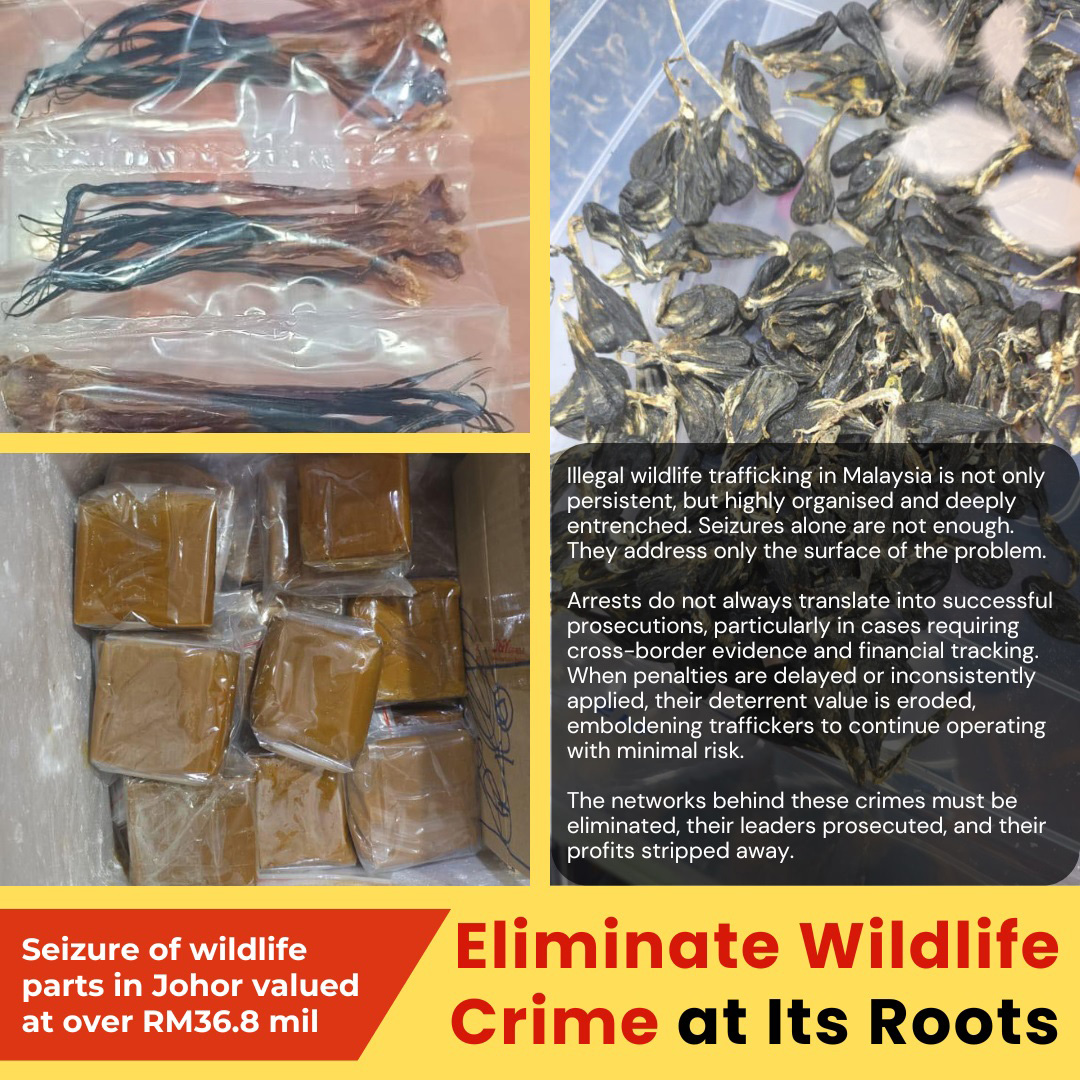
The Consumers’ Association of Penang (CAP) refers to the recent seizure of wildlife parts in Johor valued at over RM36.8 million. While the swift action by authorities is commendable, the scale of the haul exposes a far more troubling reality: illegal wildlife trafficking in Malaysia is not only persistent, but highly organised and deeply entrenched.
The confiscation involving tiger parts, bear bile, python bile and other protected species underscores Malaysia’s continued role as a significant hub in a lucrative global trade. This is not an isolated case. From rescued turtles in Penang to past seizures involving pangolins and other endangered wildlife, a clear pattern has emerged: enforcement agencies intercept shipments, yet the criminal networks behind them remain largely intact.
Wildlife trafficking today bears little resemblance to small-scale poaching of the past. It is now driven by sophisticated syndicates that rely on encrypted communications, complex supply chains, and layers of intermediaries to evade detection. Corruption further undermines enforcement, allowing elements of this trade to operate with impunity. The result is predictable. Those at the top, the so-called kingpins, often remain elusive.
While enforcement actions are necessary, they frequently address only the surface of the problem. Arrests do not always translate into successful prosecutions, particularly in cases requiring cross-border evidence and financial tracking. When penalties are delayed or inconsistently applied, their deterrent value is eroded, emboldening traffickers to continue operating with minimal risk.
Seizures should therefore be seen not only as successes, but as warning signs. They reveal both the effectiveness of enforcement and the vast scale of illegal activity that remains undetected. At the same time, agencies are constrained by limited resources, from manpower to technical capacity. Without sustained investment in advanced surveillance, forensic tools, and intelligence capabilities, enforcement efforts will struggle to keep pace with increasingly sophisticated criminal operations.
Malaysia’s legal framework is not the issue. The Wildlife Conservation Act 2010 provides for substantial penalties. What is needed is a stronger shift towards intelligence-led enforcement, strengthening international cooperation through regional and global partnerships, improving financial tracking to follow the money trail rather than just the movement of goods, and deeper cross-border collaboration to dismantle transnational syndicates. Wildlife crime must be treated on par with other forms of organised crime, given its scale, profitability, and irreversible ecological damage.
Demand remains a critical driver. Misguided beliefs in the medicinal value of wildlife products, combined with the high prices they command, continue to fuel this trade. Addressing this requires sustained public education, tighter regulation of online marketplaces, and penalties that reflect the enormous profits involved.
The public has a role, but it cannot carry the burden alone. Reporting suspicious activities and rejecting wildlife products are important steps, but must be matched by visible enforcement outcomes and accountability at all levels.
Seizures alone are not enough. The real measure of success will be whether the networks behind these crimes are eliminated, their leaders prosecuted, and their profits stripped away. Only then can Malaysia move from episodic victories to lasting impact and ensure that its rich natural heritage is preserved for future generations.
Mohideen Abdul Kader
President
Consumers’ Association of Penang
Press Statement, 15 May 2026