
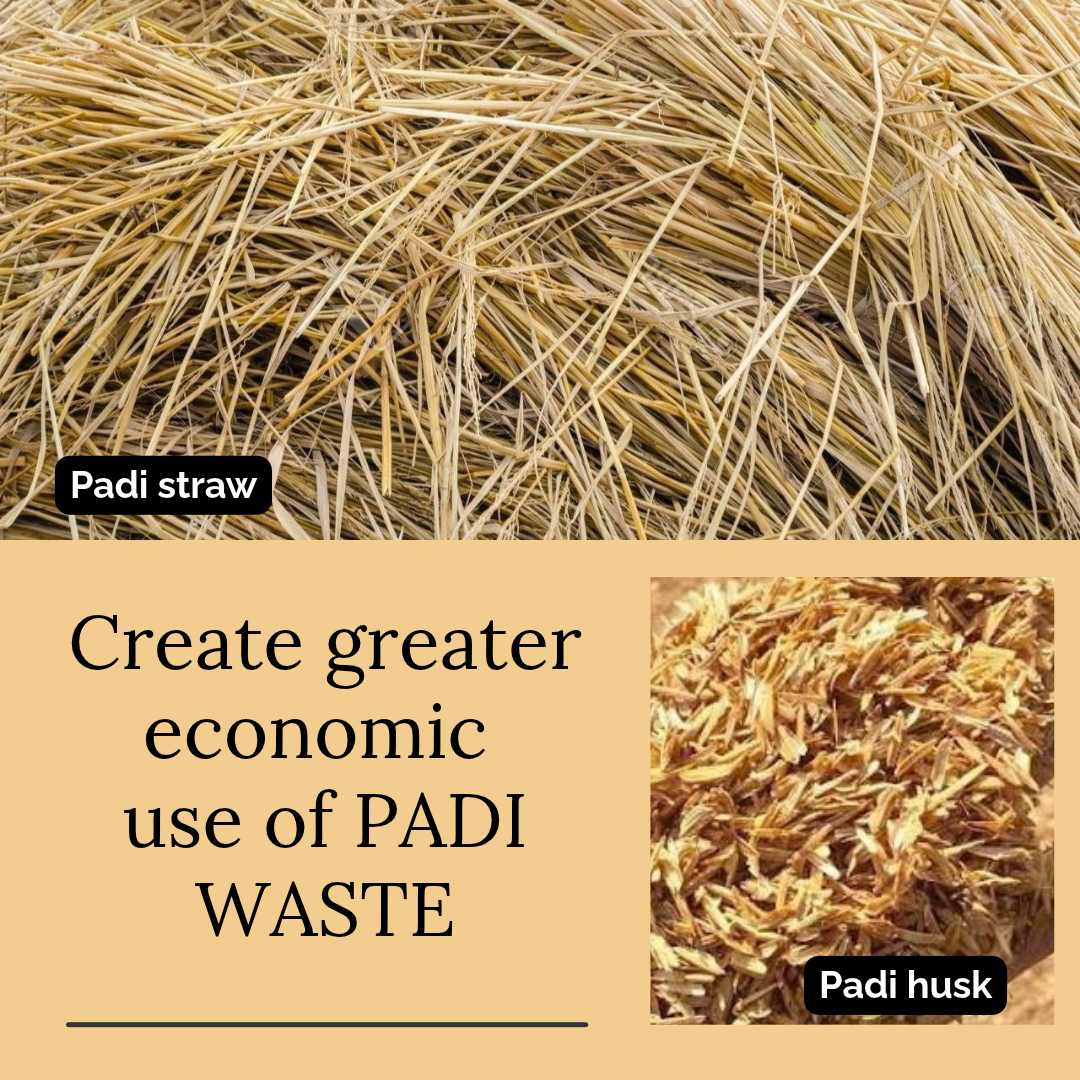
CAP Urges Greater Economic Use of Padi Waste
The Consumers’ Association of Penang (CAP) urges the authorities to collaborate with institutions of higher learning, research bodies and businesses to develop practical solutions that curb open burning and enhance the economic value of padi waste.
In 2000, the West Sumatra Provincial Government’s Regional Investment Coordinating Board published a guide for farmers on processing padi stalks into pulp for paper manufacturing. The guide estimated that one hectare of padi cultivation could yield approximately 1.2 tonnes of padi stalks, underscoring the potential of agricultural residues as valuable raw material.
The Muda Agricultural Development Authority (MADA) area in Kedah generates around half a million tonnes of padi stalks (rice straw) during each padi planting season. However, only 10,330 hectares, or about 10% of the MADA area, participate in recovery programmes, yielding roughly 15,000 tonnes of straw. Much of the remaining straw is burnt in the field, left to decompose or incorporated into the soil. While incorporation and composting can return nutrients to the land and improve soil health, open burning is polluting.
Between 2021 and 2023, nearly 5,000 farmers in the MADA area recovered approximately 15,000 tonnes of padi straw, generating a sales value of RM3 million. This demonstrates that padi straw, often dismissed as waste, can in fact generate significant economic value when systematically collected and put to productive use.
Rather than using padi stalks mainly for decorative displays such as the Jerami Castle at MADA@Jerai Geopark, MADA could assist farmers in developing higher-value uses, including pulp for paper production, bioethanol, and organic fertilisers.
We urge the Ministry of Agriculture and Food Security (KPKM) to collaborate with institutions of higher learning and research institutes to develop value-added applications for padi stalks. Although padi harvesting is seasonal, this need not be a major constraint, as padi-straw pulp can be blended with wood pulp or recycled paper, including for packaging.
Thailand is already producing biodegradable paper and packaging, while the Philippines, China and India are also working towards commercial-scale paper production using padi stalks. Using non-wood-based pulp could reduce reliance on wood, ease pressure on forests, and foster more sustainable supply chains for paper and packaging.
Studies by local and international institutions have examined padi-straw processing since at least the 1970s. While production costs may be higher than conventional alternatives, the environmental and social benefits help offset these challenges. Projects that utilise agricultural waste not only avoid emissions from open burning but also support rural livelihoods, strengthen resource efficiency, and contribute to climate and air-quality objectives.
Padi husk also has considerable potential as a resource. Studies indicate that for every 1,000kg of padi milled, about 220kg (22%) of husk is produced. It can be used as boiler fuel, particularly for drying padi. The resulting rice husk ash, consisting mainly of amorphous silica and minerals, should be recognised as a valuable industrial input rather than discarded.
Bernas, through its waste-to-wealth initiatives, produces what it describes as “reactive silica” of “substantial economic value”, which is sold to fertiliser manufacturers and farmers as a plant-growth medium. Carbonised padi husk can be converted into biochar for agricultural applications or used as feedstock for activated carbon.
Because padi straw is light and bulky, transporting it over long distances can be uneconomical. A practical solution would be to establish communal or decentralised processing facilities close to major padi-growing areas. These could collect straw from surrounding farms and convert it into higher-value products while creating additional employment and income opportunities.
Padi straw can also be used for mushroom cultivation. Farmers who utilise part of their straw for mushroom production could generate additional income while reducing agricultural waste. Another potential application is the production of wallboards and panels, subject to meeting appropriate strength, fire and durability standards.
The problem of padi husks and stalks should not be viewed merely as a waste disposal issue. Instead, it represents an opportunity to develop a circular agricultural economy in which rice-production residues are converted into paper, packaging, repurposed as livestock feed, organic fertiliser and other useful products.
CAP calls on KPKM, MADA, research institutions and industry to move beyond small-scale recovery projects and develop commercially viable, locally based processing systems. With appropriate technical support, financing, market development and environmental incentives, what is now often burnt or discarded could become an additional source of income for farmers, reduce air pollution and create new rural industries.
Malaysia should aim not merely to manage its padi waste, but to transform it into a valuable resource that strengthens sustainability, livelihoods, and climate resilience.
Mohideen Abdul Kader
President
Consumers’ Association of Penang
Letter to the Editor, 22 October 2026