
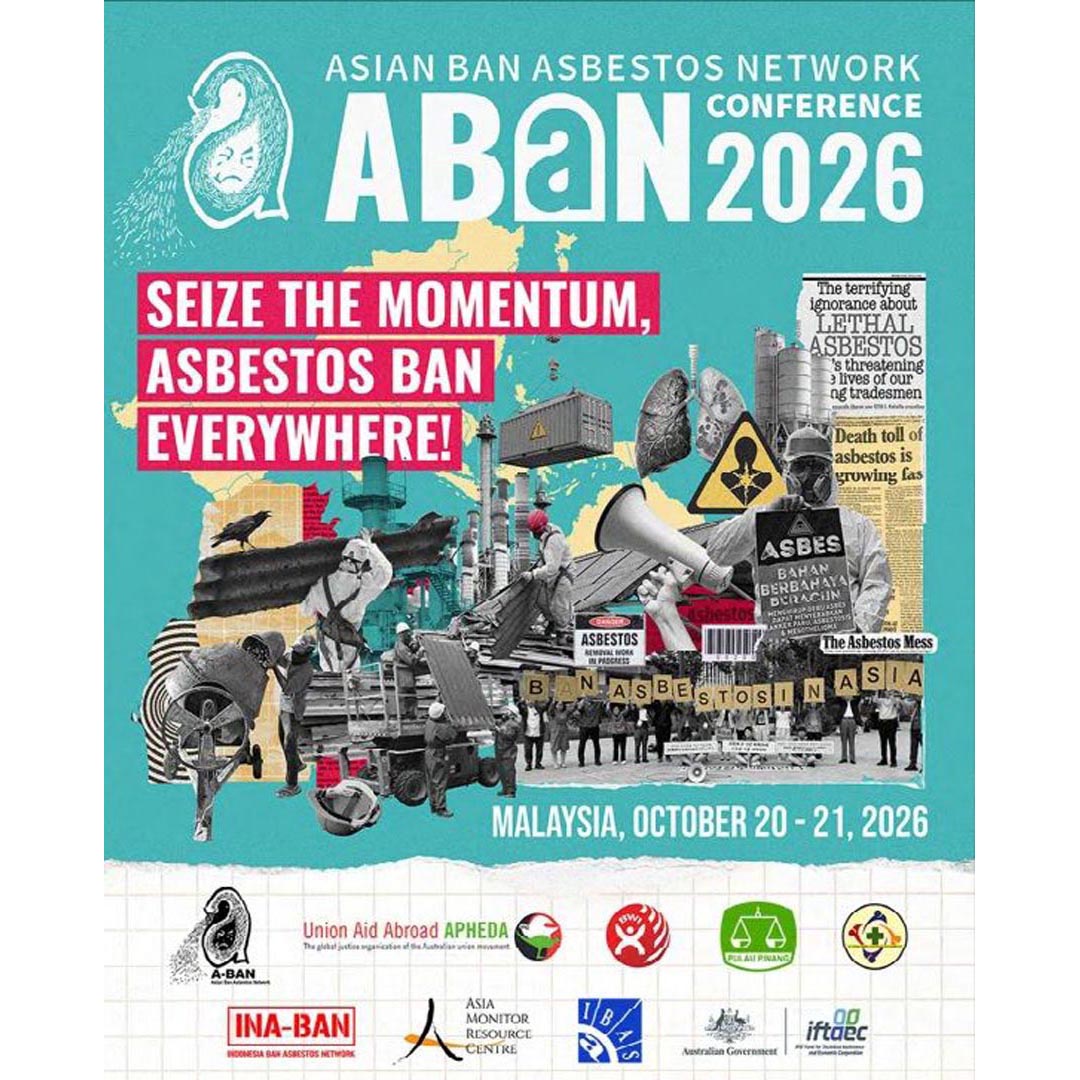
A-BAN 2026 Asia Pacific Conference: ‘Seize the Momentum, Ban Asbestos Everywhere’
Conference Statement
Why is Asia the last region in the world to stop importing toxic asbestos to use in manufacturing in any real quantity?
At what cost to public health, the economy and the environment?
Malaysia urged to move ahead with announced ban on asbestos imports as a matter of urgency.
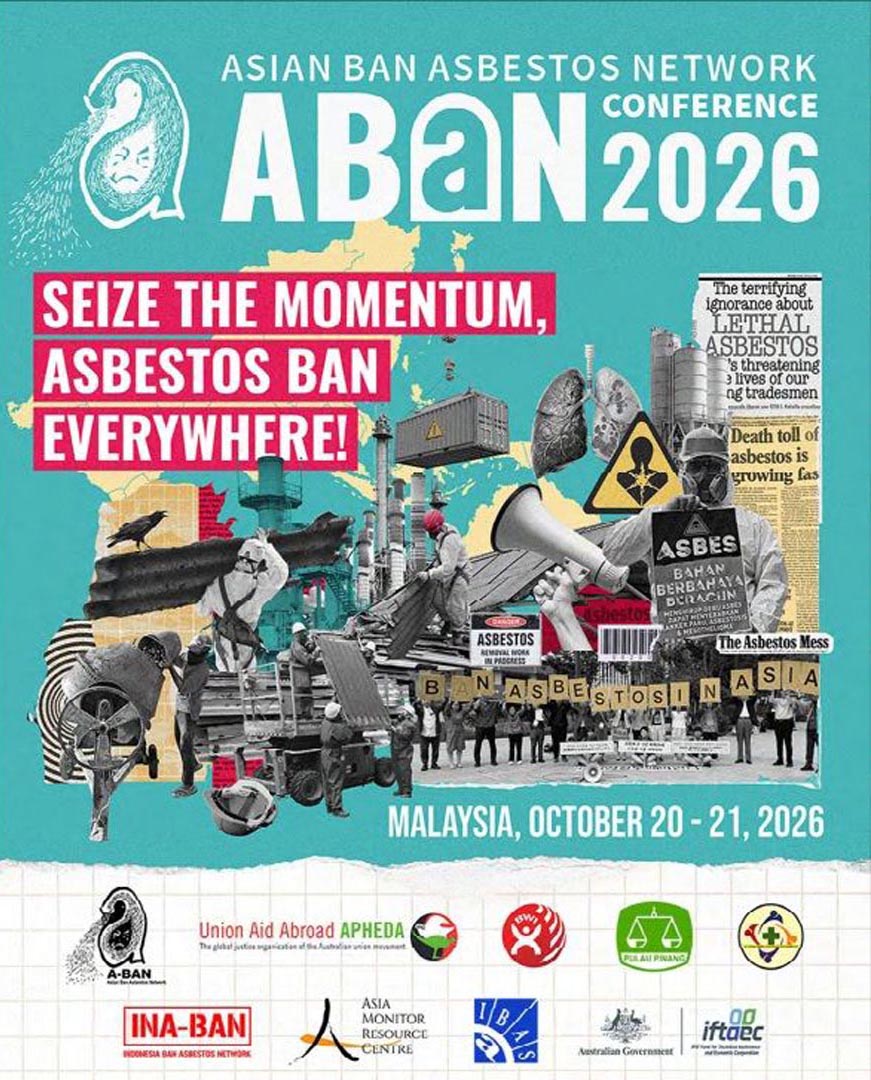
Kuala Lumpur 21 October 2026: The Asian Ban Asbestos Network (A-BAN), including a wide range of organisations in Malaysia, and 16 other countries across the Asia Pacific gathered in Kuala Lumpur on 20th and 21st October for the A-BAN Asia Pacific Conference ‘Seize the Momentum, Ban Asbestos Everywhere’.
The meeting noted significant Government announcements across the Asia Pacific in the last six months to move away from asbestos, transition to safer alternative materials and reduce asbestos related diseases, including the Philippines, Indonesia, Cambodia, Malaysia and Fiji and previous announcements from Vietnam and Laos. Also noted was the Asia Development Bank’s prohibition on asbestos containing materials from January 2026 in all new investments, as well as the full ban of asbestos, announced by the Brazil Supreme Court in October 2026.
The meeting calls on
- The Malaysian government to urgently move forward with the planned outright ban on all types of asbestos fibre including chrysotile being imported into the country. The network also calls for an urgent phasing out of consumer products containing asbestos.
- Construction companies across the region to join companies in more than 75 other countries and Territories who prohibit the use of asbestos containing materials and use safer alternative materials, to stop exposures and save the lives of their workforce and the public in coming decades.
- The asbestos industry to immediately desist from its intimidation of government officials and health advocates in their blatant attempts to interfere in national policy, delay health and safety regulation and silence voices warning workers and the public of the risk of exposure to this material.
- All governments that are still allowing the import and use of asbestos and asbestos containing materials, to ignore misinformation from those profiting from the sale of this Class 1 carcinogen, chrysotile asbestos, and follow WHO and ILO recommendations and advice and the action of 75 other countries and Territories, to transition to safer materials as the most effective way to eliminate asbestos related diseases and ensure just compensation for asbestos disease victims.
- The International Finance Corporation (IFC) and the World Bank, to immediately prohibit asbestos containing materials from their supported investments.
- Parties to the Rotterdam Convention concerned about the 20 years of blocking of chrysotile asbestos by industry interests (among a growing list of other chemicals), to work together to find a solution to ensure hazard and health information on recommended chemicals such as chrysotile asbestos, is available to low-income countries and transitioning economies.
The meeting commends
- Health advocates and activists, within trade unions, civil society and government, who bravely stood up against industry intimidation and threats across the region, in their efforts to protect public health and at-risk workers.
The meeting acknowledges and supports the Asia Pacific regional trade union movement, through the ITUC-AP, which is convening a regional asbestos meeting in Jakarta, Indonesia on 23 and 24 October 2026 to:
- Build solidarity, connections and share organising strategies between trade unions and campaigners of ban asbestos in the region and globally.
- Encourage actions by governments at the local, national, regional and global level to transition away from asbestos and improve worker protection.
- Provide support for the campaign for an asbestos transition in Indonesia at a time of heightened efforts by the pro-asbestos lobby to misinform governments on the toxicity of asbestos and influence government policies.
Global and regional solidarity among workers, their trade unions, civil society, health and environmental specialists is vital to bring an end to trade in this deadly product and the devastation it is bringing to communities.
Further information
Asbestos is a group of naturally occurring silicate minerals composed of long, thin fibres used extensively last century in building and other products until its deadly health impacts became clear.
The WHO, ILO have advised there is no safe level of exposure to asbestos fibre. Asbestos is classified as a Group I carcinogen by the International Agency for Research on Cancer (IARC) and responsible for over 200,000 deaths annually around the world.
There is clear and unequivocal evidence of cancer and other disease risks associated with the exposure to asbestos fibres in the lung. This fibre alone is the cause of 70% of global occupational cancers according to the ILO.
As most of the world has stopped using asbestos fibre in manufacturing, in 2023, an astonishing 94% of global imports of asbestos fibre were to Asia.
Workers continue to face serious risks from asbestos exposure, particularly in asbestos product manufacture, removal and demolition of buildings, building maintenance, transport, ship-breaking, waste handling activities and in disaster situations. Risks of exposure and disease affect workers in the formal and informal workforce, including migrant workers, women and men as well as children.
Asbestos-related diseases include lung cancer as the most common, mesothelioma, ovarian cancer, laryngeal cancer and asbestosis among others. There is no cure for asbestos related diseases. These diseases related to exposure to asbestos can all be prevented and the most efficient way to prevent them is to stop the use of all forms of asbestos to prevent exposure.