
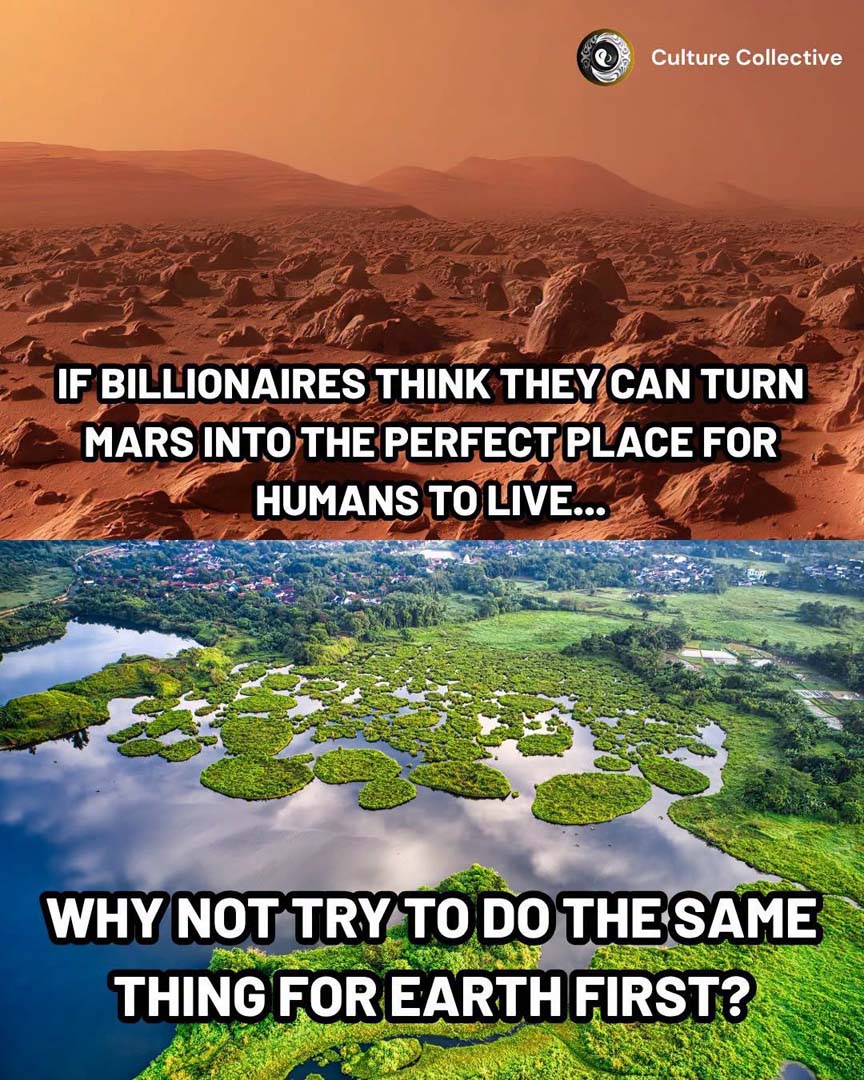
Fix Earth or Colonise Mars?
Some of the world’s wealthiest people are investing billions of dollars into developing technology that could one day allow humans to live on Mars.
But there’s something extraordinary about that ambition when you consider what life on Mars would actually involve.
Mars has almost no breathable oxygen, extremely cold temperatures, very little atmospheric protection and no oceans or forests to sustain human life.
Scientists would have to develop incredibly advanced systems just to provide the basic necessities we already have naturally on Earth.
Meanwhile, our own planet already has everything humans need to survive.
We have breathable air, freshwater rivers, fertile land, beautiful forests, thriving oceans and an atmosphere that protects us from the harsh conditions of space.
Yet we continue to face enormous environmental challenges, from pollution and deforestation to climate change and the destruction of natural habitats.
If billionaires believe they can turn Mars into a perfect place for humans to live, why not try doing the same thing for Earth first?
It’s a question that has sparked a fascinating debate about humanity’s priorities and the future of our planet.
Protecting earth’s resources deserves the same ambition and creativity directed toward space exploration. Restoring damaged ecosystems, reducing pollution, and protecting biodiversity are investments in a future we can build right here.
After all, restoring forests, cleaning oceans and developing cleaner technologies are far more achievable than transforming an entire planet millions of miles away.
Space exploration and environmental protection don’t have to compete, but the comparison raises an important question about where humanity chooses to focus its resources.
Perhaps the greatest achievement wouldn’t be making another planet more like Earth. Perhaps it would be making sure Earth remains the beautiful, extraordinary place it already is.
Preserve the unique world we have. Because there truly is no Planet B. Let’s prioritise taking care of Earth.
Source: Top 10s; PowWows; Culture Collective