
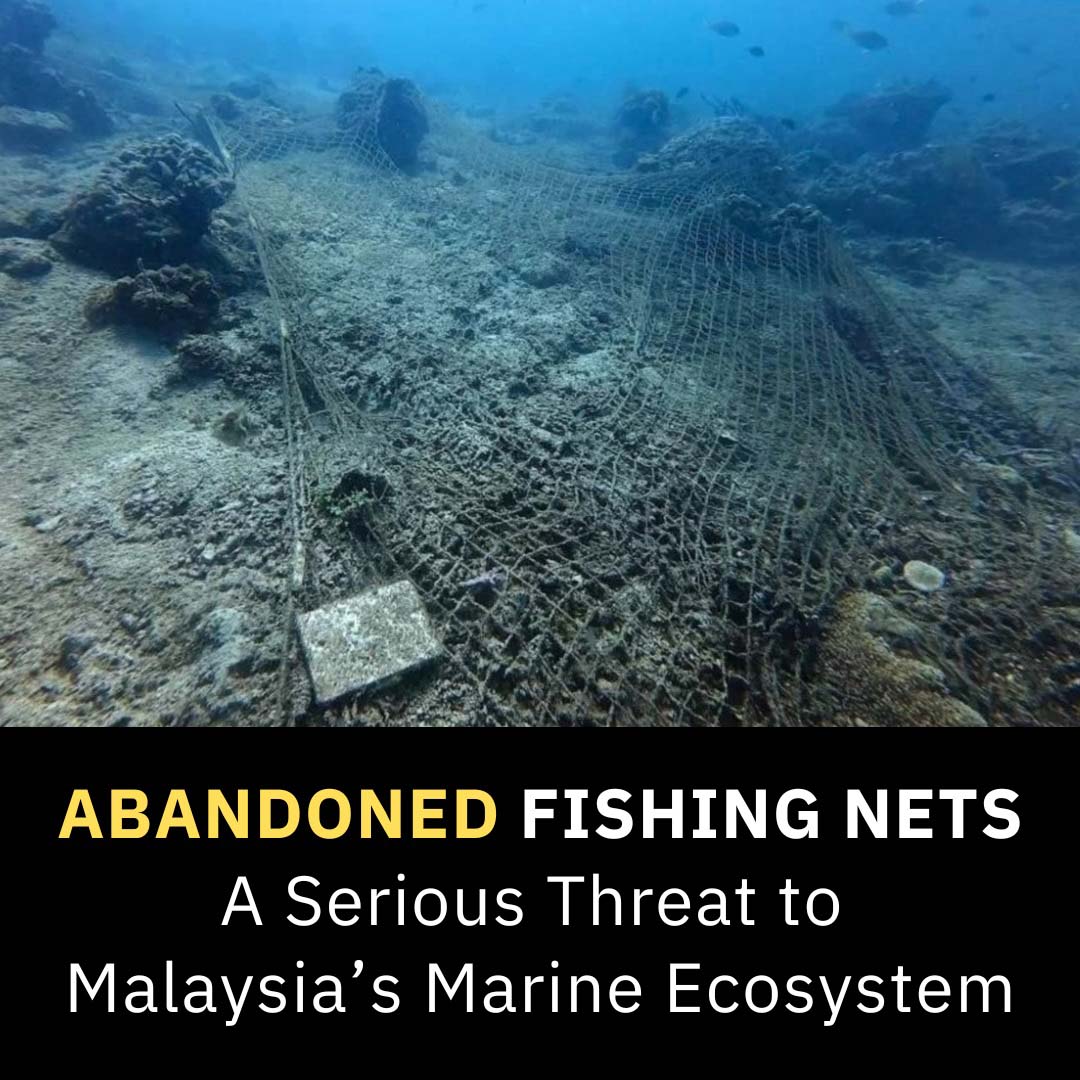
Ghost Nets Persist as a Serious Threat to Marine Biodiversity in Malaysian Waters
Ghost fishing nets are rapidly emerging as one of the most destructive yet overlooked threats to Malaysia’s marine ecosystem. These abandoned nets left drifting or entangled beneath the surface are the direct result of irresponsible fishing practices.
As highlighted in recent news, the persistence of such behaviour raises serious concern as to whether it stems from a lack of awareness or a deliberate neglect of environmental responsibility. Ahead of World Ocean Day on 8 June, greater attention must be given to the urgent need for stronger marine conservation and responsible fishing practices.
Once lost or discarded, these fishing nets trap marine life in a cycle of death. Rare guitar sharks, turtles and large fish have been trapped in these nets and die due to suffocation and starvation, while others mistake plastic materials for food, ingesting them as they resemble jellyfish. What follows is not immediate, but prolonged suffering which eventually turns Malaysian waters into unsafe habitat for marine life.
Beyond marine species, the damage extends to the entire marine ecosystem. Ghost nets entangle and break coral reefs, which are one of the most vital foundations of marine biodiversity, causing long-term ecological degradation. These impacts are not temporary as they accumulate over time and weaken the resilience of oceans.
It was reported that in waters off Kota Kinabalu, Yong Lip Khiong, programme director of the Sabah Dive Squad Club, together with his team, descended 12 metres below the surface to remove part of a 100-metre-long ghost net. The retrieval of 78kg of waste including abandoned fishing nets during a single clean-up operation underscore how widespread and severe this issue has become.
This is not an isolated case confined to Sabah waters. Similar threats are present across Malaysian waters, signalling a nationwide environmental concern that can no longer be addressed through isolated clean-up efforts alone.
The Consumers’ Association of Penang (CAP) therefore urges the Department of Fisheries Malaysia and the Ministry of Natural Resources and Environmental Sustainability to address this issue at its source and take action by:
- Enforcing mandatory reporting of lost or abandoned fishing nets with clear penalties for failure to comply.
- Introducing an accountability system, including tagging or identification of nets to trace ownership.
- Imposing strict penalties for deliberate disposal or negligent loss of fishing equipment.
- Conducting compulsory training or certification workshops on sustainable fishing practices for all licensed fishermen.
- Establishing a structured system for the collection, repair and recycling of abandoned and damaged fishing nets.
While clean-up initiatives remain valuable, they are reactive measures that address only the aftermath of the issue. As long as irresponsible fishing practices continue unchecked, ghost nets will keep accumulating in Malaysian waters. Drifting ghost nets is also a transboundary issue.
Addressing this issue requires a decisive shift from periodic removal efforts to firm prevention and enforcement at the source. Without such action, marine ecosystems will continue to suffer from threats and pollution.
Only through strong regulation, accountability and sustained enforcement, can we effectively curb the rise of ghost fishing nets and protect our oceans and marine biodiversity.
Mohideen Abdul Kader
President
Consumers’ Association of Penang
Press statement, 8 June 2026