
Malaysia’s Expanding Waste-to-Energy Plans Raise Climate Concerns, as Delhi Report Finds Incinerators Carry High Fossil-Carbon Burden
29 October 2026
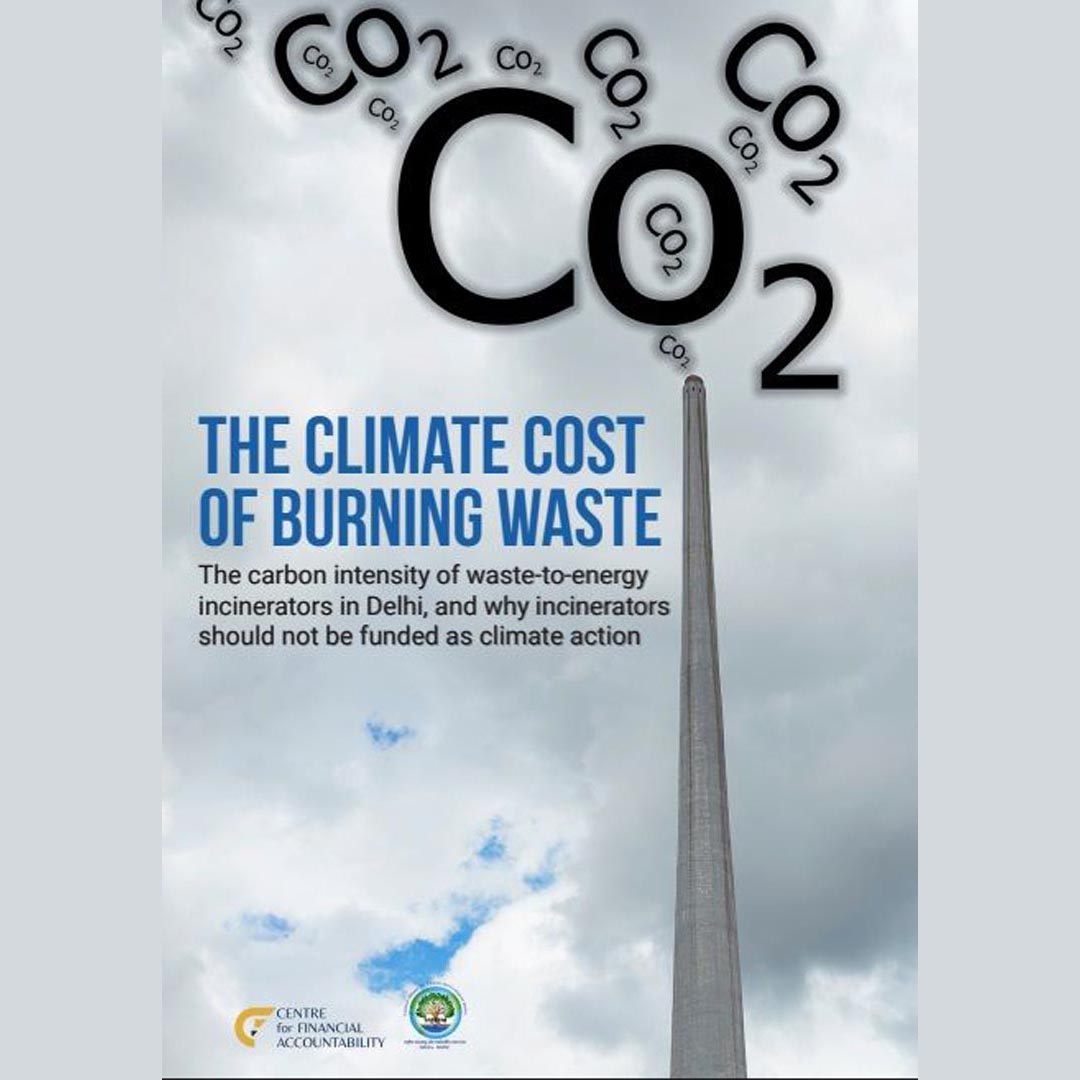
A new report, The Climate Cost of Burning Waste: The Carbon Intensity of Waste-to-Energy Incinerators in Delhi, and Why It Should Not Be Funded as Climate Action, finds that electricity generated by Delhi’s four operational waste-to-energy (WTE) incinerators carries a high fossil-carbon burden.
The joint study done by the National Alliance for Climate and Ecological Justice (NACEJ) and the Centre for Financial Accountability (CFA) estimates 3.4 kg of fossil-origin (plastic waste) CO₂ per kWh of net electricity exported – around 4.7 times the Central Electricity Authority’s weighted-average factor for Indian grid electricity and 3.5 times the coal factor used in the report.
Delhi’s waste-to-energy plants expose the climate cost of a model being promoted across the Global South. As cities across Asia, Africa and Latin America face pressure to adopt incineration in the name of modern waste management and clean energy, Delhi raises a critical question: why should public money and climate finance support the burning of plastic-rich waste when genuine Zero Waste systems offer a pathway focused on prevention, reuse, recycling and composting?
Malaysia’s expanding WTE programme makes the findings of this report particularly relevant to Southeast Asia. In Selangor, the Jeram WTE 1 incinerator began commercial operations in May 2026, with a capacity to incinerate up to 1,500 tonnes of municipal waste daily and generate 26 MW of electricity. A second unit at Jeram is nearing completion, while another facility is planned at Tanjung Dua Belas, Selangor.
At the national level, Malaysia has announced plans for 18 WTE plants by 2040, targeting a combined electricity-generation capacity of 600 MW. As incineration is increasingly promoted as a solution to landfill pressures and a source of renewable energy, questions about its actual climate impact, long-term financial implications and consequences for waste prevention and recycling require urgent scrutiny.
Although this report examines Delhi’s four WTE incinerators rather than facilities in Malaysia, its findings raise important questions for Malaysia’s waste and climate policies. Public investment and climate finance should prioritise waste prevention, reuse, refill systems, source segregation, toxic-free recycling and composting, rather than lock communities into an infrastructure model that depends on a continued supply of waste to burn.
Plastic combustion is central to the climate cost
The four plants in Delhi reported processing 735,840 tonnes of plastic in 2023 – roughly 2,016 tonnes per day. The report estimates that plastics made up about 42% of their RDF feed by mass. Burning plastic releases fossil carbon as CO₂ and destroys material that could otherwise be targeted for prevention, reuse or recycling. The study’s direct emissions estimate is equivalent to the annual emissions of about 1.44 million cars, using the report’s comparison.
| 7,35,840 tons
plastic reported as incinerated by Delhi’s four plants in 2023 |
42% plastic burnt
as refuse-derived fuel (RDF) feed by the four WTE incinerators |
2.1 million tons
estimated direct fossil-origin CO₂ from plastic combustion |
The “plastic paradox”: burning plastic can generate EPR value
India’s Extended Producer Responsibility (EPR) framework recognises WTE incinerators as Plastic Waste Processors, allowing them to generate EPR certificates for quantities of plastic they burn. The report argues this can create a financial incentive for combustion rather than reductions in plastic use, reuse and refill systems, or improved packaging.
A regulatory contradiction
The report also questions the classification of WTE incineration as an “essential environmental service”. CPCB introduced a Blue Category for Essential Environmental Services in 2025 that includes WTE incineration; a separate CFA assessment estimated a Pollution Index of 100/100 for Delhi’s four plants. The index measures pollution potential, not climate emissions.
Very little electricity for a high carbon cost
| ~198 kWh
estimated net electricity exported per tonne of raw municipal solid waste |
Less than 1.5%
estimated share of Delhi’s total electricity demand supplied by the four plants |
Although this is a Delhi case study, the findings have wider relevance as WTE incineration is promoted across the Global South as a waste-management, energy and climate intervention. The report argues that international climate finance should back measurable emissions reductions and zero-waste systems, not infrastructure that depends on continued waste generation and plastic combustion.
What the report calls for
| 1. Exclude municipal-waste incineration from climate finance, including new and expanded projects. | 2. End carbon crediting for municipal-waste incineration, including reconsideration of Clean Development Mechanism credits. |
| 3. Remove mixed municipal-waste incineration from renewable energy classifications and “Blue” categorisation. | 4. End EPR credits and other incentives that reward plastic combustion; prioritise prevention, reuse, source segregation, recycling, biological treatment and waste-worker integration. |
“Expanding waste incineration fuels the climate crisis. Waste-to-energy incineration facilities emit significant greenhouse gases, toxic air pollutants and hazardous ash, posing risks to both the environment and public health. Rather than destroying valuable resources through incineration, investments should prioritise waste prevention, reduction, reuse, repair, composting and advancing zero-waste systems that deliver far greater climate benefits, conserve resources, create local employment opportunities, and support community livelihoods.” said Mageswari Sangaralingam, Chief Executive and Senior Researcher for the Consumers’ Association of Penang (CAP) and the Honorary Secretary for Sahabat Alam Malaysia (Friends of the Earth Malaysia).
“Extracting fossil fuels, producing ever more plastic, and then burning the resulting waste in waste-to-energy plants is an unending cycle that doesn’t solve the problem; it only makes the waste mountains disappear from view. Incineration simply converts that waste into CO2, an invisible gas that continues to warm the planet. Financing these facilities with climate funds is not a Zero Waste solution, and it must stop.” said Anwesha Maharana, co-author of the report and visiting Scientist, United Nations University – Institute for Environment and Human Security (UNU-EHS).
“International Climate finance should not support WTE incineration whose electricity carries such a high fossil-carbon burden. It should instead support waste prevention, reuse, recycling and worker-centred zero-waste systems,” said Chythenyen Devika Kulasekaran, co-author of the report from the Centre for Financial Accountability.
“Waste incineration is being projected as climate action, but it is among the most carbon-intensive ways to generate electricity. It also displaces the livelihoods of thousands of marginalised waste workers, releases carcinogenic pollutants, leaves toxic residues, and deprives the soil of nutrients. We must stop burning waste forthwith,” said Soumya Dutta, Research Director of the report and Trustee, MAUSAM (Movement for Advancing Understanding of Sustainability and Mutuality), and former Advisory Board member, UN Climate Technology Centre and Network.
Link to full report – https://cenfa.org/the-climate-cost-of-burning-waste/