
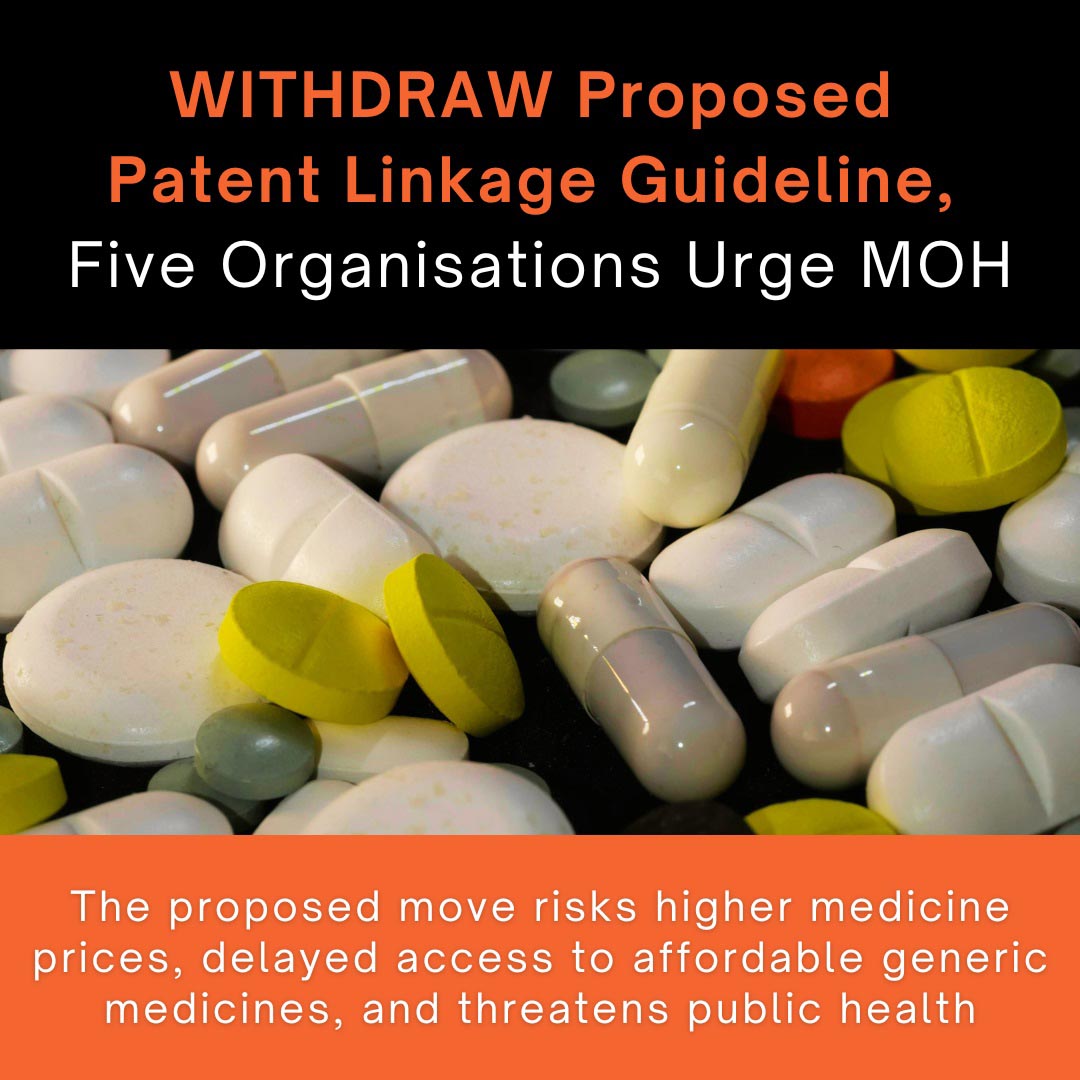
MOH’s Proposed Patent Linkage Guideline Risks Higher Medicine Prices and Delayed Access
Malaysia stands at a critical juncture in ensuring access to affordable medicines. The government’s decision to cut the health budget by RM3.06 billion, together with a proposed move by the Ministry of Health, risks worsening the situation.
In April, the National Pharmaceutical Regulatory Agency (NPRA) opened a public consultation on its proposed ‘Guideline on Implementation of Patent Linkage for Pharmaceutical Products in Malaysia’, presented as fulfilling an obligation under the Comprehensive and Progressive Agreement for Trans‑Pacific Partnership (CPTPP). Although framed as procedural, the guideline’s implications run far deeper and threatens timely generic entry, medicine affordability and public health.
CPTPP’s Article 18.53 provides options. Its minimum requirement is to provide a simple system of notification to the patent holder prior to the marketing of a generic pharmaceutical product during the term of an applicable patent, plus adequate time to seek remedies. It does not mandate the more intrusive measures that NPRA proposes.
Under NPRA’s draft, the originator companies would list their patents during the new product registration process. The generic company seeking regulatory approval may undertake not to market its generic medicine until expiry of the patents in force. Where the generic company believes that the patent in force is invalid or will not be infringed by the marketing of its generic medicine, the generic company will have to notify the patent holder and product registration holder of the new product. Upon notification, the latter are then entitled to a 45-day window to initiate legal action which, once initiated, will trigger an automatic 12-month suspension of the regulatory approval process of the generic medicine. Notably, New Zealand, a CPTPP Party, with Gross National Income per capita 4 times larger than Malaysia has made clear that CPTPP compliance does not necessitate such measures.
International experience and studies show that “patent linkage” mechanisms of this kind function as powerful tools to delay generic competition regardless of the merits of the underlying patent claim.
Generic entry reliably lowers prices and expands access to life‑saving medicines. In Malaysia, where pharmaceutical costs already burden patients and an over-stretched public health system, prompt access to generics is a public health necessity, not merely an economic issue. NPRA’s proposed guideline risks erecting procedural barriers that shield originator companies from competition and place affordable medicines beyond reach for those most in need.
Crucially, NPRA’s statutory mandate is to assess the quality, safety and efficacy of pharmaceutical products. Patent grants and enforcement fall under the Intellectual Property Corporation of Malaysia (MyIPO) and the courts. This separation reflects a principled distinction between public health regulation and private commercial rights. The proposed guideline erodes that divide by effectively deputizing the regulator to act — automatically and without judicial determination — as an enforcement arm for patent holders.
Yet Malaysian law already equips patent holders with robust remedies. Under the Patents Act, they may seek injunctions and other legal relief if they can demonstrate to a court that infringement is imminent. The burden of proof lies with the patent holders — as it should.
This inversion of roles in the proposed guideline is dangerous. It converts a scientific regulator into an administrative gatekeeper for private intellectual property (IP) rights operating without the procedural safeguards a court provides.
The patent linkage system as proposed by NPRA is particularly susceptible to strategic manipulation. Originator companies commonly pursue numerous secondary patents on various forms and formulations of an existing medicine including dosages, esters, salts, polymorphs and new uses. These rarely represent meaningful therapeutic innovations but can be used to extend their market monopoly by several years (so‑called “evergreening”).
NPRA is encouraging this practise through its draft guideline. Now the originator company will be even more motivated to file secondary patents. Each listed patent will extend the patent expiry date with the potential to trigger litigation and suspend the regulatory process of the generic applicant.
Evidence from countries that have implemented linkage systems reveals predictable harms. Countries that adopted linkage saw increases in patent filings and disputes, with consequential delays in generic market entry.
In the United States, investigations by the Federal Trade Commission have revealed systemic abuse of the linkage system. The Commission found that originator companies engaged in improper patent listings and warned that such practices can harm generic competition, discourage investment in the development of generic medicines, limit patient access to more affordable treatments, and drive up costs across the healthcare system. It further observed that “given the enormous profit margins of many branded drugs, even small delays in generic competition can generate substantial additional profits for brand companies at the expense of patients”.
In Malaysia, where public health budgets are finite, now to be further reduced, and many patients pay out-of-pocket, delays translate into higher treatment costs, increased financial strain on households, greater pressure on public health spending and reduced access to essential medicines. The cost of delayed competition is paid directly by patients and taxpayers.
Malaysia has progressed in developing a domestic generic pharmaceutical sector that underpins affordability and national health security. NPRA’s proposal creates a structural incentive to pursue litigation against generic companies.
In Malaysia, generic manufacturers operate on tight margins, face substantial risks in an uncertain market and lack the resources to withstand repeated or prolonged legal challenges from patent-holding multinational companies. The threat of litigation alone, even in the absence of any actual patent infringement, can deter generic companies from seeking marketing authorisation.
A linkage system that facilitates litigation‑triggered delays will raise uncertainty and costs, have a chilling effect, discouraging generics from entering the market as early as possible, just to avoid the risks and costs of frivolous lawsuits, thereby delaying market entry and weakening competition. Over time, this undermines the very ecosystem Malaysia is working to build through its various national policies such as the National Generic Medicines Framework and the New Industrial Master Plan 2030.
Proponents argue patent linkage protects innovation and is needed to fulfil international obligations. This frames a false choice. Respecting patents and ensuring access to medicines are compatible goals; Malaysia’s current system already strikes that balance. The question is whether regulatory agencies should be repurposed to enforce private IP rights in ways that go beyond CPTPP’s minimal requirements and is economically unjustified. The NPRA guideline, as drafted, risks locking Malaysia into a system that shifts enforcement power from courts to administrative processes, expands opportunities for evergreening patents and strategic delay, delays generic competition, and sustains high medicine prices. It offers no public health benefit to justify these trade-offs.
At a time of rising healthcare costs, a shrinking health budget and growing demand for affordable treatment, Malaysia cannot afford policies that restrict access to medicines. Generic competition remains one of the most effective tools for reducing prices and expanding treatment access. Any policy that delays this competition is contrary to public interest. The proposed patent linkage guideline, if adopted in its current form, risks doing more harm than good — introducing new barriers, enabling prolonged monopolies, and ultimately hurting patients.
Malaysia has the opportunity to implement its CPTPP commitments in a manner that preserves flexibility, supports its generic industry, protects public health and national health security. That opportunity should be seized. The proposed NPRA guideline must be withdrawn. The stakes are concrete and urgent — they are measured in medicine affordability, the sustainability of the healthcare system, and the lives of patients.
Consumers’ Association of Penang (CAP)
Federation of Malaysian Consumers Associations (FOMCA)
National Cancer Society of Malaysia (NCSM)
Malaysian AIDS Council (MAC)
Third World Network (TWN)
Letter to the Editor, 2 May 2026