
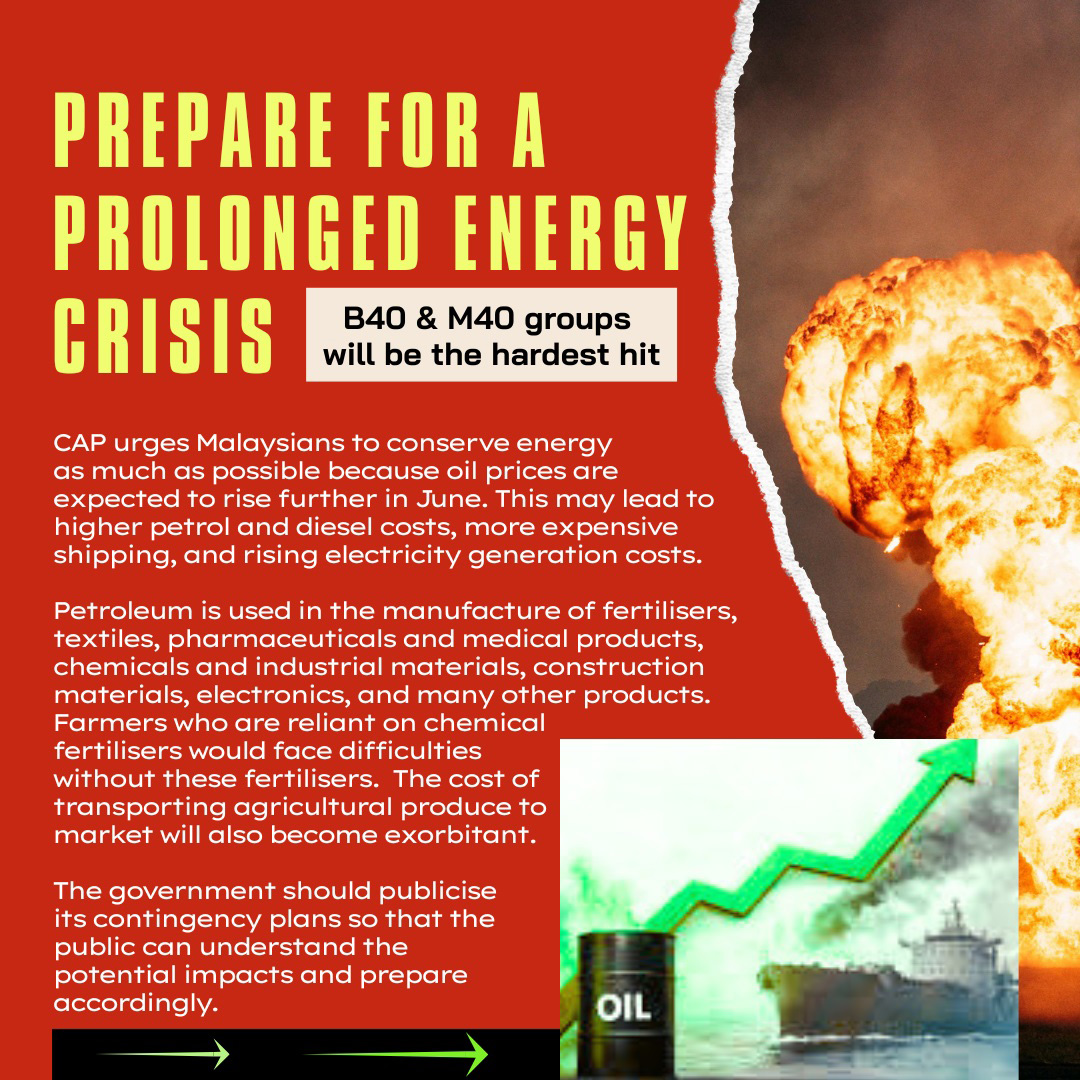
Preparing for a Prolonged Energy Crisis
The oil supply shortage is a global issue, and Malaysia cannot continue sustaining its RON95 and diesel subsidies indefinitely. It was reported in early March 2026 that the government was subsidising RM3.2 billion per month, but by April 2026 this had risen to more than RM6 billion per month. Even at RM3.2 billion per month, the subsidy would cost the government close to RM40 billion per year, assuming oil prices do not increase further. This would amount to approximately 9% of the national budget for 2026. The subsidy burden is ultimately shared by all Malaysians.
It has also been estimated that the T20 group consumes about 30% of the total RON95 subsidy. The higher consumption is attributed to the fact that those in the T20 are more likely to own multiple vehicles, drive larger vehicles, and travel more frequently. Reducing or removing RON95 subsidies for the T20 therefore appears inevitable on these grounds. Meanwhile, the government should also consider removing access to RON95 subsidies for mat rempits and banning the organisation of motorised convoys during the current energy crisis.
Many Malaysians are unaware that RON95 and diesel subsidies are intended to buffer the economy for as long as possible, initially in the hope that the conflict would end quickly. However, the asymmetric warfare led to the blockage of the Strait of Hormuz, disrupting a significant portion of the approximately 20% of global oil supply that passes through it. There have also been temporary shutdowns in production as oil fields and refineries in Gulf states were damaged, evacuated, or forced to suspend operations.
At present, there is no indication of when the conflict will end and, if the situation deteriorates further, oil prices could reach USD150 per barrel or more. The head of the International Energy Agency reportedly described the situation caused by the war as the “greatest global energy security challenge in history”.
The Consumers’ Association of Penang (CAP) urges Malaysians to conserve energy as much as possible because oil prices are expected to rise further in June. This may lead to higher petrol and diesel costs, more expensive shipping, and rising electricity generation costs. The B40 and M40 groups are likely to be affected the most.
Most people focus excessively on fuel prices and overlook the fact that petroleum is used in the manufacture of fertilisers, textiles, pharmaceuticals and medical products, chemicals and industrial materials, construction materials, electronics, and many other products. Farmers who are reliant on chemical fertilisers would face difficulties without these fertilisers. The cost of transporting agricultural produce to market will also become exorbitant.
Factories may have to scale down production for three main reasons: shortages of raw materials, increased production costs, and logistical disruptions. If the situation reaches that stage, factories may have to implement Voluntary Separation Schemes (VSS) or retrench workers. CAP therefore calls on the public to reduce unnecessary expenditure on expensive products and services and to begin saving in preparation for possible economic hardship.
The World Bank has projected that fertiliser prices could increase substantially this year, with urea prices potentially rising by about 60%. In emerging markets, where it is difficult to pass these costs on through higher food prices, farmers may reduce fertiliser usage, resulting in lower crop yields.
The fuel crisis highlights the risks of an agricultural system that relies on fossil fuel-based inputs. Malaysia needs to urgently shift toward agroecology, moving away from agrochemicals, and transition to using biological inputs such as compost, practise integrated soil fertility management, agroecological pest control and boosting agrobiodiversity.
Another concern is that electricity consumption may increase as people rely more heavily on fans and air conditioners, while global warming exacerbated by the Gulf conflict may further contribute to rising temperatures. Moreover, more than 30% of Malaysia’s power generation is dependent on liquid natural gas (LNG).
Malaysia needs to drastically reduce our reliance on fossil fuels for energy generation and accelerate the National Energy Transition Roadmap. Our transition to renewable energy that is clean, accessible, affordable, sustainable, and reliable has to be stepped up. Policy support and government financing through subsidies and tax incentives are needed to enable consumers to afford renewable energy solutions.
Some preliminary studies have estimated that the recent conflict involving the United States, Israel, and Iran generated more than five million tonnes of carbon dioxide in its first two weeks. Climate change may further disrupt agricultural cycles, reduce crop yields, and contribute to rising food prices.
Even if the Gulf conflict ends soon, damaged oil infrastructure could take years to recover fully. If the conflict continues for years, the problem may no longer be limited to inflation but could extend to shortages of goods and energy, requiring strict rationing. To prepare for these possible consequences, consumers should be ready for an energy crisis that may affect the entire world.
The government should publicise its contingency plans so that the public can understand the potential impacts and prepare accordingly. However, governments can only do so much to soften the impact, and individuals must also take steps to protect themselves financially and reduce unnecessary consumption.
Mohideen Abdul Kader
President
Consumers’ Association of Penang
Letter to the Editor, 18 May 2026