
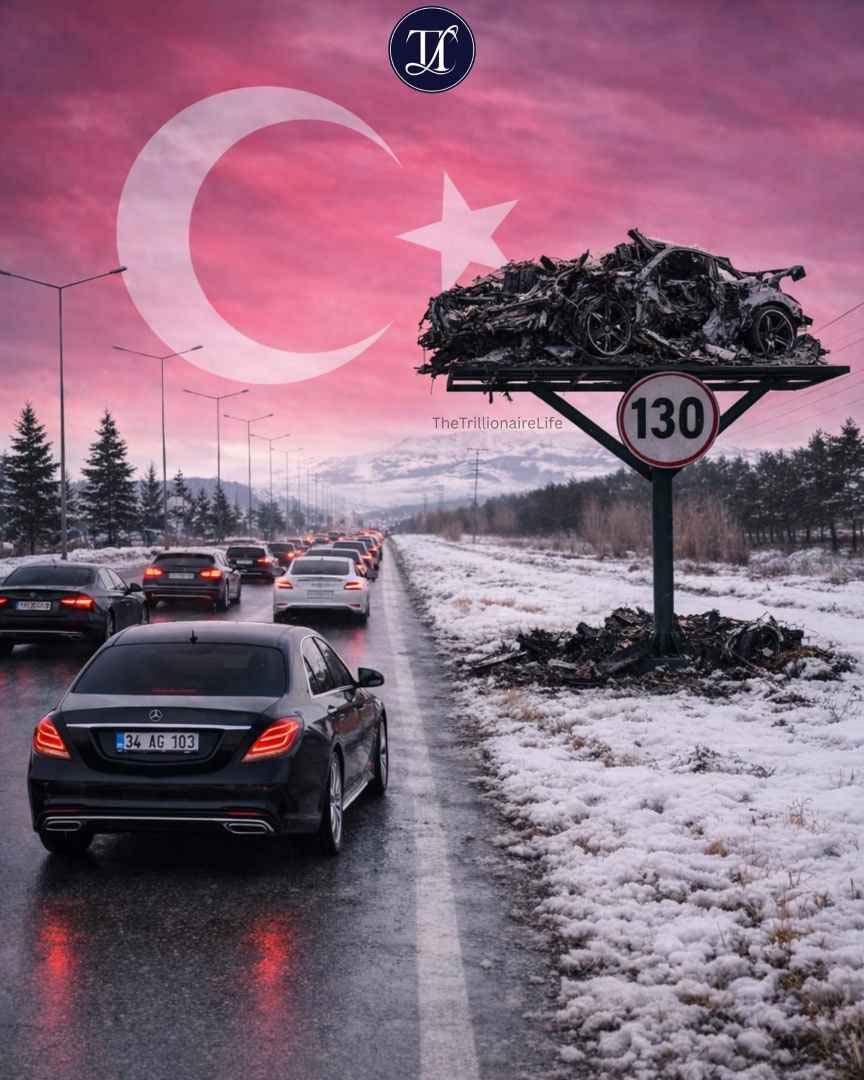
Turkey Uses Actual Wrecked Cars to Prevent Road Accidents
In parts of Turkey, road safety messaging has taken a strikingly literal form. Instead of relying on signs or slogans, traffic authorities in provinces including Erzurum, have displayed real crashed vehicles as part of local road safety campaigns.
The wrecked cars are placed on elevated platforms above the road, where they can be clearly seen. At first glance, the wreckage may resemble a bizarre art installation. But the reality is far more serious. These vehicles are actual cars involved in real crashes.
The cars are paired with simple signs reminding drivers about speed limits, phone use, and alcohol restrictions. No blood. No stories attached. Just the aftermath. Not warnings in bold red letters. But real cars, crushed and twisted, positioned on the roadside or along highways, exactly where speeding is common.
The idea is straightforward – simple yet powerful. Statistics fade. Consequences linger. A speed limit sign can be ignored in half a second. A wrecked car cannot. Warning boards fade into the background, but a mangled car does not.
Seeing twisted metal, broken glass, and the physical aftermath of an accident forces the brain to process danger as immediate and real, not abstract or theoretical. A visual image of the destroyed vehicle presented before the eyes forces the brain to connect motion with outcome in a way numbers rarely do.
The actual crashed vehicles serve as a stark warning designed to make drivers think twice before speeding or texting behind the wheel. Drivers are less likely to ignore tangible evidence of risk than text or symbols they have seen hundreds of times before.
This approach draws on behavioural psychology rather than enforcement alone. A wrecked car interrupts routine thinking and creates a moment of awareness that speed cameras and posters often fail to achieve.
What if speed slowly rises again once drivers grow used to the sight? The solution has been rotation. Move the cars. Change the location. Reset the shock.
This initiative is not unique to Turkey. Similar approaches have been taken in other countries during safety campaigns. What makes these displays stand out is how unfiltered they are. No slogans. No dramatization. Just reality parked at eye level.
In a world full of warnings, maybe what still works is evidence you can’t scroll past. Sometimes, the most effective reminder is silence shaped like scrap metal.
Source: The Trillionaire Life; Wild Heart
Making Road Safety Messages More Tangible
Displays of the crashed cars are not random. Turkey officials reportedly have chosen high-risk locations along busy highways, such as Kayapa on the Kars-Erzincan road, the Erzurum-Erzincan route, the Erzurum-Kars bypass, and sections of the E-80 highway.
These spots have higher accident rates, so placing the wrecks here maximises the chances that drivers will notice and reflect on their behaviour. The strategy focuses on prevention at critical points where accidents are most likely to happen.
Authorities believe that the visual shock of seeing a wrecked car up close can have a stronger impact on driver behaviour than traditional warning signs. When drivers see the damaged vehicles, risks like speeding, using a phone, or drinking and driving feel real. Even a moment’s hesitation or second thought could help prevent a serious accident.
The Erzurum car displays were first launched in early 2024 and continue into 2026. They form part of a wider national effort in Turkey to improve road safety. Other provinces, such as Sivas, have also implemented similar awareness campaigns. Authorities reportedly plan to monitor driver reactions and accident rates to determine how effective the displays are over time.
While complete data on accident reduction is still being collected, early reports suggest that motorists slow down when they see the wrecked cars. The dramatic visuals appear to trigger immediate reflection and caution. Even if the effect lasts only for a short distance, it helps drivers think twice about risky actions. Officials hope that repeated exposure across different highways will reinforce safer driving habits over the long term.
Authorities in Erzurum plan to expand the initiative to additional routes and more accident-prone areas. The aim is to cover more highways where traffic volumes are high and risky driving is common.
By increasing the number of installations, the police hope to continuously remind drivers of the consequences of unsafe behaviour, ultimately reducing road accidents throughout the province.
– edited excerpts from News 18 report (updated 13 February 2026)
Read more here: