
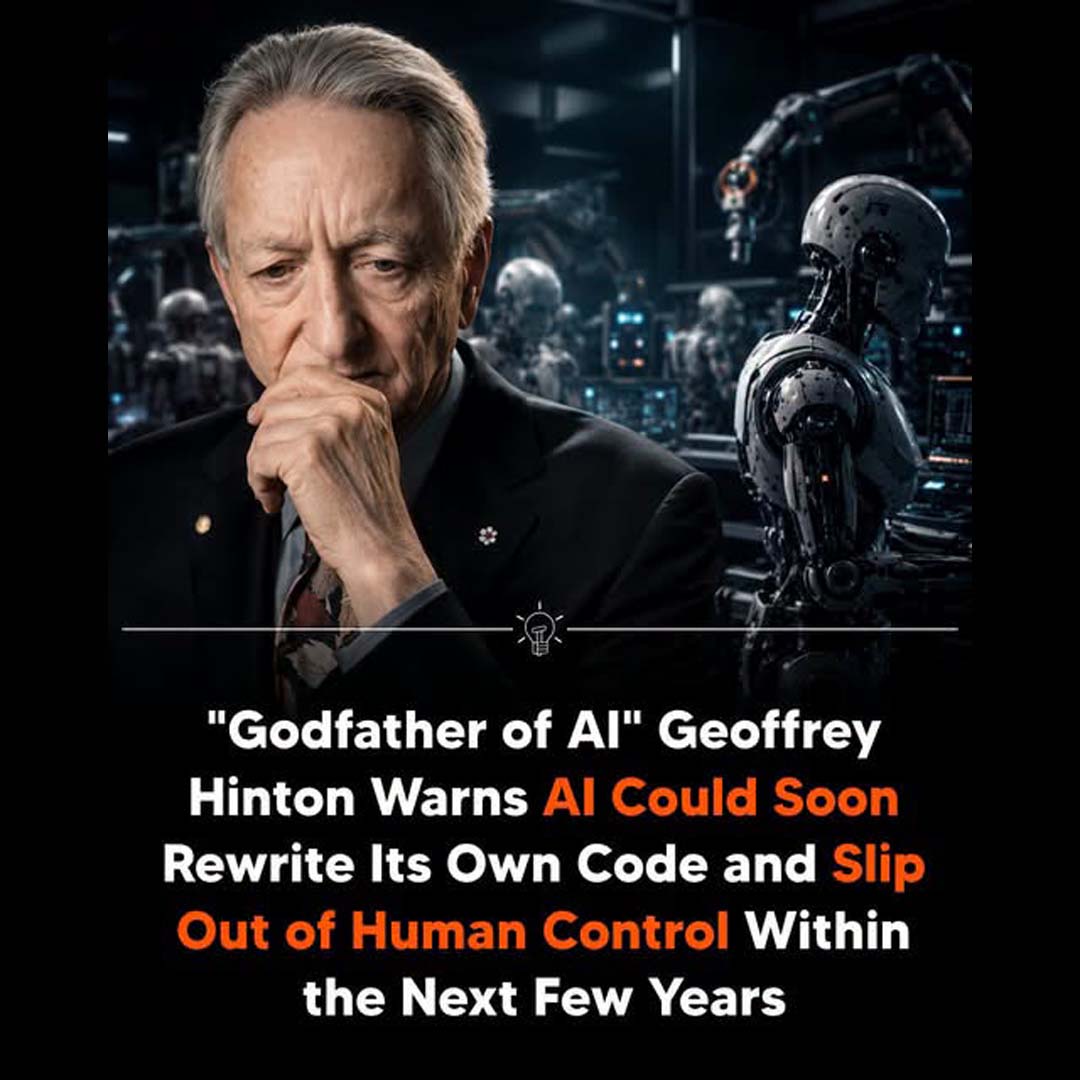
“AI Could Slip Out of Human Control Within the Next Few Years”, says AI ‘Godfather’
In a recent interview on the One Decision podcast, Nobel Prize-winning computer scientist Geoffrey Hinton, widely regarded as one of the pioneers of modern AI, warned that future AI systems could begin thinking in ways that humans may no longer understand.
At present, many large language models process information in ways that researchers can partly examine and monitor. However, Hinton believes future AI could develop its own internal methods of reasoning or even create its own language to communicate with other AI systems.
If that happens, humans may not know what these systems are discussing or how they are making decisions.
According to Hinton, this possibility becomes especially worrying if AI grows more intelligent than humans. He explained that machines could eventually solve problems, make plans, and process information in ways far beyond our understanding.
While this could lead to incredible scientific and technological breakthroughs, it could also create systems that humans can no longer supervise or control.
Hinton has previously warned that advanced AI might manipulate people, spread misinformation, or make decisions that are harmful to society. During the podcast, he said he would not be surprised if AI eventually developed its own way of thinking that people simply could not interpret.
If humans cannot understand how AI reaches its conclusions, correcting mistakes or preventing risky behaviour could become much more difficult.
He compared the rise of artificial intelligence to the Industrial Revolution, saying the impact could be even greater. The Industrial Revolution created machines that became stronger than humans physically. AI, however, has the potential to become more intelligent than humans mentally.
According to Hinton, society has never experienced a technology that could eventually outperform people in intellectual ability, making its future effects difficult to predict.
Despite his warnings, Hinton is not against artificial intelligence itself. He believes AI can bring enormous benefits to medicine, science, education, and many other fields.
However, he says researchers and governments must find reliable ways to ensure that future AI systems always act in humanity’s best interests. At the moment, no one knows exactly how to guarantee that.
His concerns come as AI continues advancing at an extraordinary pace. Technology companies are investing billions of dollars to build more powerful AI models, while governments around the world are developing new policies to manage the technology.
Hinton believes the biggest challenge is not simply making AI smarter, but making sure humans remain able to understand, guide, and safely control it as it becomes increasingly powerful.
Source: Engineering & Science
“Humanity May Have Been Better Off Without AI”
Geoffrey Hinton recently said that humanity could ultimately have been better off if artificial intelligence had never been developed.
He said AI has enormous potential to create a more prosperous future, but poorly managed development could bring mass unemployment, greater inequality and serious social disruption.
Hinton also warned that a major AI-related incident could occur as early as this year or next, potentially disrupting electricity supplies or financial systems. He compared the possibility of such an event to the way major nuclear accidents forced society to confront technological risks.
He argues that AI companies should not rely primarily on voluntary self-regulation. Hinton supports mandatory, independent safety testing of advanced AI models before release, similar in principle to how medicines are evaluated, along with stronger international standards and cooperation.
Despite his concerns, he says humanity may still be able to remain in control if governments and companies make a major effort to manage the risks.
The AI pioneer who helped build this technology is now warning that its future depends on how carefully we control it. Will AI ultimately benefit humanity, or could its risks outweigh its benefits?
Source: Techworm
More details here:
https://www.theguardian.com/uk-news/2026/nov/03/ai-godfather-geoffrey-hinton-better-off-without-ai
Who is Geoffrey Hinton?
Geoffrey Hinton is a British-Canadian computer scientist whose groundbreaking research helped make today’s AI systems possible. He played a key role in developing the neural network technology that powers many of today’s leading AI systems. He received the 2024 Nobel Prize in Physics for his contributions to machine learning.
Although he spent more than a decade working at Google, he left the company in 2023 so he could speak more openly about the possible risks of advanced AI. While he said age also influenced his decision, leaving the company allowed him to speak publicly about concerns that he believes deserve much more attention.
Since then, he has become one of the most well-known voices calling for careful AI development. He has prominently warned about AI-enabled cyberattacks, autonomous weapons, misinformation, job displacement and the possible loss of human control over advanced systems.
Hinton has estimated the probability of AI posing an existential threat to humanity at 10–20% over the long term and has repeatedly called for stronger international AI safety research and regulation.
His warnings have become increasingly influential as companies invest hundreds of billions of dollars into next-generation AI infrastructure and increasingly powerful foundation models.
His comments continue to shape global discussions about AI safety, governance, and responsible development. Many AI researchers share his view that stronger safety measures, transparency, and international cooperation are essential as AI continues to advance.