
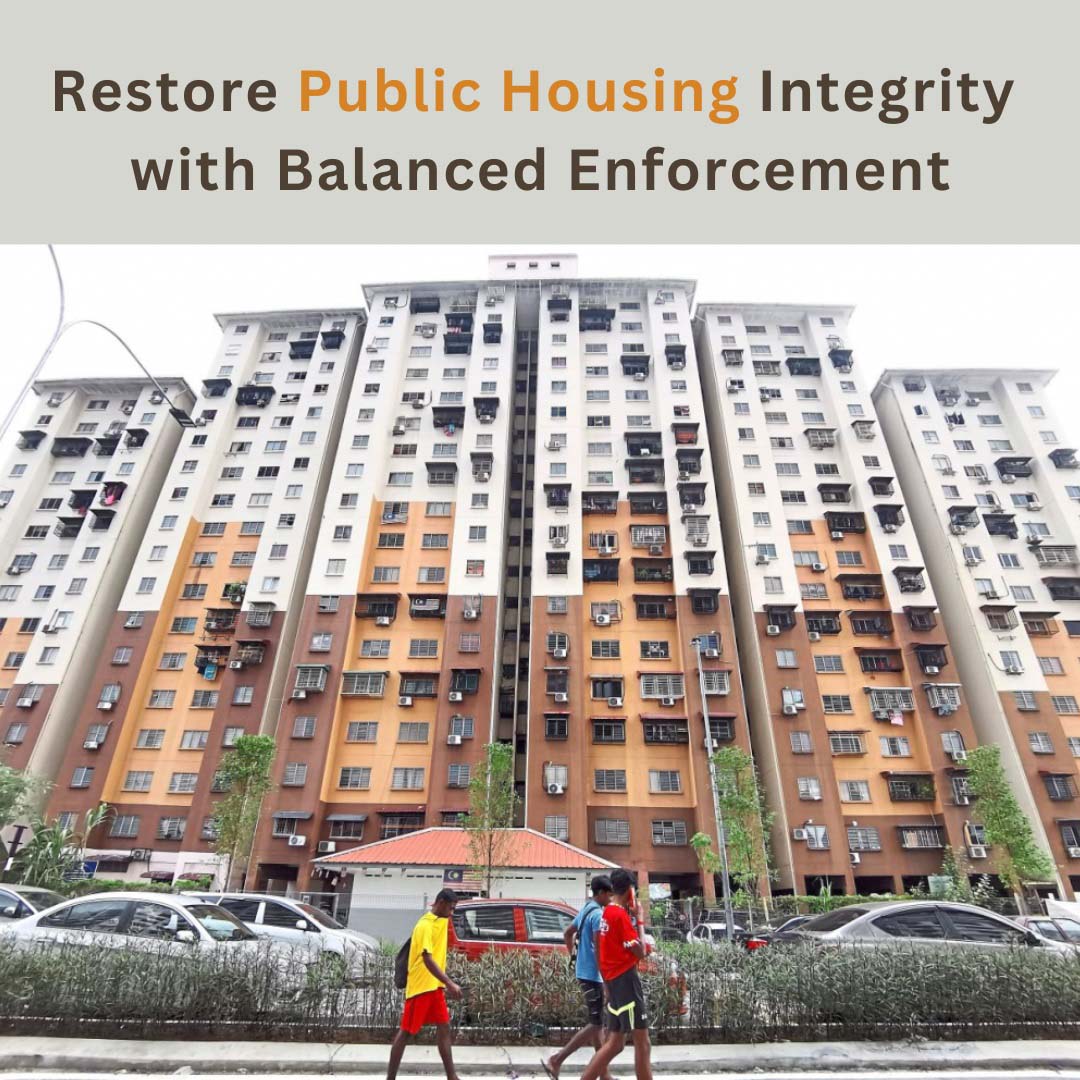
CAP backs balanced enforcement for public housing integrity
The Consumers’ Association of Penang (CAP) supports the Penang state government’s decision to evict ineligible tenants from public housing where there is clear evidence of violations or abuse of the terms and conditions under the People’s Housing Programme (PPR), administered by the Ministry of Housing and Local Government. It must be clearly understood that PPR tenancies are contractual and temporary in nature, typically granted for a period of two to three years and extended only on a case-by-case basis, subject to continued eligibility.
Under these agreements, residents are required to meet strict criteria, including remaining within prescribed income thresholds, not owning other property, occupying the unit as their primary residence, and paying subsidised rent and maintenance charges consistently. Subletting or transferring occupancy is strictly prohibited, and tenants are expected to provide accurate information during periodic reviews conducted by the authorities.
The urgency of enforcement is highlighted by the scale of the problem. The state’s public housing schemes have recorded rental arrears exceeding RM2 million, involving more than 1,100 occupied units. In Penang, there are four PPR schemes, namely PPR Taman Manggis, PPR Taman Bagan Jaya, PPR Mak Mandin and PPR Permatang Tok Suboh, comprising 999 units, of which 934 are currently occupied. These figures highlight both the high demand for such housing and the strain caused by non-compliance and arrears.
However, the present situation reflects not merely individual non-compliance but deeper systemic shortcomings. Enforcement has historically been uneven, with limited and infrequent income verification, weak monitoring of occupancy, and a general reluctance to carry out evictions due to social and political sensitivities. As a result, some tenants have been able to remain in PPR units for decades, well beyond the intended duration. In certain cases, tenants have under declared income, acquired higher value assets such as vehicles, or even relocated elsewhere while continuing to retain and sublet their units for financial gain.
Such practices undermine the very purpose of PPR as a transitional safety net for low-income households. They distort allocation, deny access to genuinely deserving applicants, and contribute to mounting rental arrears. Nonetheless, enforcement should not be indiscriminate. A more calibrated and humane approach is required.
Moreover, it must be recognised that the number of PPR units is limited, and therefore strict monitoring and consistent enforcement are essential to prevent abuse. The primary objective of the programme is to provide temporary housing assistance to genuinely deserving low-income households, not to be exploited as a long-term or profit generating arrangement.
In cases where units have been sublet, the authorities may consider reviewing the eligibility of current occupants. If these subtenants genuinely meet the criteria, there is merit in allowing them to continue renting under a newly regularised arrangement, while declaring the original tenancy null and void. This would prevent disruption to deserving households while correcting abuse.
Similarly, rental arrears should be assessed on a case-by-case basis. While deliberate non-payment must be addressed firmly, there are tenants who face genuine financial hardship due to unemployment, illness, or other unforeseen circumstances. For such cases, structured repayment plans or targeted assistance may be more appropriate than outright eviction.
We are of the opinion that, ultimately, the effectiveness of public housing depends on both clear rules and consistent enforcement. A balanced approach, firm action against abuse yet fair and compassionate towards legitimate need, is essential to restore integrity, ensure equitable access, and uphold public confidence in the system.
Mohideen Abdul Kader
President
Consumers’ Association of Penang
Letter to the Editor, 7 May 2026