
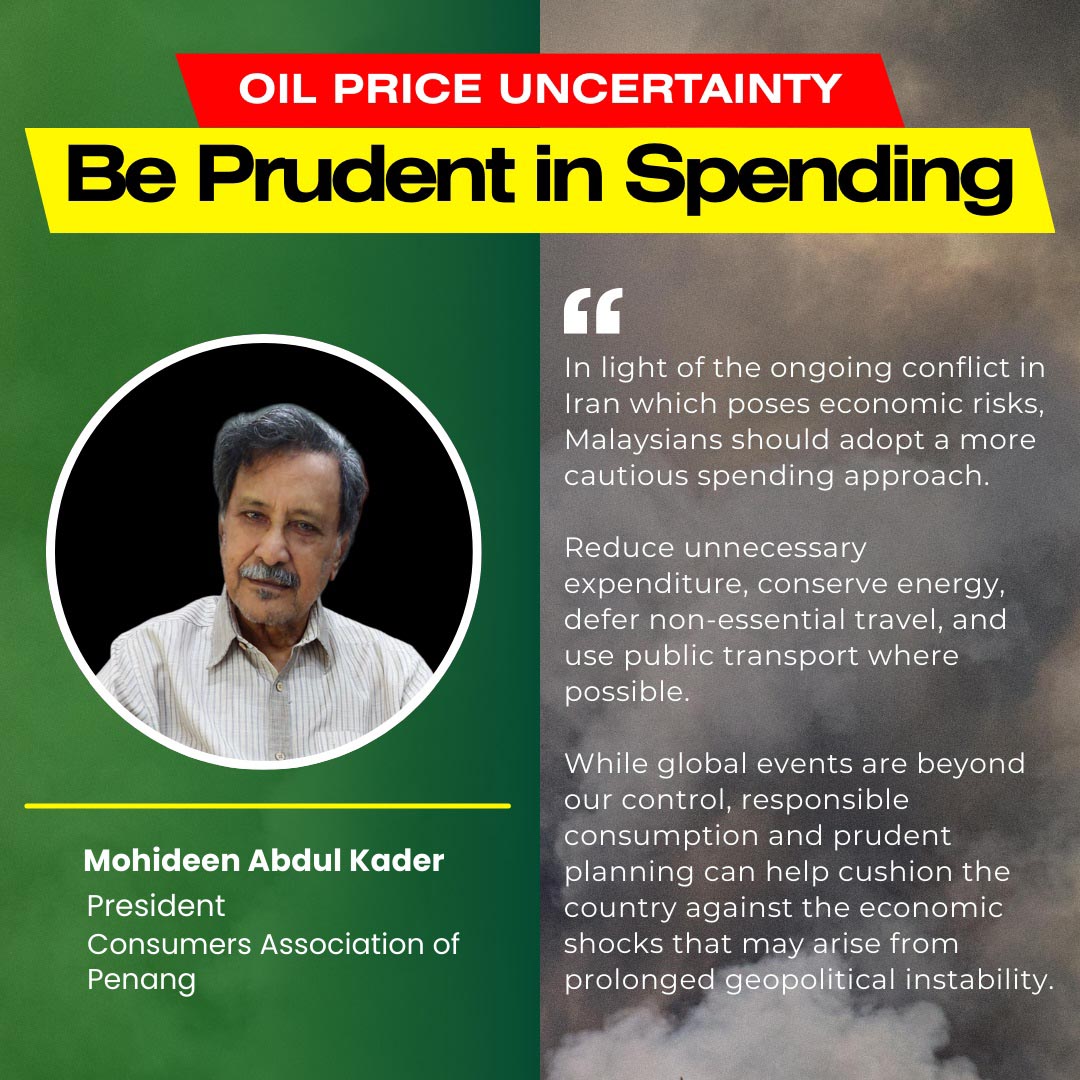
Consumers Must Practise Prudence Amid Oil Price Uncertainty
The Consumers’ Association of Penang (CAP) urges Malaysians to be more financially prudent in the current climate in order to withstand geopolitical uncertainties in the Middle East, particularly in light of the ongoing conflict in Iran that began on 28 February.
Although the government has maintained the subsidised price of RON95 petrol at RM1.99 per litre since the introduction of the BUDI MADANI petrol subsidy programme on 30 September 2025, Malaysians should be aware that the unsubsidised price of petrol continues to fluctuate with global market conditions.
For example, the retail price of RON95 was estimated at RM2.59 per litre during the week of 26 February, just two days before the escalation of hostilities involving Iran. Within less than two weeks, the market price rose to RM3.27 per litre. This means the government would have to subsidise approximately RM1.28 for every litre of RON95 sold if the market price remains at RM3.27. At the subsidised rate of RM1.99, Malaysia’s RON95 petrol remains among the cheapest in the ASEAN region.
However, the government cannot continue subsidising RON95 at RM1.99 indefinitely if global crude oil prices rise sharply amid supply disruptions. Malaysia produces mainly light sweet crude oil of relatively high quality, much of which is exported. Domestic refineries are not always able to switch feedstock quickly or economically, and the country therefore still relies on imported crude oil and refined petroleum products to meet local demand.
Government regulation and subsidisation of domestic petrol prices help cushion the immediate impact of global oil price increases. Nevertheless, if global oil prices continue to escalate for an extended period, the prices of goods and services in Malaysia are likely to rise due to higher transport and production costs. In such circumstances, the government may find it increasingly difficult to sustain fuel subsidies.
Furthermore, Malaysia may eventually have to regulate domestic fuel consumption if global oil supply declines significantly during a prolonged conflict. This is particularly concerning because roughly 20 per cent of global seaborne oil trade passes through the Strait of Hormuz, a strategic chokepoint in the Gulf region. Any disruption to this route would force tankers to take longer alternative routes, thereby increasing transportation costs and tightening supply.
Malaysians should therefore appreciate the objectives of the BUDI MADANI subsidy framework, including the strict use of identification cards for subsidised fuel purchases. Without such controls, cross-border fuel smuggling could surge, benefiting smugglers and neighbouring countries rather than Malaysian consumers.
In anticipation of possible supply and price shocks, consumers can help by reducing oil and gas consumption and adopting a more cautious spending approach. When global oil and gas prices rise, the effects are not limited to petrol at the pump but also extend to liquefied petroleum gas (LPG) and diesel. LPG is widely used for household cooking, while diesel powers heavy transport vehicles and many industrial activities. Rising prices in these fuels can contribute significantly to inflation, particularly affecting the B40 and M40 income groups.
The government’s call for ministries, government agencies and government-linked companies (GLCs) to scale down expenditure such as by avoiding large Hari Raya open house events and limiting overseas travel unless essential is therefore a prudent step during uncertain times.
Malaysians should also consider reducing petrol consumption by deferring non-essential travel. Aviation fuel consumption is substantial; for example, a long-haul aircraft such as a Boeing 747 can burn roughly 150,000 litres of fuel on a 10-hour flight. As fuel costs rise, airline ticket prices will inevitably increase.
For road travel, the public should make greater use of public transport where possible in order to conserve national fuel supplies. If driving cannot be avoided, carpooling and careful trip planning can help reduce fuel consumption by allowing several errands to be completed in a single journey.
The impact of a global oil supply disruption may remain manageable if the conflict lasts only a few months. However, if it continues for a longer period, the consequences could be more severe and may trigger wider economic difficulties, including:
- Rising inflation caused by higher fuel and food prices, as well as increased shipping and insurance costs for transport through conflict-prone regions.
- Disruptions to food supply chains when harvests cannot be exported promptly or when shipments are delayed, leading to spoilage and shortages.
- Fuel shortages, including liquefied natural gas (LNG), affecting transportation and electricity generation where gas-fired power plants are used.
- Industrial slowdowns or shutdowns in sectors that rely heavily on oil or gas, potentially leading to layoffs and job losses.
In light of these risks, Malaysians should adopt a spirit of moderation and resilience. Households can strengthen their financial position by reducing unnecessary expenditure, conserving energy and supporting efforts to improve national food security. While global events are beyond our control, responsible consumption and prudent planning can help cushion the country against the economic shocks that may arise from prolonged geopolitical instability.
Mohideen Abdul Kader
President
Consumers’ Association of Penang
Press Statement, 17 March 2026