
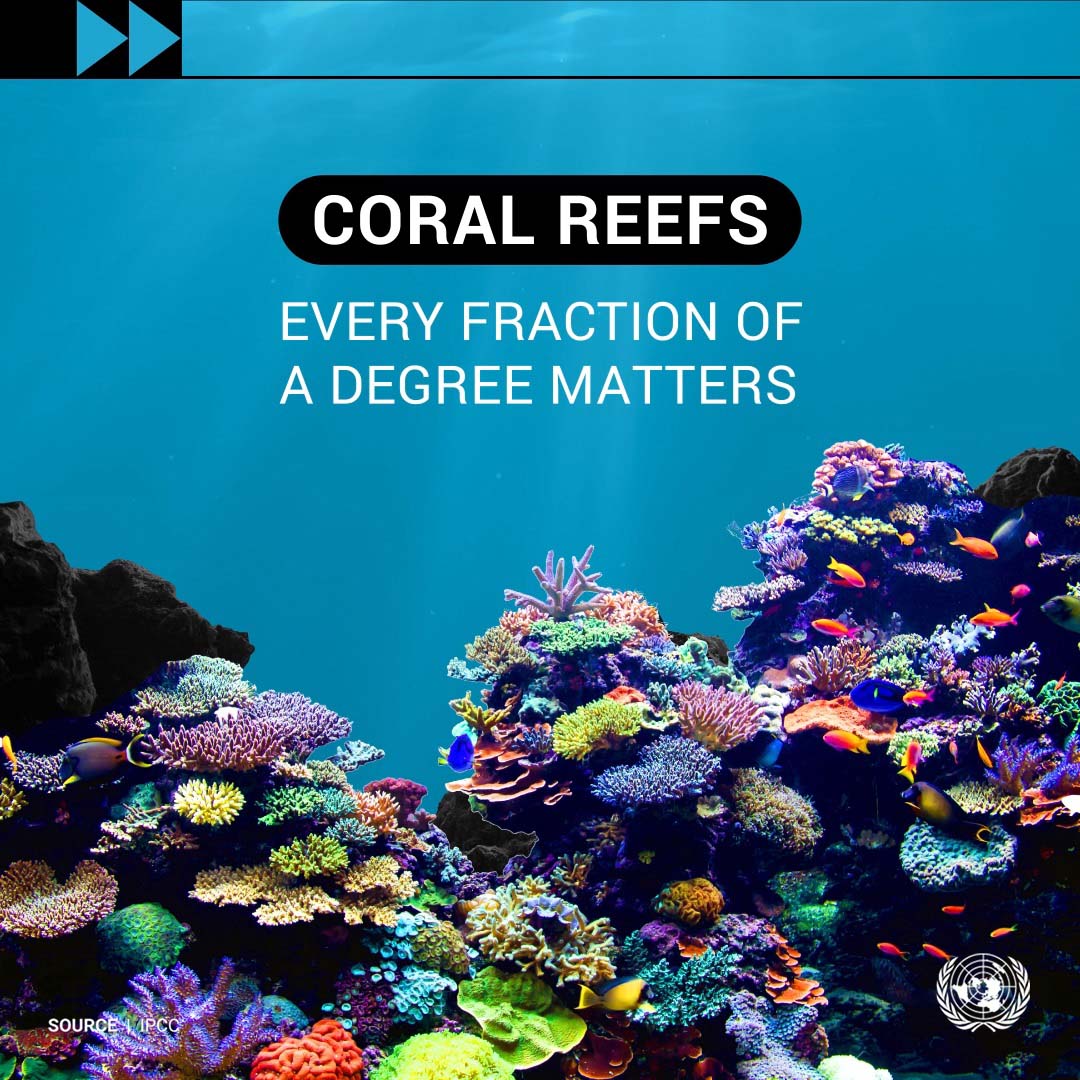
How Global Warming Affects Coral Reefs

Human-made global warming has a big effect on the ocean. Rising temperatures put marine life and coastal ecosystems at risk of irreversible loss. Today, widespread changes have been observed, including damage to coral reefs and mangroves that support ocean life, and migration of species to higher altitudes and altitudes where the water could be cooler.
Loss of marine biodiversity is another concern. Latest estimates from the UN Educational, Scientific and Cultural Organization warn that more than half of the world’s marine species may stand on the brink of extinction by 2100.
Where marine and coastal ecosystems are concerned, every fraction of a degree in rising temperatures matters. Coral reefs especially, are extremely sensitive to temperature changes. Increased water temperatures, which may be linked to global warming, can cause mass coral bleaching, which is often fatal for corals, leading to the death of reefs, which are critical habitats for marine life.
- At a 1.1°C increase in temperature today, an estimated 60% of the world’s marine ecosystems have already been degraded or are being used unsustainably.
- A warming of 1.5°C threatens to destroy 70-90% of coral reefs.
- A 2°C increase means a nearly 100% loss – a point of no return.
– Info and pictures from UN Environment Programme
What are Coral Reefs?
Corals might look like plants or even rocks, but they are actually tiny animals called “polyps”. Each polyp has a soft body, with a little mouth surrounded by tentacles that grab food – similar to a sea anemone. To protect themselves, corals use minerals from seawater to build hard skeletons made of limestone. When thousands of these polyps live together, their skeletons connect to form a coral reef.
Over time, coral reefs grow into large, colourful underwater cities that give shelter and food to all kinds of sea life – from tiny fish to giant turtles. That’s why they’re often called the “rainforests of the sea”.
What are the threats to coral reefs?
Over the last three decades, the world has lost half of its coral reefs. Today, over 80% of the world’s reefs are affected by bleaching, driven by rising ocean temperatures. Destructive fishing, pollution from land, coastal development, and shipping have also damaged reef ecosystems.
In addition, our oceans absorb as much as 30% of human-made carbon dioxide emissions from the air (much like our forests do). This extra carbon makes seawater more acidic, which weakens and corrodes corals’ limestone skeletons, leaving them more fragile and less able to recover.
Source: WWF, UK