
Microplastics Found in Nestlé and Danone Baby Food
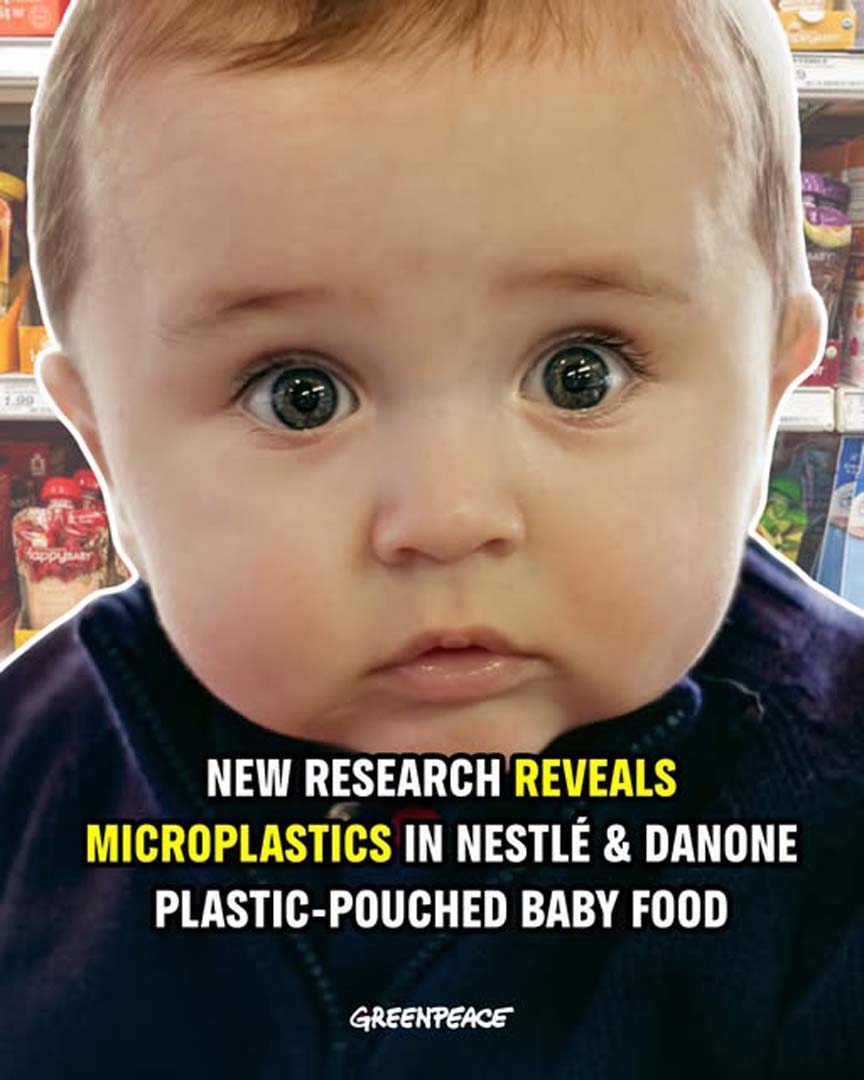
New research conducted by Greenpeace International has found an alarming amount of microplastics in Nestlé and Danone baby food sold in plastic pouches. The microplastics were present in every sample analysed, that suggests the packaging may be the contaminating source.
Greenpeace has issued a report, “Tiny Plastics, Big Problem: The Hidden Risks of Plastic Pouches for Baby Food”, detailing the laboratory testing where a range of 54 to 99 fragments were found per gram of baby food – as many as 270 to 495 microplastics per teaspoon.
The microplastics were found in Nestlé’s Gerber and Danone’s Happy Baby Organics samples. The study suggests a link between the type of plastic the pouches are lined with – polyethylene – and some of the microplastics found.
Here are the details:
● For every gram of baby food tested, researchers found up to 54 microplastic particles in Gerber pouches and up to 99 particles in Happy Baby Organics pouches, on average. That’s equivalent to as many as 270 (Gerber) and 495 (Happy Baby Organics) microplastics per teaspoon.
● The study estimated a total of more than 5,000 particles in each Gerber pouch and more than 11,000 particles in each Happy Baby Organics pouch.
● The study also identified a range of plastic-associated chemicals present in both the packaging and the food, including the presence of a potential endocrine disruptor in the Gerber samples tested.
This is a problem for parents everywhere, says Greenpeace. Today, millions of single-use pouches are purchased daily, meaning that millions of babies could be ingesting microplastics alongside their food.
The group is calling on companies and governments to put children before plastic profits.
● Nestlé, Danone, and all baby food producers must urgently investigate their products, prove they do not put young children at risk, and commit to phasing out plastic packaging for non-toxic, plastic-free, reusable alternatives.
● Governments negotiating the UN Global Plastics Treaty must act urgently to ban these products, reduce plastic production, and end uncontrolled, unregulated plastic and chemical contamination that threatens human health.
Baby food used to come in safe glass jars. Now, parents are pressed to feed their babies from plastic pouches, with almost no alternatives left on store shelves.
Make your own baby food to minimise your baby’s exposure to microplastics.
Read the Greenpeace report here:
https://www.greenpeace.org/international/publication/83101/hidden-risks-of-baby-food-plastic-pouches/