
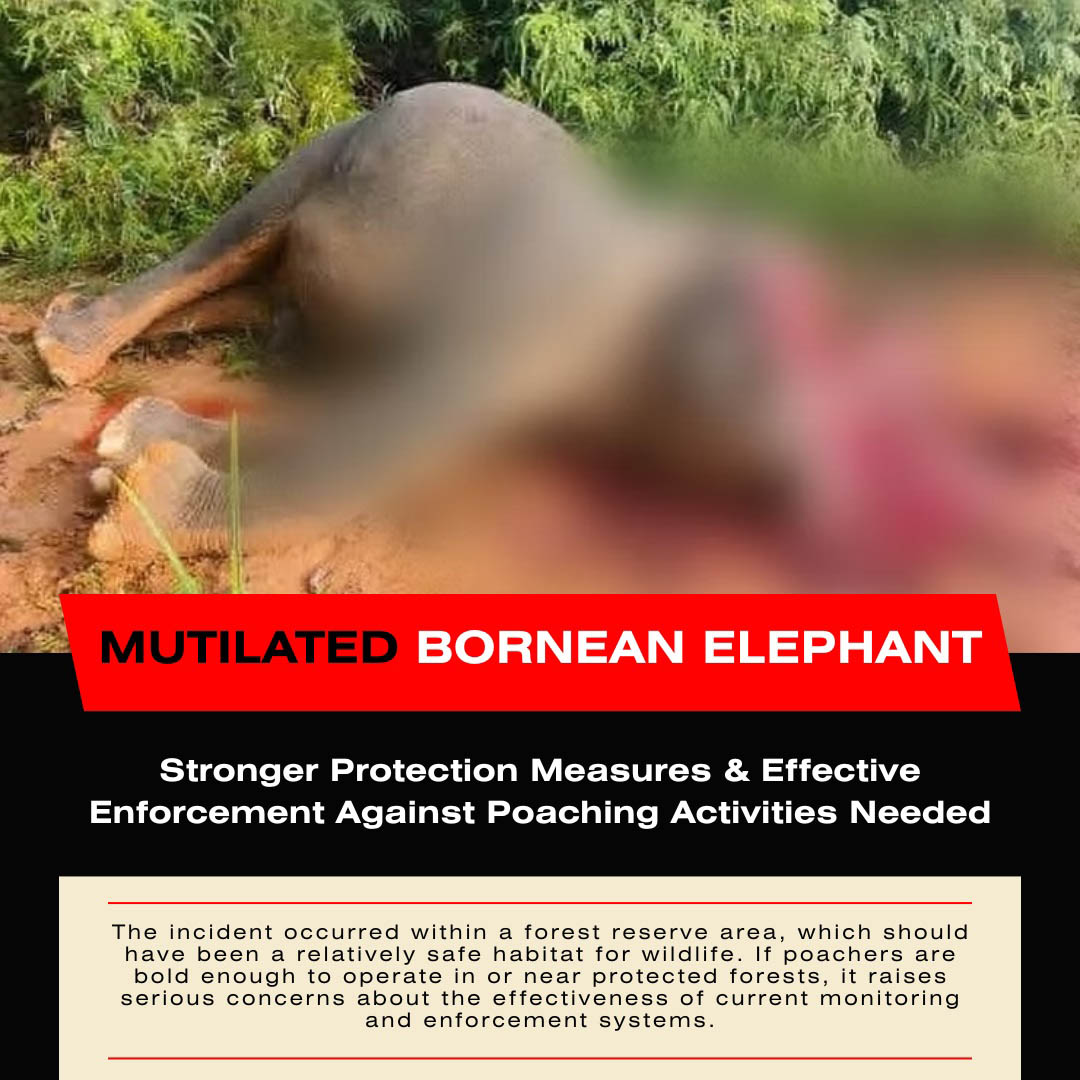
Mutilated Bornean Elephant a Wake-Up Call for Sabah’s Wildlife Protection
The Consumers’ Association of Penang (CAP) refers to the shocking discovery of a mutilated Bornean elephant in the Sungai Pinangah Forest Reserve in Tongod which should horrify Malaysians and serve as an urgent wake-up call to the authorities.
The details released by the Sabah Wildlife Department and State Tourism, Culture and Environment Ministry paint a deeply disturbing picture of what appears to be a cruel and deliberate act of ivory poaching against one of Sabah’s most treasured and endangered wildlife species.
This is not merely an isolated wildlife crime. It represents a dangerous escalation in threats facing the Bornean elephant (Elephas maximus borneensis). It is a national disgrace and a stark warning that Sabah’s conservation battle is far from over.
According to reports, the male elephant was found with its face and mouth cut in an L-shaped pattern using sharp tools, while its tusks had been removed. Such brutality reflects not only criminal greed but also a complete disregard for life and the rule of law. Whether the animal was killed specifically for its ivory or mutilated after death, the incident highlights the ongoing threat posed by wildlife crime syndicates that continue to target endangered species for profit.
At the same time, the sighting of another elephant suffering visible trunk injuries raises further concerns about the increasing risks faced by wildlife within increasingly fragmented forest and plantation landscapes.
With only an estimated 1,000 to 1,500 Bornean elephants remaining in Sabah, every death or serious injury represents a major loss to the state’s biodiversity and environmental heritage.
The Bornean elephant is not merely another wild animal inhabiting Sabah’s forests. It is a unique subspecies found only in Borneo and recognised internationally as endangered. With its population already under pressure from habitat loss, fragmentation of forests, human-elephant conflict, and illegal hunting, every elephant killed represents a serious blow to conservation efforts. Experts have repeatedly warned that the survival of the species depends on stronger protection measures, continuous habitat preservation, and effective enforcement against poaching activities.
What is particularly troubling is that this incident occurred within a forest reserve area, which should have been a relatively safe habitat for wildlife. If poachers are bold enough to operate in or near protected forests, it raises serious concerns about the effectiveness of current monitoring and enforcement systems. The report that estate workers heard an explosion-like sound on the evening before the carcass was discovered, also suggests that illegal hunting activities may have taken place openly without immediate intervention.
While the Minister’s assurance that firm action will be taken is welcome, Sabahans and Malaysians alike have heard such promises before. The real challenge lies not in issuing statements after a tragedy occurs, but in preventing these crimes from happening in the first place. Wildlife protection cannot rely solely on reactive investigations after animals are already dead.
Authorities must urgently strengthen anti-poaching operations by increasing patrols in known wildlife corridors and vulnerable forest reserves, particularly in remote areas where enforcement presence is weak. The Sabah Wildlife Department should also work closely with police, forestry authorities, plantation operators, and local communities to improve intelligence gathering and early detection of suspicious activities. The use of technology such as drones, camera traps, GPS tracking, and surveillance systems should be expanded to monitor protected habitats more effectively.
Equally important is to put an end to illegal wildlife trade network that fuels these crimes. Poaching exists because there remains demand for ivory and wildlife products in black markets. Enforcement agencies must therefore target not only those directly involved in killing animals, but also middlemen, traffickers, and buyers who profit from this illegal trade.
Penalties for wildlife crimes should be severe enough to serve as genuine deterrents rather than mere symbolic punishments. Individuals convicted of wildlife crimes should face mandatory jail terms, as imprisonment has a stronger deterrent effect than fines alone.
At the same time, conservation cannot succeed without public support. Greater awareness and education are needed to ensure that local communities understand the ecological importance of elephants and the long-term value of preserving biodiversity. Protecting wildlife should not be seen as the responsibility of conservationists alone, but as a shared duty involving government, businesses, stakeholders, communities and ordinary citizens.
Sabah has earned international recognition for its rich biodiversity and ecological assets. The Bornean elephant is one of the state’s most iconic species and a symbol of its natural heritage. Incidents like this not only threaten the survival of wildlife but also damage Sabah’s reputation as a responsible steward of nature.
CAP reiterates its stand that if the elephant was indeed killed by poachers, then its death must not become just another statistic in a growing list of wildlife crimes. It should instead mark a turning point that compels stronger action, greater accountability, and a renewed commitment to protecting Sabah’s endangered species before it is too late.
Mohideen Abdul Kader
President
Consumers’ Association of Penang
Letter to the Editor, 26 May 2026