
New Assessment Finds Financial Regulators Are Failing to Turn Biodiversity Commitments into Binding Rules

Malaysia, alongside other strategically important financial jurisdictions, lacks comprehensive restrictions on financing deforestation and ecosystem conversion ahead of the UN biodiversity summit.
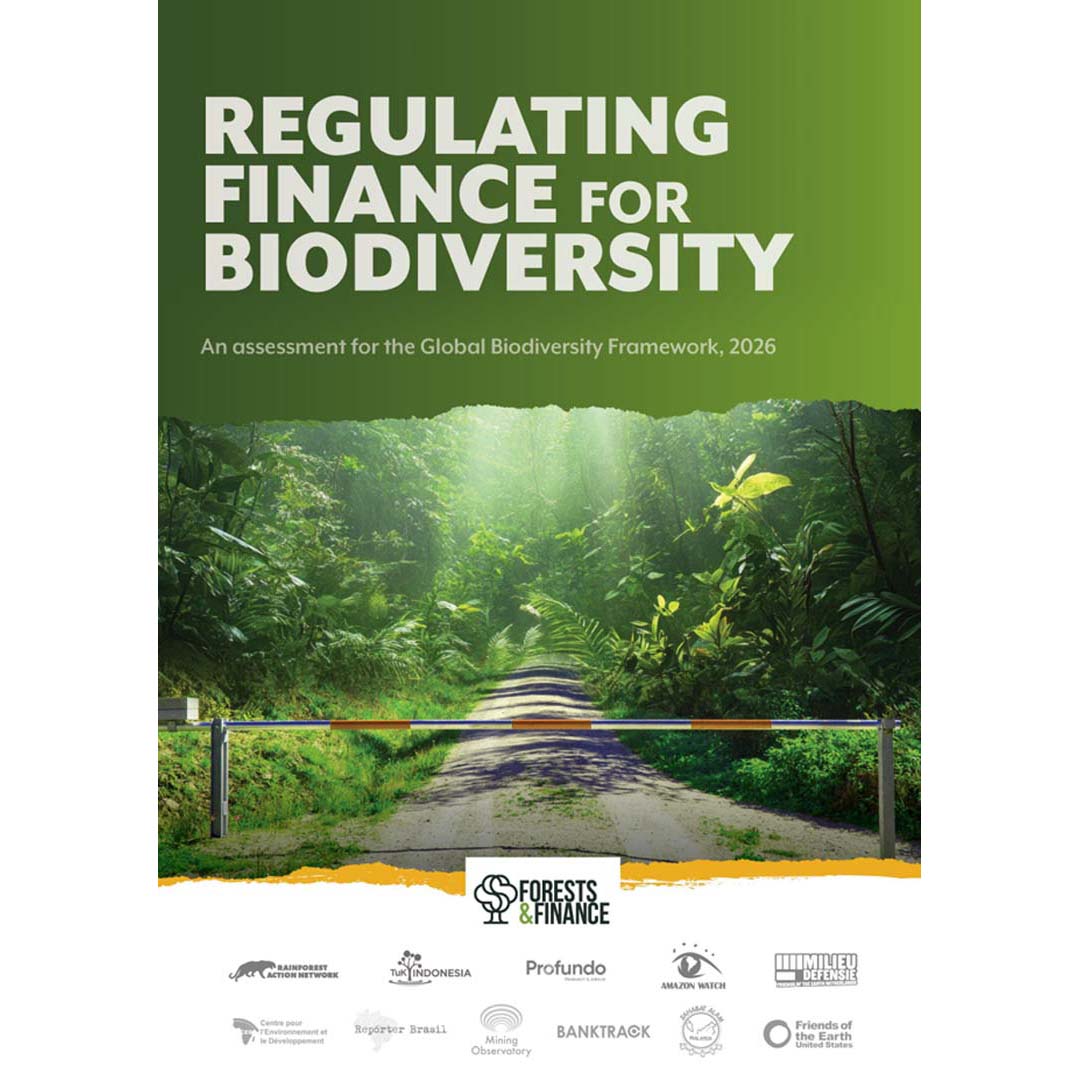
KUALA LUMPUR October 22, 2026 — Four years after governments agreed to align public and private financial flows with global biodiversity goals, a new report, Regulating Finance for Biodiversity: An Assessment for the Global Biodiversity Framework, finds that major financial jurisdictions have yet to translate those commitments into binding rules capable of stopping finance for deforestation and ecosystem destruction.
Alongside Malaysia, the report examines financial regulation in 10 other jurisdictions that play a strategically important role in the financing of forest-risk industries: Brazil, Canada, the Central African Economic and Monetary Community, China, the European Union, Indonesia, Japan, Singapore, the United Kingdom and the United States. The report finds significant differences among jurisdictions, but no clear leader.
Although Malaysia claims progress in fulfilling its commitments under the Kunming-Montreal Global Biodiversity Framework (GBF), adopted in December 2022, financial regulators have yet to meaningfully engage.
Target 14 calls on governments to progressively align public and private financial flows with GBF goals. The new assessment by the Forests & Finance Coalition examines whether financial regulation is beginning to deliver on that commitment.
The report finds a significant gap between international biodiversity pledges and the regulations governing lending and investment. While biodiversity is increasingly featured in financial disclosure frameworks, taxonomies and risk-management policies, binding requirements across entire financial portfolios remain rare.
The Malaysian government’s latest National Report to the Convention on Biological Diversity — based on the National Policy on Biological Diversity 2022-2030 — does not provide a credible account of how the financial sector is being realigned with GBF targets to 2030, nor does it direct financial regulators to establish rules that restrict harmful flows to forest-risk sectors
It is therefore unsurprising that Malaysia did not achieve the report’s highest green rating. Across jurisdictions, most ratings were red or dark red and only few yellow. In fact, no jurisdiction comprehensively prohibits banks or investors from financing companies involved in deforestation or the conversion of natural ecosystems.
The findings are being released as governments meet in Yerevan for COP17 of the UN Convention on Biological Diversity. Among the report’s key findings:
- Financing ecosystem destruction remains largely unrestricted. None of the 11 jurisdictions comprehensively prohibits financial institutions from financing or investing in companies involved in deforestation or natural ecosystem conversion.
- Disclosure is advancing faster than accountability. Reporting requirements are emerging, but no jurisdiction requires full transparency of financing and investment flows together with comprehensive disclosure of their biodiversity and social impacts.
- Biodiversity remains largely absent from monetary policy. Central banks have begun incorporating climate considerations into some operations, but biodiversity is rarely reflected in collateral frameworks, refinancing or other monetary policy tools.
- Just-transition requirements are largely missing. Financial regulations generally do not require banks and investors to ensure that transitions in agriculture, forestry, fisheries and other high-risk sectors to protect Indigenous Peoples and local communities.
The regulatory gap is particularly significant because of the scale of finance continuing to flow to industries linked to tropical forest destruction. Forests & Finance identified USD 894 billion in forest-risk-adjusted loans and underwriting between January 2016 and September 2026.
In Malaysia, top banks like CIMB and Maybank lead in sustainability policies based on the recently published Banking on Biodiversity Collapse Report. However, the status quo may be triggering a ‘race to the bottom’; only mandatory regulation will level the playing field.
The report argues that closing the regulatory gap will require governments to move beyond voluntary guidance and product-level sustainability labels toward binding rules governing entire lending and investment portfolios. For Bank Negara Malaysia and the Securities Commission Malaysia, it would mean instituting requirements for banks and investors to disclose financial flows and their biodiversity impacts — beyond voluntary frameworks such as the Taskforce on Nature-related Financial Disclosures (TNFD); mandatory due diligence for financing and investment linked to deforestation and ecosystem conversion; biodiversity criteria in prudential regulation; time-bound portfolio alignment targets; mandatory Free, Prior and Informed Consent (FPIC) and project‑level safeguards with clear grievance channels; and, finally, effective sanctions when financial institutions fail to comply.
Meenakshi Raman
President
Sahabat Alam Malaysia
Press Release, 22 October 2026
Links:
Regulating Finance for Biodiversity is available at:
https://forestsandfinance.org/regulatingfinance2026
Download the full report
Download the Executive Summary