
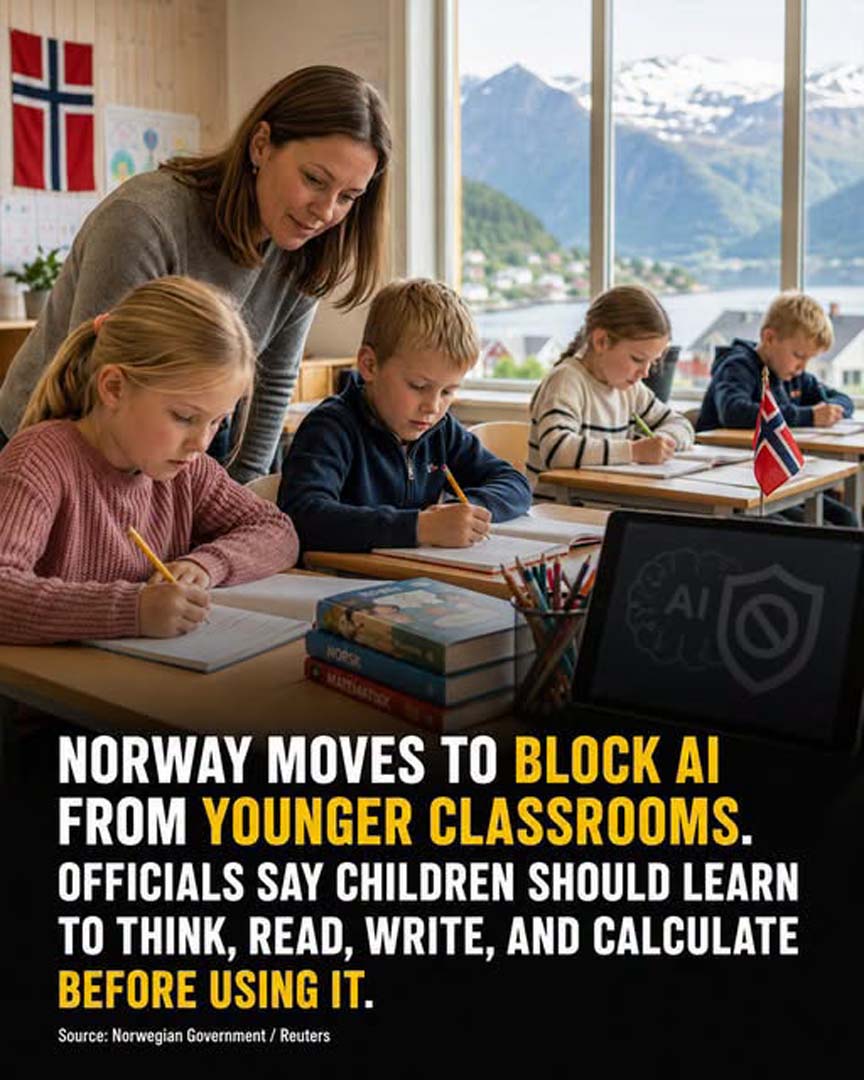
Norway Restricts AI Use in Schools
Norway is drawing a hard line in the classroom. Starting in the 2026 school year, Norway implemented a strict, age-based restriction on generative AI in schools.
The policy completely bans AI for children aged 6 to 13, limits usage for 14-to-16-year-olds to direct teacher supervision, and allows independent AI use only for students aged 17 and older.
The new standards will be imposed from the new school year beginning in late August.
The Norwegian government instituted these restrictions to protect foundational cognitive skills and prevent students from skipping critical stages of early education.
Using AI increases the risk that young children skip important steps in their education. Officials say children need to build the basics first. Young students should learn to read, write, calculate, think critically, work with classmates, and find their own answers before relying on generative AI.
In upper secondary education, from ages 17 to 19, students should learn to use AI appropriately so that they are prepared for further education and work, according to the new policy.
Norway began adopting computers in classrooms in the 1990s and tablets after the introduction of the iPad from 2010 onwards, reducing the reliance on books and handwriting. They went all in on digital education. Then the test scores started dropping.
In a recent related statement, the government said it will propose legislation to fund the use of more books in classrooms, reversing the trend towards computer tablets.
Norway has also taken strict action over smartphone use in schools. In 2024, Norway banned smartphones from schools amid concerns about declining student performance and excessive screen exposure. The move also gave teachers back more powers to enforce discipline in the classroom.
Following the move, a study of over 400 middle schools showed bullying went down. Grades went up. Visits to school psychologists fell by about 60%, especially among girls.
The Norwegian government in April 2026 also announced plans to ban children from using social media until they turn 16, following a trend pioneered by Australia and some other nations to reduce young people’s use of electronic devices.
Now they are doing the same with AI – the country that gave iPads to kids in 2010 just banned AI in every primary school.
Prime Minister Jonas Gahr Støre didn’t mince words: kids need to learn reading, writing, and math first. Hand a 9-year-old an AI tool and they will skip all three.
While much of the world races to put AI into schools, Norway is asking a much bigger question: what should kids learn first?
The country that pioneered digital classrooms is now drawing the hardest line against AI in education.
Source: Educraft; Reuters (19 June 2026)