
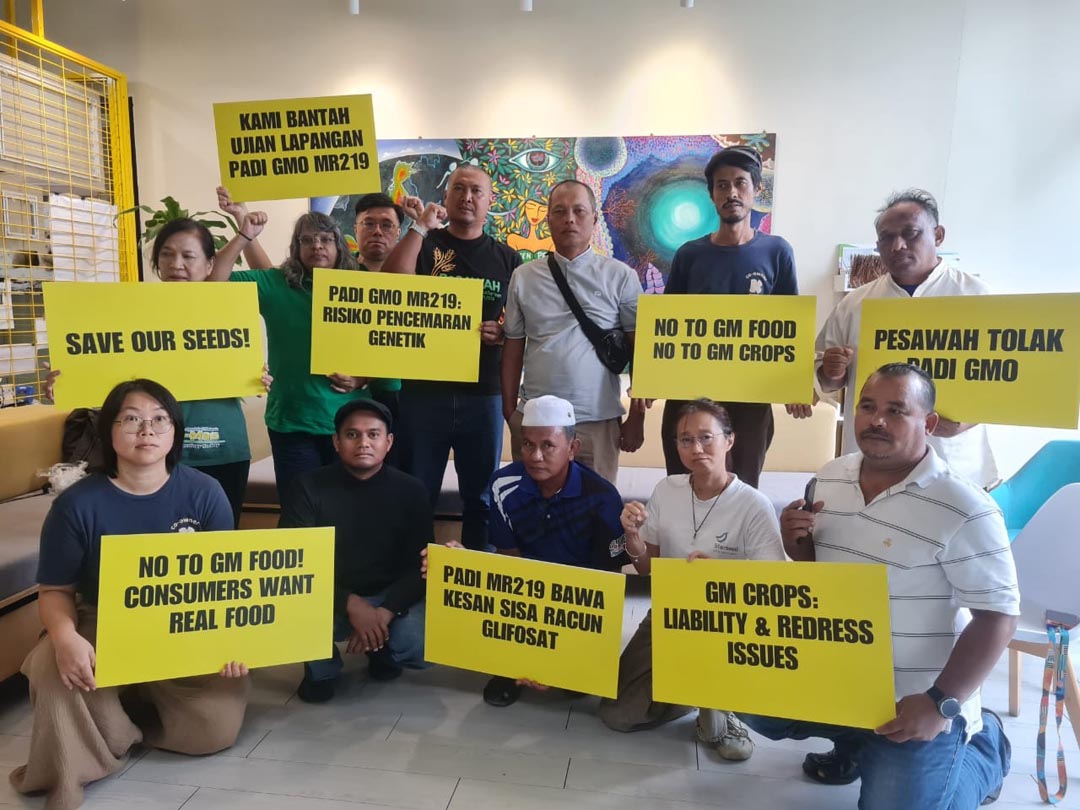
61 Organisations Submitted Feedback to the Department of Biosafety Objecting the Field Trial of GMO MR219 Rice
We, representing a coalition of Malaysian organisations and groups comprising farmers, consumers and environmental interests, hereby express our objection to the application by Zen Cropscience Sdn. Bhd. for the release of the genetically modified (GM) rice of the MR219 variety at a confined field trial site in Kampung Kepayang, Perak.
We submitted this formal objection to the Director General of the Department of Biosafety on 7 August 2026 via the Unified Public Consultation (UPC) website. We note that this application is identical to the application for the MR219 GMO field trial in 2019 at Tambun Tulang, Perlis and we wish to reiterate the grounds for our objections, which remain relevant.
The existing MR219 rice variety has been genetically modified to confer resistance to the herbicide glyphosate, while also providing resistance to diseases caused by bacteria and fungus. We are deeply concerned about the risk of genetic contamination of conventional and wild rice when it is cultivated in the field. Currently, Malaysia’s Biosafety Act 2007 does not provide adequate statutory protection or a legal liability and redress to farmers in the event of economic losses resulting from GM contamination of farmers’ fields. The financial burden would fall entirely upon the affected farmers.
The genetic modification of MR219 rice for glyphosate tolerance will inevitably encourage the use of this agrochemical. The plant does not break down glyphosate; instead, it absorbs the herbicide into its tissues. Consequently, these toxic residues may remain in the harvested crop and enter our staple food supply. A fact sheet shared by the Department of Biosafety also acknowledges that acute toxicological data for this GM rice is still unavailable.
Pertubuhan Persaudaraan Pesawah Malaysia, PeSAWAH has clearly rejected GM MR219 rice since 2019. Farmers have previously experienced the failure of similar herbicide-tolerance strategies, such as the Clearfield (herbicide-resistant rice) variety, where weeds rapidly developed resistance to the herbicide. As a result, farmers were forced to apply increasingly higher doses of pesticides, raising production costs and degrading soil fertility.
Glyphosate has negative effects on vital soil microorganisms and severely damages the biodiversity of paddy ecosystems. Any contamination incident could undermine local organic production and potential export markets, as occurred in China in 2008, when European markets rejected rice exported from China.
We emphasise that there are practical and proven-safe alternatives for managing weeds and diseases, such as the System of Rice Intensification (SRI), as well as other alternative and conventional methods that do not rely on genetic modification.
Although this application is for a confined field trial, we view that this research should be cancelled. Genetically modified organisms cannot be fully controlled, contained or recalled once released. Once introduced into the environment, the modified genes may persist and spread through cross-pollination and germination. In addition, GM crops may become mixed with non-GM crops during harvesting, storage or transportation. This research is irrational at a time when consumers are increasingly shifting towards organic food.
Given these severe socioeconomic, environmental and health risks, a total of 61 organisations nationwide have expressed their support in opposing this field trial.
– The above statement is issued by the following farmers’, consumers’, and environmental organisations:
1. Agora Society Malaysia
2. Alam Selangor
3. Blue Oasis (M) Sdn Bhd
4. Borneo Komrad
5. CETDEM Organic Farming
6. Chiron Yeng Coaching Services
7. Consumers’ Association of Penang (CAP)
8. Ecopro Training Center
9. Field and Fortune Venture – Sawah Organik Lambor
10. Forum Kedaulatan Makanan Malaysia (FKMM)
11. GRASS Malaysia
12. Green Bamboo Organic
13. Greenpeace Malaysia
14. Guardians of Nature’s Retreat
15. Jaringan Orang Asal Se-Malaysia (JOAS)
16. Kebun Nenek Kebayan, Dabong, Kelantan.
17. Kokoriu
18. Koperasi Kongsi Selangor Berhad (Kongsi Co-op)
19. Koperasi Pekerja Justlife Selangor Berhad
20. Ladang Greenleaf
21. Liga Rakyat Demokratik
22. Lions Club of Raub
23. Little Forest House
24. Malaysia Demeter Association
25. Marvhelly Pace A Voi SDN.BHD
26. Nadeen Hope Enterprise
27. Natural Farming Association Malaysia (NFAM)
28. Nature School of Ipoh
29. PACOS Trust, Sabah
30. Persatuan Agroekologi Malaysia (SRI-Mas)
31. Persatuan Iban Marudi, Sarawak
32. Persatuan Kampung Long Pilah, Sarawak
33. Persatuan Keilmuan Murni Kendiri Pulau Pinang
34. Persatuan Pendidikan dan Kebajikan Jaringan Nelayan Pantai Malaysia (JARING)
35. Persatuan Penduduk Kampong Uma Bawang, Baram, Sarawak
36. Persatuan Penduduk Kampung Long Lunyim, Sarawak
37. Persatuan Penduduk Kampung Long Miri, Sarawak
38. Persatuan Penduduk Nanga Seridan, Tinjar, Baram, Sarawak
39. Persatuan penduduk Rh Lachi Sungai Sebatu, Sarawak
40. Persatuan Penduduk Sungai Buri, Bakong, Baram, Sarawak
41. Persatuan Pengguna Luar Bandar dan Ekologi Malaysia (RURAL Malaysia)
42. Persekutuan Persatuan Pekebun Sayur-Sayuan Malaysia
43. Pertubuhan Persaudaraan Pesawah Malaysia (PeSAWAH)
44. Pertubuhan Rangkaian Pembangunan Kesinambungan Malaysia (SUSDEN Malaysia)
45. Pesawah Kelompok Lahar Kepar, Pulau Pinang
46. Pesawah Kelompok Tanjung Piandang, Perak
47. Possibilitree Ventures
48. Sahabat Alam Malaysia (SAM)
49. Samaria Organik Kemaman
50. Setia Selama Enterprise
51. SOAS University of London
52. Sounds of Soil
53. Stono Farm
54. Suara Mahasiswa UMS
55. Sukod Borneo Sdn Bhd
56. The Hope Village
57. Tube Ventures System Engineering
58. Urban Hijau
59. Wau Farm Kampar
60. Women for Equality Association WEA
61. World Food Forum Malaysia Youth Chapter
Press Statement 11 August 2026