
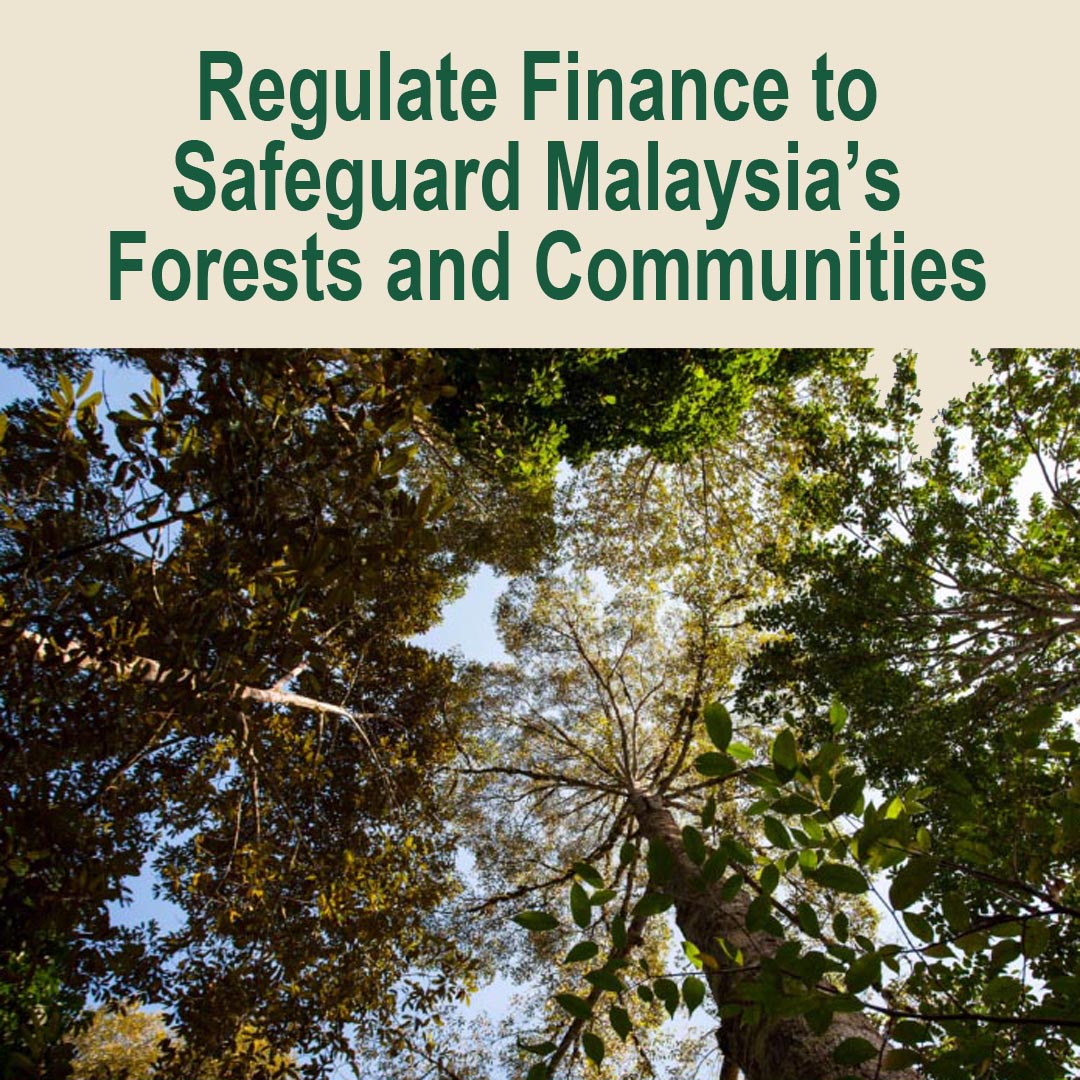
Regulate Finance to Safeguard Malaysia’s Forests and Communities
A new report by Sahabat Alam Malaysia (SAM), in partnership with the Forests & Finance Coalition (FFC), reveals that Malaysia’s financial regulatory sector is not yet fully aligned with the Global Biodiversity Framework (GBF)’s 2030 targets and highlights areas where further alignment could be considered.[1]
This report reviews key policies and guidelines published to date by Bank Negara Malaysia and the Securities Commission, including those on climate risk, sustainable finance, and sustainability reporting frameworks. On a color-coded scale from red (no reference to GBF targets) to green (full alignment with GBF targets), analysis reveals that most regulatory documents score yellow, indicating that financial institutions are only expected to take relevant steps towards the GBF targets, or orange, meaning references to the GBF targets are present but limited to voluntary recommendations.
The intersection between forests and finance
According to the most recent assessment by the Intergovernmental Platform on Biodiversity and Ecosystem Services (IPBES) on Business and Biodiversity (released on 9 February 2026), the ongoing loss of biodiversity cannot be halted if current practices and the prevailing business-as-usual approach continue to persist.
Hence, protecting Malaysian forests is essential not only for biodiversity but also for climate change mitigation. Forests act as carbon sinks by absorbing and storing significant amounts of carbon dioxide from the atmosphere. When forests are degraded or cleared, stored carbon is released, leading to increased greenhouse gas emissions and exacerbating global warming. In this context, the rights of indigenous peoples are crucial, given their role as long-standing stewards of the land. Their traditional knowledge and practices sustain forest ecosystems, and biodiversity conservation.
Forests & Finance data show that Malaysia is a forest-rich country with the second largest investment holdings of bonds and shares (amounting to USD 6.9 billion or 64%) in companies operating in the tropical forest-risk commodity sectors. In terms of credit, Malaysian banks rank 7th globally, having provided USD 16.4 billion in loans and underwriting services to companies operating in forest-risk sectors between 2016 and June 2024. (Forest-risk sectors include palm oil, logging, pulp & paper, and timber plantations, among others.)
These investments give financial institutions significant influence over activities that drive deforestation and forest degradation. Through their lending, investment, and risk management practices, financial institutions can therefore play a decisive role in either enabling or preventing environmental and social harm, making the role of financial regulators critical in shaping the standards that govern these decisions.
While acknowledging regulators’ efforts to balance principle-based and rule-based approaches, this report questions how long the financial industry can rely on a gentle, principle-based stance on deforestation, especially given the urgency of global warming, biodiversity loss and community rights.
Voluntary responsible investment policies have resulted in uneven sustainability standards among Malaysian financial institutions, creating an uneven playing field and allowing clients to gravitate toward banks with weaker requirements. The report therefore calls on regulators to set a clear timeline for transitioning to mandatory, binding rules to safeguard forests and community rights in response to the scale and urgency of climate, environmental and social challenges.
Specifically, the following measures are key:
(1) Beyond pledging to No Deforestation, No Peat, No Exploitation (NDPE) standards and respect for the UN principle of free prior and informed consent (FPIC) of indigenous peoples, there is also a need to establish credible grievance mechanisms and improve client transparency. Further, banks must also urge regulators to introduce mandatory, industry-wide rules to ensure stability and a level playing field.
(2) Financial regulators, in turn, must move decisively from recommendations to binding requirements, with clear timelines, robust enforcement, meaningful civil society participation in policy development and establish penalties for non-compliance — measures that would better protect forests and communities while positioning Malaysia as a leader in sustainable finance.
Meenakshi Raman
President
Sahabat Alam Malaysia
Letter to Editor, 2 March 2026
[1] (Malaysia ratified the Convention on Biological Diversity (CBD) on 24 June 1994. The Kunming-Montreal Global Biodiversity Framework (GBF) was adopted under the CBD on 19 December 2022, with commitments to halt and reverse biodiversity loss by 2030 through 4 Goals and 23 Targets. Malaysia subsequently launched the National Policy on Biological Diversity 2022-2030 on 24 October 2023.)