
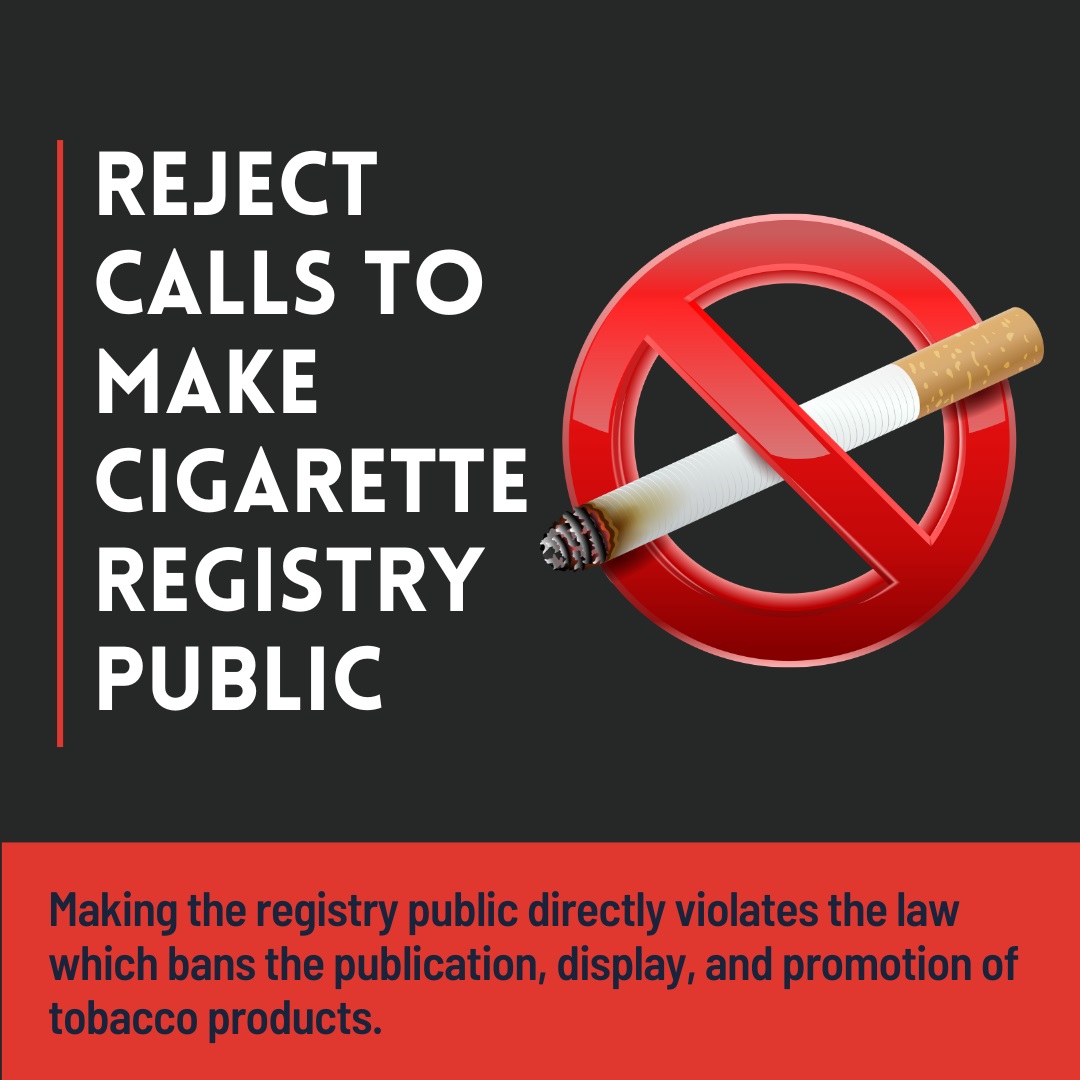
Reject MSCSPGA’s Calls to Publish Cigarette Registry
The Consumers’ Association of Penang (CAP) urges the government to reject the recent call by the Malaysia Singapore Coffee Shop Proprietors’ General Association (MSCSPGA) to make the registry of legally registered cigarette brands public. Furthermore, the authorities must critically evaluate the source and credibility of the survey claims cited by the MSCSPGA that “68.8% of Malaysians surveyed identified sellers of illegal cigarettes as foreign nationals, while 99% described illegal cigarettes as easy or very easy to obtain.”
First and foremost, as its name implies, the MSCSPGA’s business mainstay is food and beverages, not tobacco products. Moreover, the association is a known tobacco industry proxy that has actively lobbied on tobacco-related policies since the mid-2000s.
The demand to make the registered cigarette brands registry public directly violates Section 7(1), Part III of the Control of Smoking Products for Public Health Act 2024 (Act 852), which bans the publication, display, and promotion of tobacco products.
This request appears to be a surreptitious attempt to revive a historical industry loophole. Tobacco companies used newspaper to publish their product price lists as a form of indirect advertising. This practice was effectively ended in 2006 when the Ministry of Health (MOH) implemented a total ban on direct tobacco advertising, promotion, and brand sponsorship.
There is absolutely no necessity to publish a public brand registry. The MSCSPGA itself noted that “illegal cigarettes are estimated to sell for less than half the price of legal products.” By the association’s own admission, consumers and retailers do not need a brand registry to identify contraband. Price alone makes it blatantly obvious.
Under national regulations, selling any 20-stick pack of cigarettes below the statutory minimum price of RM12.00 is illegal. Any cigarette pack sold below this threshold has automatically violated the law and is illicit, regardless of whether its brand name appears on a registry.
The survey findings echoed by the MSCSPGA citing Wawasanex’s report that 68.8% of illegal sellers are foreign nationals warrant immediate and stern enforcement by the government. If foreign nationals are found guilty of operating or distributing contraband tobacco, they must face severe legal consequences and immediate deportation.
Malaysia should follow the precedent set by countries like Australia, which deported Kazem Hamad, the mastermind behind Victoria’s illicit tobacco syndicate, back to Iraq where he was subsequently sentenced to life imprisonment. Malaysia must not harbour or allow foreign visitors to stay if they disregard and violate the country’s laws.
Finally, the study cited by Wawasanex is highly questionable on multiple counts. Wawasanex’s founder and managing director, Tarmizi Anuwar, simultaneously serves as the Malaysia Country Associate for the Consumer Choice Center (CCC).
According to investigations by the Tobacco Control Research Group at the University of Bath (UK), the US-based Consumer Choice Center is a well-documented front group that receives funding from major transnational tobacco companies. Any survey originating from or tied to industry-funded entities must be treated with extreme scepticism and should not form the basis of national public health policy.
Mohideen Abdul Kader
President
Consumers’ Association of Penang
Letter to the Editor, 4 August 2026